Subscribe to Our Newsletter
Double Vision

A unique two-museum retrospective invites a thorough reconsideration of the meaning of Jasper Johns’ work.
By John Dorfman
Jasper Johns, at 91, is the ranking member of the contemporary American art world. In the words of the New York Times, he is nothing less than “America’s foremost living artist.” In the late 1950s, Johns was a key part of the group that upended the assumptions of Abstract Expressionism, which by then had hardened into an orthodoxy. His influence on subsequent movements is incalculable—so pervasive that it can be hard to quantify and explain. Johns’ notorious reticence about his own work only adds to the inscrutability.
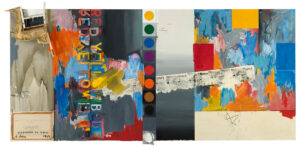
Jasper Johns, According to What, 1964, oil, charcoal, and graphite on canvas with objects (six panels), 88 x 191 3⁄4 in. overall.
The Middleton Family Collection. © 2021 Jasper Johns / Licensed by VAGA at Artists Rights Society (ARS), NY. Philadelphia Museum of Art Photo Studio; Joseph Hu
So a massive retrospective exhibition is particularly welcome, as it makes it possible to see and assess a wide range of work, not just the iconic images such as American flags and targets. In an unprecedented collaboration, the Philadelphia Museum of Art and the Whitney Museum of American Art in New York are presenting “Jasper Johns: Mind/Mirror” (September 29–February 13, 2022), an exhibition of some 500 works divided between two venues in two cities, where they will be on view simultaneously. The show is the most comprehensive Johns retrospective to date, and the first on the East Coast in 25 years. (A smaller, but still major, retrospective was held at the Broad Museum in Los Angeles in 2018.)
The doubleness of “Mind/Mirror” is appropriate, given Johns’ long-term preoccupation with duplication and repetition, as manifested in his penchant for redoing the same images with variations of color and context, as well as his enthusiasm for printmaking, a medium of multiples. As the curators of the exhibition observe in their catalogue essays, there is another kind of doubling in Johns’ work, a sense that contrary to Frank Stella’s famous dictum that “what you see is what you see,” a work by Johns is “what you see” plus something else—even if that is only the ambiguity that familiar images like the American flag are not supposed to have. The fact that Johns himself never complies when asked to elucidate the “meaning” of his art and has even held out “the possibility of complete lack of meaning” only makes the experience of looking more tantalizing, thought-provoking, and engrossing.
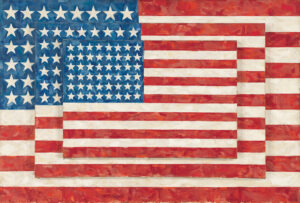
Three Flags, 1958, encaustic on canvas (three panels), 30 7⁄8 x 45 3⁄4 in. overall
Whitney Museum of American Art, New York; purchase, with funds from the Gilman Foundation, Inc., The Lauder Foundation A. Alfred Taubam, Laura-Lee Whittier Woods, Howard Lipman, and Ed Downe in honor of the Museum’s 50th Anniversary 80.32. © 2021 Jasper Johns / Licensed by VAGA at Artists Rights Society (ARS), NY
On the institutional level, both the Philadelphia Museum and the Whitney have a long history with Johns, making this particular double venue especially resonant. As director Timothy Rub writes, “It would be fair to say that the Philadelphia Museum of Art has been a destination point and a source of reference for Johns throughout his career.” This affinity has its origins in the figure of Marcel Duchamp, whose work, in the collection of the Philadelphia Museum thanks to the generosity of collectors Walter and Louise Arensberg, drew Johns to Philadelphia in 1957, three years after the Duchamp works were installed. The first Johns solo exhibition at the museum was in 1970, dedicated to the artist’s prints. In 1988, the Philadelphia Museum curated the Johns exhibition that was presented in the American Pavilion of the 43rd Venice Biennale. In the years since, the museum has continued to acquire and show Johns’ work regularly and in 2001 dedicated an entire gallery to him. As for the Whitney, Johns was the first artist of his generation to be included in one of its Annual shows, with a flag painting in 1959, and he subsequently appeared in 13 Whitney Annuals and Biennials, as well as 64 other Whitney shows, including a retrospective in 1977–78. The museum has systematically collected Johns, with more than 200 works in the collection. As a museum dedicated to American art, the Whitney is an especially fitting place for Johns’ flag paintings; his Three Flags (1958) is one of the jewels of its collection, where it shares space with hundreds of other artworks that reference the flag in one way or another.
Three Flags, on view in “Mind/Mirror,” is truly an astonishing work, a transformation that adds new glory to Old Glory while causing us to re-examine our perceptions of this symbolic icon. Johns first got the idea of using the flag as source material in 1954. He later recalled, “One night I dreamed that I painted a large American flag, and the next morning I got up and I went
out and bought the materials to begin it.” The fact that these works originated in a dream gives some indication of how powerful the symbol must have been to Johns, although in typical fashion he has always declined comment. His flag paintings have been called patriotic and unpatriotic, decorative and anti-decorative. If Johns has given any hint as to how to interpret them, it is in his comment that his flags, numerals, maps, and so forth are simply “things the mind already knows”—that is, things whose familiarity allows the artist to play with theme, variation, perception, and consciousness. Johns’ flags are both flags and pictures of flags; in the case of Three Flags, we have a superimposition or stacking of flags in a three-dimensional effect that causes the viewer to experience tensions between depth and flatness, image and ground, symbol and substance. Johns’ flags have been used as fodder by those who want to lump him with the Pop movement, but they are actually conceptual, even philosophical, rather than Pop. Celebrating shiny surfaces was never Johns’ intention.
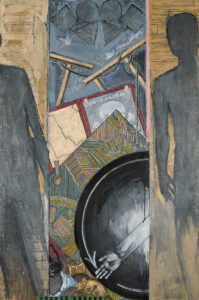
Fall, 1986, encaustic on canvas, 75 x 50 in.
Collection of the artist; on long-term loan to Philadelphia Museum of Art. © 2021 Jasper Johns / Licensed by VAGA at Artists Rights Society (ARS), NY
Likewise, Johns’ maps and numeral paintings situate him in the modernist tradition of subverting illusionistic representation by using graphic symbols in unaccustomed ways. His map paintings bring to mind Jorge Luis Borges’ speculation as to what a map would be if it were exactly the size of the territory it depicts. With Johns, scale is not the issue, but his brightly painted, unnervingly obscured maps make the viewer question the relation of the representation to represented. His number paintings are in the lineage of Marsden Hartley and Charles Demuth, artists who made mathematical symbols glow with mystic meaning. Johns’ numerals are less mystical, perhaps, but as the ultimate “things the mind already knows,” they are a fertile field for experimentation with the “meaning of meaning.” And in repeating these symbols, sometimes over and over within one composition, Johns demonstrates how the process of repetition, when it becomes more and more intense, can rob a symbol of meaning, or at least of conventional meaning.
“Mind/Mirror” gives viewers the opportunity to see some major works by Johns that are outside the more familiar categories and reveal a different side of the artist. The “Constellation” works of the 1960s are monumental in size and scope, somewhat similar in concept to the “Combines” of Robert Rauschenberg (Johns’s friend, lover, and art colleague during that period) but with a very different emotional temperature and technical approach. Undoubtedly the greatest and most important of these works is According to What (1964), a 7 x 16-foot panoramic multi-panel work consisting of painting, plaster casting, collage, and assemblage. In the tradition of Surrealism, Kurt Schwitters’ Dadaist Merz, and most of all Duchamp’s mind-bending constructions, According to What is an encyclopedic compilation and epitome of Johns’ concerns.
On the far right of the composition are passages of gestural abstraction in pastel hues, intruded upon or interrupted by hard-edged geometric elements in primary colors and off-white. In the middle is a sort of gray scale, progressing gradually from black to white and back again, with a series of colored circles, like the paints in a watercolor paint box. Letters spelling out the names of the primary colors are placed in a vertical rather than horizontal orientation, disrupting the normal reading process, and the effect is only augmented by the fact that some of the letters are three-dimensional objects that stand out from the picture plane at a 90-degree angle. A strip of newsprint, beloved of the earliest collagists such as Picasso and Braque, appears pasted across much of the frame. Most shocking of all is the cross-sectional fragment of a chair that is affixed, upside-down, to the far left of According to What, with a cast of a human leg placed on it as though it were sitting in the chair. Most interestingly, the leg is also a cross section, like a plaster cast cut off a mended leg by a doctor, with the inside of the leg rather than the outside pointed toward the viewer. With this detail, Johns is taking us inside the human body as well as inside the human mind. He is also adding the tactile to the visual, making this a truly multisensory experience.
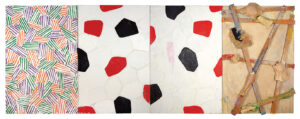
Untitled, 1972, oil, encaustic, and collage on canvas with objects (four panels), 72 x 192 1⁄4 in. overall
Museum Ludwig, Cologne, donation Ludwig, 1976 © 2021 Jasper Johns / VAGA at Artists Rights Society (ARS), New York
Untitled (1972), Johns’ other major “Constellation,” is a more restrained work that explores the possibilities of the crosshatching technique of painting that Johns explored in depth during the 1970s. The crosshatching (based on the memory of passing car that Johns once saw) is juxtaposed with a flagstone motif that the artist had used a few years earlier (the “Constellations” are autobiographical statements in which the artist causes different periods of his own work to collide and coexist) and with a panel in which broken rulers echo the criss-crossing of the crosshatched paint marks. Attached to one of the broken rulers is an equally broken irregular fragment of wood on which are collaged photographic images of a foot and a hand. Again, the idea of the fragmentary or dissociated body part comes through, suggesting a deep unease in the artist’s mind, or in the minds of all of us.
In the exhibition’s section on prints, Johns’ focus on repetition and reiteration is most apparent. A 1982 series of monotypes depicting a Savarin coffee can used as a receptacle for paintbrushes puts this simple image through its paces. We see this little studio still life, a homely snippet of artistic autobiography, over and over, transformed into grisaille, set against colorful crosshatches, set against handprints (disembodiment again!), enclosed in a cartouche, combined with lettering, even seeming to disintegrate. What we have here is not so much redoubling as kaleidoscopic multiplying and seemingly endless refraction. As Johns himself memorably put it, “Take an object. Do something to it. Do something else to it. [Repeat.]”
Johns’ work from the past decade or so, unsurprisingly for someone at his time of life, is rather death-obsessed, with frequent imagery of skulls, skeletons, hourglasses, and chaotic forms suggesting decay, with a palette rich in somber grays. And yet in these as in everything he has done, there is a tremendous sense of vitality, of conscious life expressing itself and renewing itself.

Subscribe to Art & Antiques for your Digital or Print copy