Subscribe to Our Newsletter
Flora Crockett – Forgotten No More
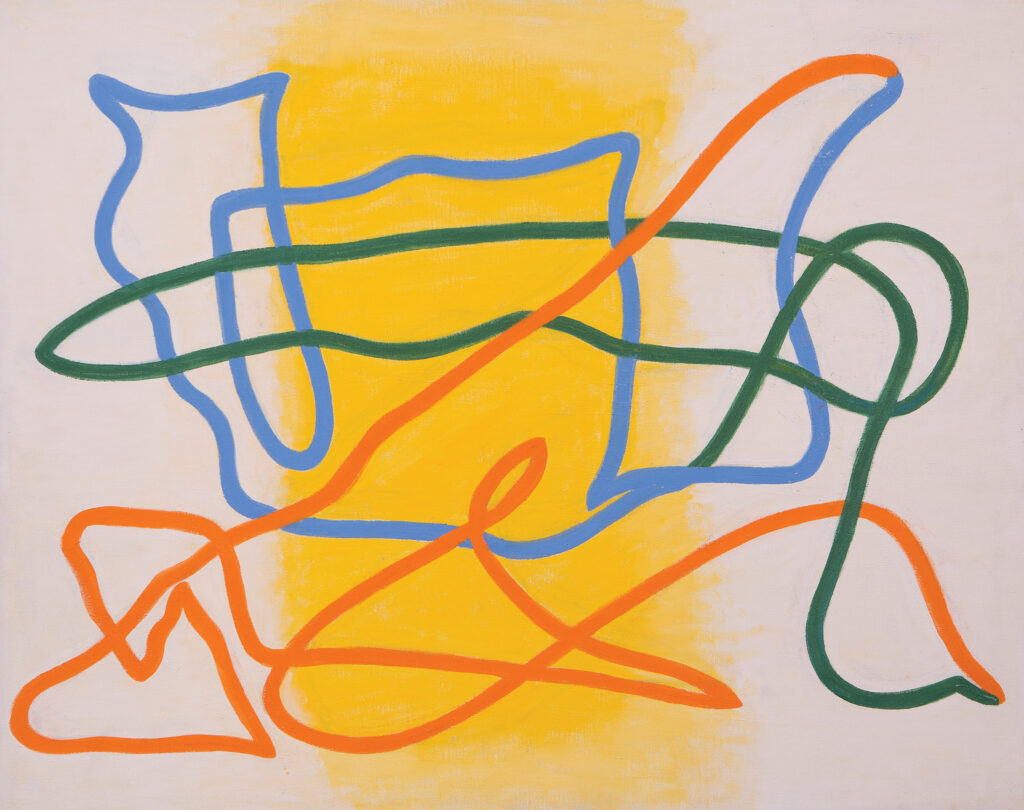
Flora Crockett is emerging from obscurity to gain recognition as an original, important, and delightful abstract painter.
By John Dorfman
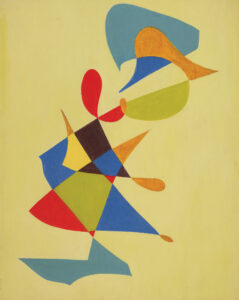
Flora Crockett, Untitled, circa 1967, oil on canvas board, 30 x 24 in.
Photo courtesy Meredith Ward Fine Art, New York
As recently as 2017, Flora Crockett was being called a “forgotten painter.” The phrase appeared in Roberta Smith’s New York Times review of an exhibition of the artist’s work at Meredith Ward Fine Art in New York. It was the gallery’s second solo show devoted to the artist, who died in 1979 at the age of 87. The previous one, in 2015, marked the first time Crockett had had a one-woman show in New York since 1946. In 1965, she had work in a group show at the American Overseas Press Club, and then nothing until 2015.
Now, however, Crockett is forgotten no more. The two exhibitions at Meredith Ward seem to have had an impact on those who care about abstract painting, and last year, the Yale University Art Gallery acquired her South American Dancers (1946). It is currently on view at the New Haven museum, hung alongside works by Stuart Davis, George L.K. Morris, Charles Sheeler, Joseph Stella, and Alexander Calder—a fitting environment for Crockett’s colorful, dynamic, utterly original art, which clearly belongs in the company of these American painters who practiced abstraction, in varying degrees, outside the stream of Abstract Expressionism. In her 2017 Times review, Smith wrote that Crockett’s work can “hold its own in the collections of the Whitney Museum of American Art or the Museum of Modern Art and in the history of American abstract painting,” and it appears that at long last she is headed in that direction.
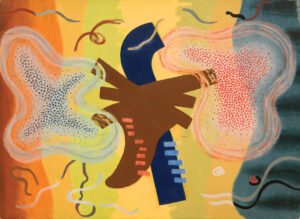
Untitled, circa 1940s–50s, oil on canvas board, 18 x 24 in.
Photo courtesy Meredith Ward Fine Art, New York
As to why Crockett was forgotten for so long, it is likely that her difficulties in making her way in the art world had a great deal to do with being a woman and with having no external sources of financial support. However, it may also have been due to her fierce independence and indifference to trends, and perhaps to a lack of desire to jockey for position and promote herself in the art world. In any case, she never let lack of recognition or even lack of time dissuade her. She kept painting steadily until nearly the end of her life, living and working in the same Greenwich Village apartment for 40 years. In fact, the years 1965–73 were the most productive of her career, a period in which her style became lighter and more joyful.
Crockett’s grit and optimism can be traced back to her beginnings. She was born in 1892 and grew up on a farm in Grelton, Ohio. Davy Crockett, the frontiersman and defender of the Alamo, was on her family tree. She attended Oberlin College in her home state, majoring in art and mathematics and graduating in 1911, and then went on to the Thomas Training School in Detroit, where she studied to be an art teacher, a typical path at the time for women who were interested in art. In 1915, she went East, having landed a job as supervisor of art in the public school system of Roslyn, N.Y., on Long Island. In Roslyn, she met Edmondo Quattrocchi, a sculptor, and they married in 1918.
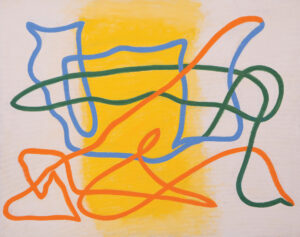
74A-71, 1971, oil on canvas board, 24 x 30 in.
Photo courtesy Meredith Ward Fine Art, New York
One of the fascinating things about Crockett is the way she touches several very distinct eras in art. Her husband, who was born in Sulmona, Italy, belonged entirely to the world of the Belle Époque, making portrait busts and monumental public sculptures in bronze and marble in a classicizing style. He also executed the carving for more prominent sculptors such as Frederick MacMonnies and Daniel Chester French. In 1924, Quattrocchi and Crockett left Roslyn for France because Quattrocchi had been hired to assist MacMonnies with his World War I memorial sculpture Liberty Weeping, dedicated to the Americans who had died at the First Battle of the Marne. During their first couple of years in France, Crockett worked as director of a school for war orphans, but in 1926, she joined the Académie Moderne in Paris, the art school founded by Fernand Léger. And with that, she entered the world of modernism.
Crockett took to this new world with great enthusiasm; in fact, before long she was made director of the Académie. During the five years she spent there, Crockett worked not only with Léger but also with co-founder Amédée Ozenfant (author of the popular book Foundations of Modern Art and an associate of Le Corbusier), both of whom were very influential with regard to her painting. The school was free of charge, and the student body was international, with some coming from as far away as Japan and South America. Crockett became friends with some American students including George L.K. Morris (later one of the “Park Avenue Cubists”) and the Provincetown painter and printmaker Blanche Lazzell.
In 1933, unhappy with Quattrocchi’s habitual drinking and infidelity, Crockett initiated divorce proceedings, a move that somehow seems symbolic of her progress from the old regime of art to the new (it actually took until 1937 for the divorce to go through). During the second half of the 1930s, Crockett exhibited her work in Paris, including a solo show at the evocatively named Galerie La Fenêtre Ouverte in 1937. In the same year, she won a bronze medal for her painting at the International Exposition in Paris. Her paintings at that time, which are not extant, were apparently figurative, still lifes featuring simplified forms.
Nineteen-thirty-seven was a watershed year for Crockett in many ways. At the height of her success and newfound independence in Paris, she decided to return to the United States, impelled perhaps by the growing political instability of a Europe careening toward another world war. Upon arriving in New York, she found an apartment on West 14th Street, which she kept for the rest of her life. Coincidentally, it was across the street from Marcel Duchamp’s, although there is no evidence that the two ever met. Within a few months, Crockett had made the acquaintance of a dealer, Blanche Bonestell, whose Bonestell Gallery on West 57th Street was known for showing women artists, and consigned some works to her. To support herself, she entered the WPA artists’ program and was assigned to teach in the town of Potsdam, in the farthest reaches of upstate New York. She had a show in a public library there in 1939.
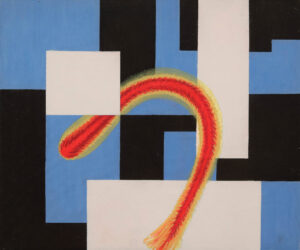
Untitled, circa 1940s–50s, oil on canvas board, 20 x 24 in.
Photo courtesy Meredith Ward Fine Art, New York
In 1940 she was back in New York City, and by the evidence of a photograph, she was working on a WPA mural project at the Red Hook Housing Project in Brooklyn. In 1942, she showed work at the Riverside Museum in an exhibition of the Bombshell Artists Group, which had come into being the previous year in response to a debate launched when the dealer Samuel Kootz threw a metaphorical bombshell in a letter to New York Times critic Edward Alden Jewell. In the letter, Kootz asked, “Isn’t there a new way to reveal your ideas, American painters? Isn’t it time right now to check whether what you’re saying is regurgitation…?” What Crockett had to say in her paintings was anything but regurgitation, but unfortunately, while the show got good reviews, it was upstaged by America’s entry into World War II—another setback for Crockett. In support of the war effort, she went to work inspecting artillery components. After the war, she continued to exhibit work with the Provincetown Art Association in Massachusetts, and in 1946 had that last fateful solo exhibition, at the Bonestell Gallery. The war had opened up some lucrative non-art job possibilities for Crockett, and during the rest of the 1940s and ’50s, she supported herself with engineering and design work in various industries, while continuing to paint after hours.
Sometime after leaving Paris, Crockett had abandoned figuration and moved into pure abstraction. An untitled painting from 1941 bears traces of representation, an industrial chimney emitting smoke that drifts across the Cubist-influenced picture space. After that, though, she enters a universe of pure abstraction, albeit one that follows no strictures as to what is permissible. Not for her was the Greenbergian rule that illusionism is wrong and the flatness of the picture plane must be affirmed. Crockett’s space has depth and more than a hint of the third dimension, but it is not achieved in the Cubist way that some of her American geometric-abstraction colleagues chose. Rather, she layers shapes on top of each other, in such a way that it is hard to tell which is uppermost. She cheerfully mixes together geometric forms, biomorphic forms, and patterned backgrounds that suggest paisleys or other textile designs—except that the patterns never repeat themselves; each element is subtly different. This lack of repetition is a keynote of Crockett’s work, and it suggests the originality and freedom of her mind. One of the characteristic gestures of her work from the ’40s and ’50s is the inclusion of loops and spirals that curl exuberantly through the compositions, in a way that fully partakes of illusionistic space. Some of these ribbon-like forms even have highlights on them, as if they were reflecting light emanating from outside the frame.
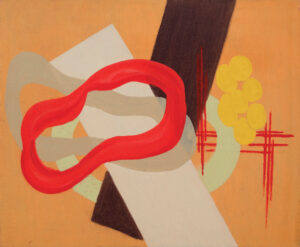
Untitled, circa 1940s–50s, oil on canvas board, 20 x 24 in.
Photo courtesy Meredith Ward Fine Art, New York
In the mid-’60s, when she had a burst of renewed energy and ambition to make paintings, Crockett changed her style significantly, opening up her canvases (actually, she always worked on prepared canvas board, an unfashionable medium, and not at large scale) with lighter colors and airier compositions. Her backgrounds are now less busy, usually just one fairly pale color, and instead of overlapping and swirling forms, there are interlocking ones resembling colorful puzzle pieces or folded origami papers. In the ’70s, Crockett modified this style by using supple string-like lines instead of the interlocking shapes, letting them coil and unfurl across the space. These lines, which have a calligraphic quality to them, occasionally allude to figuration—maybe even a human body here and there—before dissolving back into abstraction. Crockett’s late works have a strong feeling of dynamism about them, as if the artist has set them in motion, like mobiles. Their unshadowed joyousness speaks eloquently of a serene, inwardly-motivated spirit.

Subscribe to Art & Antiques for your Digital or Print copy