Subscribe to Our Newsletter
Flower Power
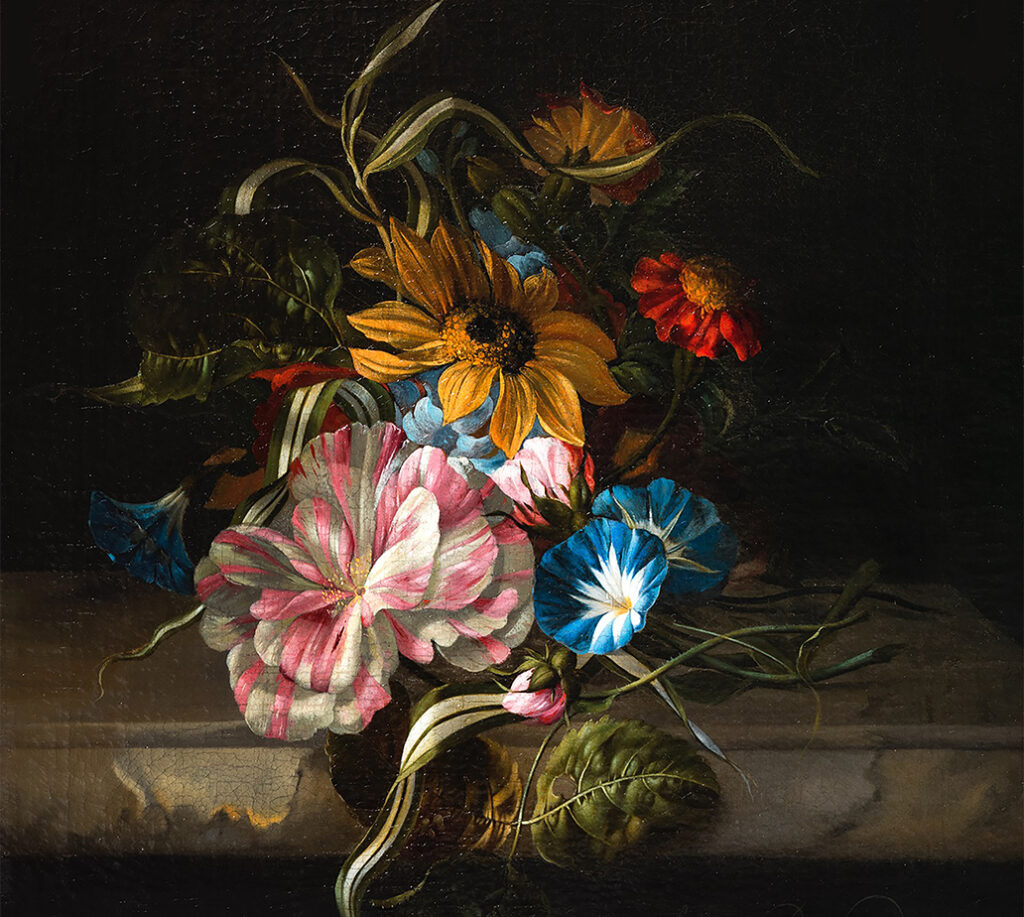
It might have taken a few centuries, but works by the Dutch flower painter Rachel Ruysch are now in full bloom in a traveling exhibition that celebrates her legacy
By Ashley Busby
In 1750, just months before her death, a book of poems celebrated the life and accomplishments of flower painter Rachel Ruysch, heaping praise on one of the era’s most prominent still-life painters. Dutch poet and playwright Lucretia Wilhelmina van Merken, a contemporary of Ruysch’s, wrote:

Flowers and Fruit in a Forest (1714)
Städtische Kunstsammlungen & Museen Augsburg, Karl und Magdalene Haberstock-Stiftung, inv. no. 12580
Oh gentle brush, so thoroughly experienced!
You do not bemoan your nearly eighty years of life;
Your winter seems your spring.
Oh RUISCH! Your divine artistic powers,
Rightly devoted to Immortality,
Shine eternally in the eyes of Posterity
A biography penned by Jan van Gool in 1750 further solidified Ruysch’s position in the art world. And yet, her continued memory falls far short of her remarkable career. Despite a well-documented life, only one book since her death, published in 1956, has examined her work.
“Rachel Ruysch: Nature into Art,” a collaboration between Ohio’s Toledo Museum of Art (TMA); the Museum of Fine Arts, Boston; and the Alte Pinakothek, Munich serves as a first career retrospective. Having completed a run in Munich, the show remains on view in Toledo through July 27, 2025, and concludes its tour this fall in Boston. A fully illustrated, scholarly monograph provides much needed academic attention. According to Robert Schindler, William Hutton Curator of European Art at TMA and the exhibition’s curator, “Rachel Ruysch is undoubtedly one of the great Dutch artists of the 17th and early 18th centuries. With this exhibition, she now finally gets the attention she deserves, and it will hopefully establish her as one of the greatest flower still-life painters ever. Her meticulously composed paintings, shaped by both artistic training and deep engagement with the natural sciences, reveal a unique ability to coalesce visual beauty with scientific observation—qualities that set her apart from her contemporaries and redefine how we understand still-life painting.”

Posy of a Flowers, with a Beetle, on a Stone Ledge (1692)
Kunstmuseum Basel, Inv. 1100, Gift of Prof. J. J. Bachofen-Burckhardt Foundation, 2015
Born in The Hague in 1664, Rachel’s father was a celebrated anatomist and botanist. The family later moved to Amsterdam, where she trained under William Van Aelst. Perhaps building on her early exposure to botanical specimens via her father or perhaps because flower painting was then widely viewed as a genre acceptable for a woman, Ruysch soon excelled in the format.
Rachel was not the only Ruysch daughter who embarked upon a career in still-life. Curators include work recently attributed to her younger sister, Anna, and her presence in the exhibition further reinforces the ways in which many women artists of the era have been overlooked. A Still life of Flowers on a Marble Table Ledge (1685) resembles a similar nosegay painting by Rachel. While there are just a few paintings attributed to Anna, curators concede that her career deserves additional research.

Talent ran in the family; Rachel’s younger sister, Anna Ruysch, painted A Still Life of Flowers on a Marble Table Ledge (1685).
Birmingham, Alabama, Private Collection. Photo: Erin Croxton, Birmingham Museum of Art
The elder Ruysch sister managed an expansive career, with over 250 known and attributed works completed over almost seven decades. In 1693 she married portraitist Juriaen Pool, and between 1695 and 1711 the two had 10 children. Whether wittingly or not, Ruysch remains a model for the successful working mother, successfully navigating the demands of career and home life. Her stunning canvases soon caught the attention of the thriving Dutch picture market. She was the first woman selected for membership in the Confrerie Pictura in 1701, and, between 1708 and 1716, she served as court painter for the Elector Palatine, Johan Willhelm of Düsseldorf.
Ruysch’s story should not simply be couched in her abilities to balance gendered expectations and demonstrate artistic excellence. Her work is remarkable for her engagement with both the latest tendencies in the art of still-life and contemporary scientific inquiry.
A portrait of Ruysch from 1692 by Michel van Musscher depicts the artist at work. In the background a large blank canvas speaks to the work for which she prepares. Sitting in the foreground, she is armed with the tools of her trade. A palette and brushes in one hand, she reaches with her right to place a bloom in an arrangement. Here she is not just the painter of beautiful things, but is shown taking an active role in the study of her subject matter. Splayed on the desk in front of her are large bound botanicals, evidence of her scientific research. Experts also now credit the painting as a joint venture between Ruysch and van Musscher; the careful attention to botanical details suggests Ruysch’s hand.
For the full story click on the link below for your Digital subscription:

Subscribe to Art & Antiques for your Digital or Print copy