Subscribe to Our Newsletter
Genre and Gender
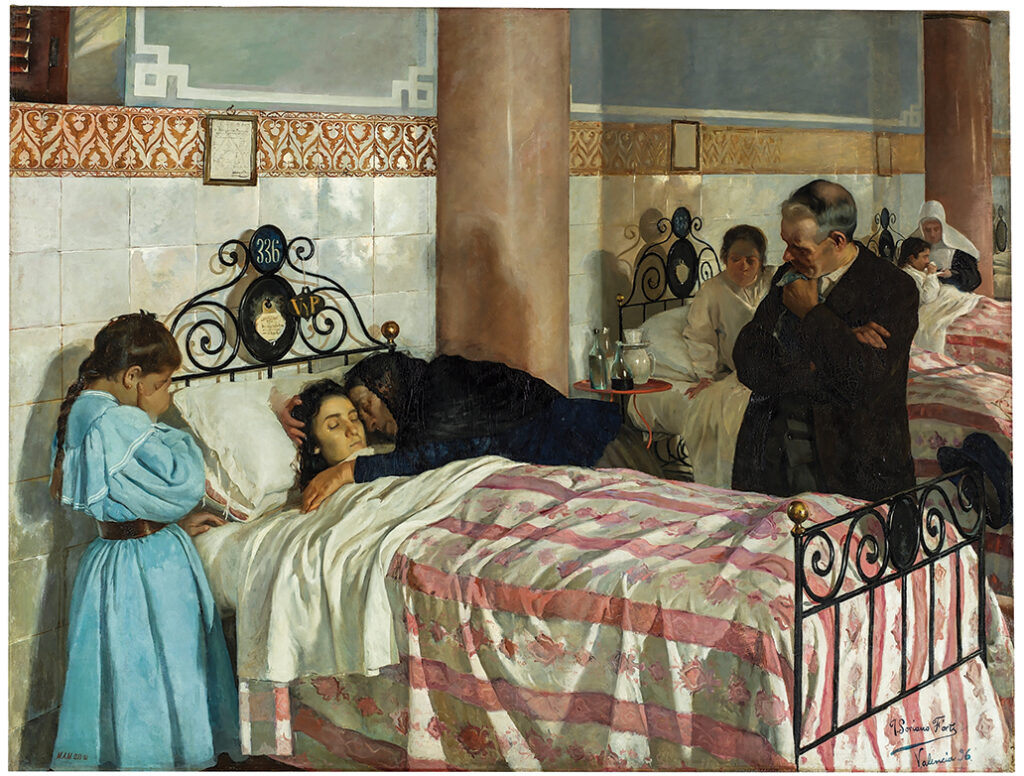
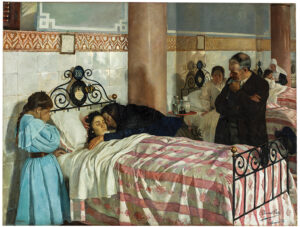
José Soriano Fort, Wretch!, 1896, oil on canvas, 175.5 x 230.5 cm.
Madrid, Museo Nacional del Prado
The Prado does a deep dive into its collection to come to grips with the situation faced by women artists in fin-de-siècle Spain.
By Sarah E. Fensom
In late 19th-century Spain, history painting’s stronghold on the state’s interest was supplanted by paintings of social denunciation and the so-called “subjects of the day.” These works both reflected societal mores and created a heightened, clichéd version of them. As such, their portrayals of women were an outgrowth of how a patriarchal society expected them to behave—or not behave. And as painting moved away from religious or mythic allegorical subjects and instead dramatized moral “everyday” quandaries, the behaviors and predicaments of women in paint reached a level of unprecedented histrionics and implied judgement. As these works were rewarded by Spain’s official exhibitions, a cyclical relationship between life and art developed, as did a host of pictorial stereotypes.
For instance, the National Exhibition of 1895 saw the beginnings of a bizarre subgenre in Spanish painting, in which prodigal daughters were depicted begging forgiveness of their fathers, the implication being that they’d left their homes after being seduced by unpictured, probably no-good men. Artists rendered the young women in these paintings, often of humble means, doubled over in dramatic displays of guilty, repentant tears. Emotions running high, they also pictured mothers and fathers bereft, be it in sympathy or indignation. Inspired by contemporary serialized fiction that warned the young women of 19th-century Spain against the poor decisions that could lead to such a scene, these works were essentially “Afterschool Specials” rendered in paint.
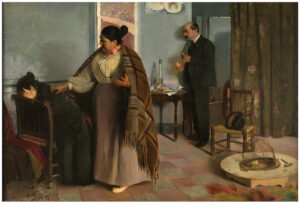
Antonio Fillol Granell, The Human Beast, 1897, oil on canvas, 190 x 280 cm.
Madrid, Museo Nacional del Prado
In God Bids Us Forgive! (1895), an example by García Sampedro Luis, the disgraced daughter has brought her own young daughter to her parental home. The father to whom she pleads, pointing to the door in anger, is being counseled by a concerned clergyman. The painting, which Luis based on models by Caravaggio and Velázquez, was awarded a prize at the National Exhibition of 1895, and was further legitimized when it was acquired by the state. Wretch!, a 1896 oil on canvas by José Soriano Fort, takes this type of predicament to the extreme. It pictures a young woman dying at the General Hospital in Valencia, her grieving parents in shabby clothing at one side of her bed and her well-dressed daughter—perhaps the child of an illicit love affair—on the other. Critics at the National Exhibition of 1897 praised the modernity of the painting’s style and subject. It received the top second-class medal, ahead of Antonio Fillol Granell’s The Human Beast.
The Human Beast was one of a rash of paintings during the period that denounced the country’s prostitution networks, which authorities hid but didn’t eradicate. The painting, inspired and titled after Émile Zola’s novel of the same name, shows a crying, recently orphaned young woman in mourning clothes being coerced by a procuress. A man, smoking, waits in the corner of the room. The work is painted in a highly naturalistic style that lays its message bare. During this period, critics and the public responded particularly well to works that married asperity with a moralizing tone. The state tended to acquire these types of works, furthering reinforcing a sense of its values.
In 19th- and early 20th-century Spain, the reinforcement of values was synonymous with upholding a patriarchal society. The realist paintings that depicted women or women’s issues, like those above, seemed to serve as reminders that women couldn’t successfully make decisions on their own (certainly, legally they couldn’t) or needed some sort of guidance to make them.
Works like Plácido Francés y Pascual’s The Father’s Advice (1892) and The Grandfather’s Lesson (anonymous painter, 1893), showed that these notions took root early. Part of a subgenre of works depicting family members lecturing young girls, the former pictures two daughters listening to an explaining father, while the latter shows a seated grandfather, dressed for the sabbath, delivering instruction to his granddaughter who sits on the floor. In these works, the preservation of tradition, duty, and hierarchical discourse feels paramount.
Maternity, then considered the chief source of a woman’s fulfillment, also captivated realist painters. The negligent mother, a moral abomination and, according to hygienist medical theories of the day, a health hazard for children, became its own subgenre. In The Toilette, a 1899 oil on canvas by Federico Godoy Castro, for instance, a woman primps in front of her mirror, consumed with her own reflection. But unlike other toilette pictures of the period, Castro’s painting includes a baby and young child untended on the floor below. The surrounding room is untidy, bolstering the sense that the woman is neglectful.
At the turn of the 20th century, the official exhibitions were flooded with paintings depicting “the female character.” With titles like Laziness or Thirst for Vengeance, these fanciful works reveled in female beauty, while also reducing women to simplified negative characteristics or archetypes. They were underscored by the paternalist notion that women were wild, almost primitive, beings governed by emotion and, though charming, needed male intervention to keep them within reason. One such work, Pride (circa 1908) by Baldomero Gili y Roig, depicts an elaborately dressed woman walking in a park, with a peacock—a symbol of vanity—strutting behind her. The beauty of the image serves almost as a grotesque reinforcement of the negativity of its sentiment—the simplification of a gender into a pretty defect.
In the early years of the 20th century, as an image of a more liberated, modern woman emerged, some artists went in the other direction. Depicting women in 18th-century garb became a popular trope, as in works like Ignacio Zuloaga y Zabaleta’s Woman From Madrid (circa 1913), which portrays a woman dressed for a bullfight in white mantilla, hair comb, and fan. At the dawn of the suffragette movement, these types of work, which idealized women of two centuries earlier as symbols of female perfection, were visual confirmations of conservative ideology and a denial of support for a nascent women’s movement.
All the works mentioned above are now in the collection of the Museo del Prado in Madrid. More recently, they find pride of place in the museum’s current exhibition, “Uninvited Guests: Episodes on Women, Ideology and the Visual Arts in Spain (1833–1931),” which runs through March 14. The exhibition, drawing largely from the Prado’s collection, seeks to provide a detailed view of the representations of women in Spanish art during the second half of the 19th century and the first several decades of the 20th. The harsh or highly sentimental examples discussed above are just a portion of a broader picture but provide the show with a deep look into realist painting’s moralizing male gaze and heightened sense of melodrama. They also speak to the conservative, bourgeois values upheld by the state and its official exhibitions at the time.
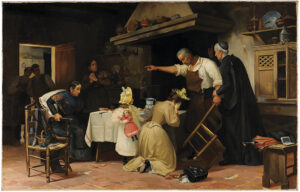
Luis García Sampedro, God Bids Us Forgive!, 1895, oil on canvas, 270.3 x 423.5 cm.
Madrid, Museo Nacional del Prado
“Uninvited Guests” features 130 works—70 by men and 60 by women artists. Those by the former are for context. Those by the latter address the accomplishments of women working in the Spanish art world during this period and the difficulties they faced. Works in the show by artists like the French miniaturist Sophie Liénard and the Spanish painter Aurelia Navarro Moreno, who eventually left painting to join a convent, poignantly speak to these successes and struggles.
Yet, since the show’s opening in October, critics have cited the gender imbalance in the show and a misattribution of a work to a female artist that was actually painted by a man (Adolfo Sánchez Megías’s La March del Soldado [circa 1895] was attributed to Concepcíon Mejía de Salvador and has since been removed from view) as reinforcements of the very misogyny it is trying to reveal. In short, even in a show about women, male creators get more wall space. All the space it gives to context (i.e. works by male artists, see above) can seem wasted when it could be spent on more discoveries and scholarship devoted to women artists (especially when considering how low the acquisition and exhibition rates of artworks by women still are at museums). Not to mention that some of this “context” does little more than create a sense of scintillation in response to just how sexist some 100-plus-year-old works can seem (again, see above).
But “Uninvited Guests” is not a “missed opportunity” as some critics have dubbed it, but rather an important show if it’s looked at for what it is. It’s not an exhibition of work by women artists; it’s an itemized reevaluation of a major museum’s collection calling its own works out for misogyny. It’s the Prado #MeToo-ing its own collection. This scanning process is fascinating to watch, but at its close, should ideally lead to greater scholarship, acquisition, and exhibition of art by women.
Though many of the works by women in the show are consistent with the genres, like still-life and portrait miniatures, women were traditionally consigned to making, they are nevertheless engrossing. There are several still lifes in the show, like the lush Grapes of Spain (1895) by María Luisa de la Riva y Callol, a Spanish painter who settled in Paris. De la Riva presented her work at the Salons, the Universal Expositions of 1889 and 1900, and other international exhibitions, and her work commanded high prices. There are also several miniatures by the aforementioned Sophie Liénard, who was highly regarded in Paris as a painter on porcelain. During Spain’s July Monarchy (1830–48) and the Second Empire (1848–52), she became popular with the Orléans family and a host of political figures. The novelty of being portrayed on porcelain, an art form that was not performed in Spain, led to a microtrend among the Spanish aristocracy, with many of its members going to sit for Liénard in Paris.
“Uninvited Guests” features a special treat in the form of early photography by women artists. Considered a minor art throughout the 19th century, it was an open field for female participants. Work by the British photographer Jane Clifford is featured prominently in the show. Clifford moved to Madrid with her husband, Charles, in 1850 and opened a photography studio. After Charles’s death in 1863, Jane continued the business and received a commission from the South Kensington Museum in London (now the Victoria & Albert) to photograph the Dauphin’s Treasure at the Prado. These sumptuous pictures of decorative objects were among the first photographic depictions of Spain’s artistic heritage.

Subscribe to Art & Antiques for your Digital or Print copy