
Subscribe to Our Newsletter
Hail Trajan!
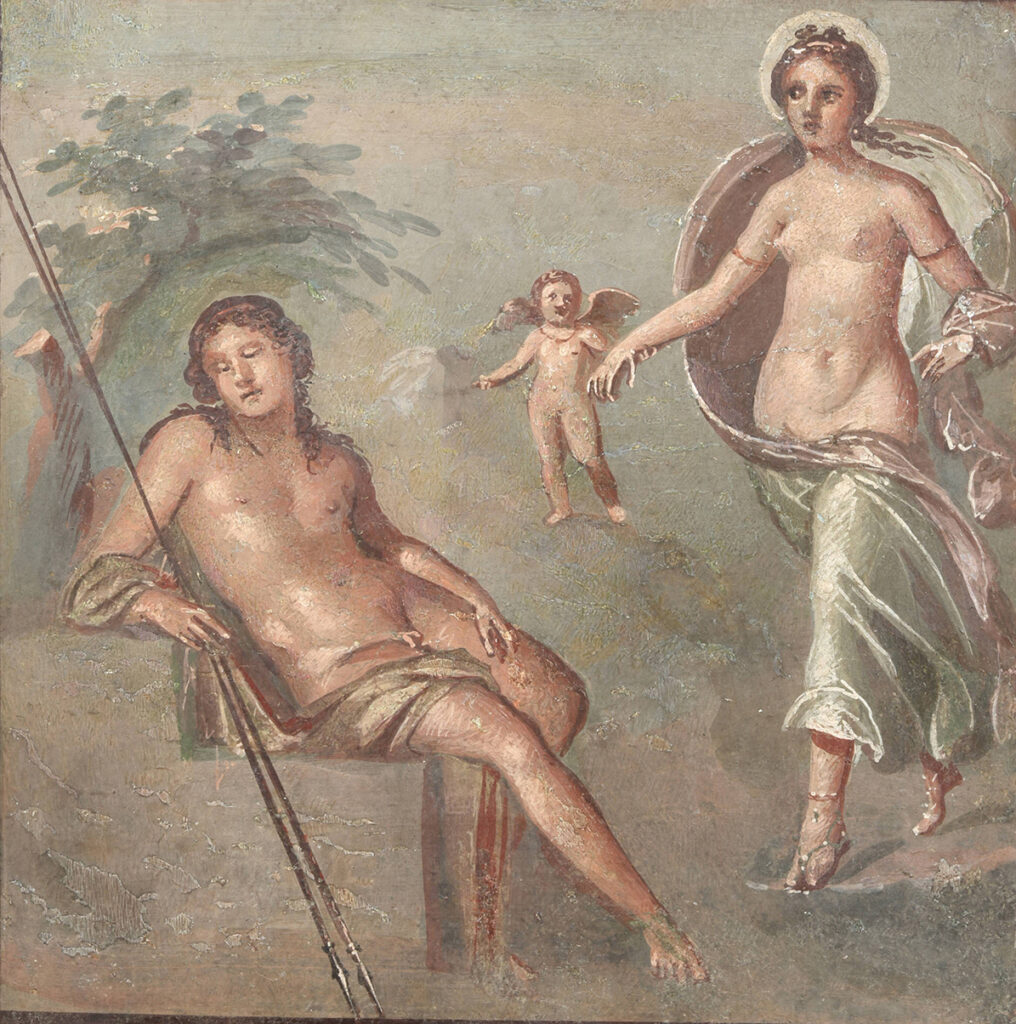
A fresco of Selene and Endymion, dating from the 1st century, once decorated a home in Pompeii
The Museum of Fine Arts, Houston
A touring exhibition, now at the Museum of Fine Arts, Houston, brings the ancient Roman emperor to life, as well as the lives of the subjects who lived under his rule
Written by David Masello
Décor, for the home and for public areas, was as important in ancient Rome as it is today. When wealthy Romans decorated their second homes in places like the fashionable seaside town of Pompeii or at their in-town palaces and villas in and near Rome, they chose frescoes and marble portraits, friezes and mosaics to adorn the interiors. And in order to make themselves known to a vast citizenry, who occupied a region spanning from North Africa to what is now the British Isles and from the westernmost shores of Europe to Asia Minor, Roman emperors such as Trajan (who ruled from 98 -117 A.D.), had self-portraits made so that people knew what they looked like. Statues, commemorative pillars, busts, coins were fashioned and spread throughout the Empire so that whomever was ruling would become a familiar image to the citizens and subjects of the Roman Empire.
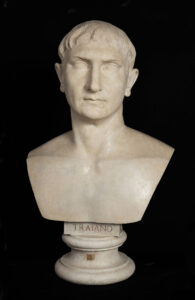
When Trajan began his reign in 98 A.D., he commissioned numerous marble portraits of himself so that his vast citizenry would know would he looked like.
The Museum of Fine Arts, Houston
Of the long line of Roman emperors, Trajan, who was born in Spain in 53 (making him the first emperor to be born outside of what is today Italy, though his family was from Umbria) and died in 117, was known not only for his good works, but also for his good looks. Pliny, an historian and an appointed official of Trajan’s court, wrote of the emperor as having a “…splendid bearing and tall stature, his fine head and noble countenance, to say nothing of the firm strength of his maturity and the premature signs of advancing age with which the gods have seen fit to mark his hair and so enhance his look of majesty.”
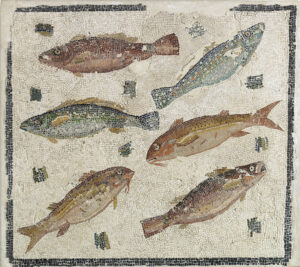
Mosaic Pavement with Fish comes from the House of the Severi in Rome
The Museum of Fine Arts, Houston
In “Art and Life in Imperial Rome: Trajan and His Times,” a unique show at the museum of Fine Arts, Houston, aka the MFAH (through January 25, after which it travels to the St. Louis Art Museum in March), visitors get to witness Trajan’s beauty and bearing. A life-size marble statue shows him dressed in his full military garb, an arm stretched and a finger pointing up as if he is addressing an army on one of his many war campaigns. As Danielle Bennett, Consulting Curator for the exhibition, explains, “Most of the time, Trajan would rather be shown as a military general as that seems to be what he saw as his primary role for the empire—military strategy to defend the borders and to expand the borders of the Roman Empire.” Of a bust of Trajan that is also in the show, Bennett adds, “He seems like a person you might see walking around. Trajan eschews a lot of the over-ostentatious representations of the emperor that we would see in previous periods.”
Trajan might have appeared in that one bust to be an everyman, of sorts, but he was a mighty, powerful, influential, occasionally ruthless, emperor whose monuments endure today. While this exhibition tells through 160 objects assembled from numerous Italian collections the story of his reign, it tells even more about the way art figured into domestic and civic life in ancient Rome. “This exhibition explores how art was used during Trajan’s era—privately in the houses of the elite, and publicly in the forums and public buildings as propaganda to promote the empire’s values as it was expanded to its greatest extent,” says Gary Tinterow, Director and Margaret Alkek Williams Chair of the MFAH. “The objects on view will tell the many stories—cultural, social, political, and economic—of life in Imperial Rome, immersing visitors in the majesty of Trajan’s world at the turn of the second century CE.”
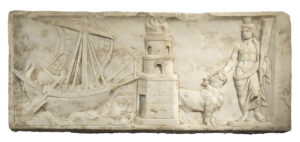
Relief with Harbor Scene and Personification of the Port, from Ostia, 2nd century.
The Museum of Fine Arts, Houston
Among the objects on display is Woman Embarking on a Boat, an eerily realistic fresco that likely comes from an excavated Pompeii villa. An elegantly gowned woman, an earring catching the light, is seen being escorted onto the wooden sailing craft by a young girl and boy. Elizabeth Thill, Program Director of Classical Studies at Indiana University, Indianapolis, explains that a fresco of this type would likely have figured into the décor of an atrium of a house, that is, an open-air courtyard that served as the actual and metaphorical heart of a villa. “The women of the household and the enslaved domestic workers would come in and use the atrium as a meeting place to do whatever work they needed to do—to weave, to clean, even to read,” says Thill.
For the full story click on the link below for your Digital subscription:

Subscribe to Art & Antiques for your Digital or Print copy