Subscribe to Our Newsletter
Grace Hartigan: Adventures in Painting
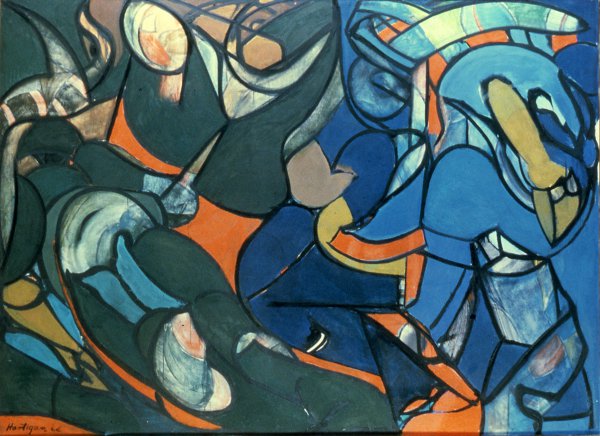
Grace Hartigan, a dauntless heroine of Abstract Expressionism, used figurative imagery to reveal the secrets of a self forged in art.

Grace Hartigan
Featured Images: (Click to Enlarge)
-
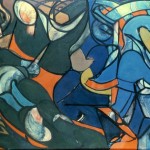
- Grace Hartigan
-
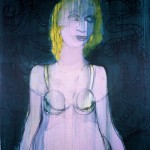
- Grace Hartigan
-
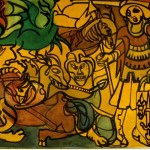
- Grace Hartigan
-
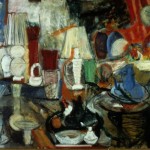
- Grace Hartigan
-
- Grace Hartigan
In 1993 Grace Hartigan was featured in “Hand-Painted Pop: American Art in Transition, 1955–62,” an exhibition organized by Paul Schimmel for the Los Angeles County Museum of Art. Including such figures as Jasper Johns, Robert Rauschenberg, and Larry Rivers, Schimmel intended the show to correct the familiar notion that Pop Art signaled a sudden and decisive break with Abstract Expressionism. In historical fact, there was a complex transition from Ab Ex to Pop, as younger New York painters allowed imagery from the streets and the media to infiltrate their versions of de Kooningesque and Pollock-style painterliness.
Thus Johns’ quirky, quasi-Expressionist brushwork coalesced into his first Flag, 1954–55, and before the end of the 1950s Rauschenberg had developed a knack for merging the splashes and drips of his elders with everything from scraps of the sports page to reproductions filched from the pages of art history books. “Hand-Painted Pop” reminded viewers that Roy Lichtenstein, one of the inventors of Pop Art, was still painting in an Abstract Expressionist manner several seasons after Rivers’ Washington Crossing the Delaware, 1953, subjected not only realism but the father of his country to a thoroughly ironic homage. And Hartigan, routinely seen as a second-generation follower of de Kooning, was represented in “Hand-Painted Pop” by heavily brushed images filled with hints—and sometimes clear renderings—of faces, full-length figures, and the fruits and vegetables offered by sidewalk vendors. That imagery earned her a place in the Whitney show and yet, when a reporter asked her how she felt about Pop Art, she said it was “a movement that I hate.”
De Kooning hated it too. His nickname for Andy Warhol is an unprintable insult. More subtly, he said that Pop Art had “no innocence.” It was too knowing, too willing to reduce art to the deployment of readymade images calculated to produce readymade responses. This view of Pop is not entirely fair, yet it conveys the belief, unanimous among the Abstract Expressionists, that Warhol and company displayed a deplorable indifference to the sources of genuine art. The images that Hartigan, Joan Mitchell, Al Leslie, and other painters of their generation gathered from their surroundings were preceded by the paintings of women de Kooning produced in the early 1950s, as well as the allusions to landscape that appear through his mature oeuvre. He was the model for those impure Abstract Expressionists who let the exterior world impinge on their fields of roiled color. Ultimately, though, they understood the origins of the subject matter as interior. The point was not to reflect the imagery of the street, the movie screen, or the funny papers but, rather, to cover the canvas with traces of energies that lurk in the dark realms of the psyche.
In 1952 Harold Rosenberg, a friend of de Kooning and supporter of all the Abstract Expressionists, declared that these artists created paintings in order to create themselves. To plunge into a new painting was to embark on “an adventure over depths in which he might find reflected the true image of his identity.” Hartigan’s passionate embrace of this existentially fraught aesthetic led her not merely to hate Pop Art but to insist that it “is not painting, because painting must have content and emotion.” By content she didn’t mean Warhol’s Popeye or Lichtenstein’s Mickey Mouse or even her own images of bits and pieces of the urban environment. She meant content of a revelatory nature: images of a creator’s self-created being. Thus Rosenberg spoke not only for de Kooning and his generation but for her, too, except in one crucial particular that had to do not with age but with gender. For this critic, a painter was always “he.” For Hartigan, the New York art world’s pervasive assumption that serious artists are inevitably male was unacceptable, a falsehood to be countered in two ways: by painting with as much energy and daring as any man on the scene and by matching the lot of them drink for drink, sexual conquest for sexual conquest.
Born in Newark in 1922, Hartigan grew up in rural Millburn, N.J. Soon after graduating from high school, she married her boyfriend, Robert Jachens. With America’s entry into the Second World War, he was drafted and sent overseas. Hartigan enrolled at the Newark College of Engineering. Upon completing a course in mechanical drafting, she got a job in an aircraft factory. When one of her co-workers showed her a book of Matisse reproductions, she was fascinated. On his advice, she took a painting class and quickly realized that she had found her vocation. “I didn’t chose painting,” she once said, “It chose me.” She also chose to start an affair with one of her teachers, a relationship that ended abruptly when he told her that she should stop painting abstractions. This was impossible. For she had seen one of Jackson Pollock’s webs of poured color by then and felt compelled to find her own way through the maze of possibilities his innovations had opened up.
Divorced from her first husband—there would be four of them, in all—she settled into a $27-a-month loft on New York’s Lower East Side. By the end of the 1940s, she had become a regular at the Cedar Tavern, the Abstract Expressionists’ primary hangout. Her friends now included de Kooning, the poet Frank O’Hara, and Franz Kline, with whom she had a two-year affair. In 1950 she had her first solo exhibition, at the Samuel Kootz Gallery. The following year, John Meyer recruited her to show at the newly launched Tibor de Nagy Gallery. She introduced him to Al Leslie, Robert Goodnough, and Harry Jackson, who joined her on the Tibor de Nagy roster, along with Larry Rivers and Helen Frankenthaler.
Having bought one of her paintings in 1953, the Museum of Modern Art tapped her, five years later, to be the only woman included in its exhibition of the decade, “New American Painting.” Seen in Paris, London and six other cultural capitals of Europe, this show introduced the Old World to the energy, the bravura, and the sheer originality of New York’s leading painters. For the first time, American art found a place at the center of the map of Western culture. By then, Hartigan was not only an art-world star—in 1957 Life magazine called her “the most celebrated of the young American women painters”—but the sort of artist who confounds routine expectations. She first attracted attention with such paintings as Kindergarten Chats (1950) and Cue (1951)—fields of color churning with gestural intensity. In 1955 came Giftwares, which could be seen, almost, as a realist’s response to the consumerist bounty of a shop window. Her immediately recognizable touch is still vividly in evidence, and yet her subject matter is sufficiently recognizable—and vernacular—to have earned her, nearly four decades later, a place in the Whitney’s “Hand-Painted Pop” exhibition.
Soon after her third marriage, to an art dealer, she met a collector named Winston Price. He bought one of her paintings, they fell in love, and, divorcing their spouses with all possible speed, got married in 1960. Price, an epidemiologist at John Hopkins University, whisked his new bride off to Baltimore, where she lived until her death in 2008, at the age of 86. Hartigan was happy with Price, who died in 1981, but not with Baltimore, where she felt exiled from the world of art. In leaving New York, she had gone from the heart of the maelstrom of postwar American art to a place that didn’t even count as an outpost.
Baltimore did, however, have the Maryland Institute College of Art. Early in the 1960s, she asked Eugene Leake, a landscape painter and president of the Institute, if he knew of any graduate students in need of a teacher. He did, and she turned out to be such a good teacher that the Institute was inspired to found the Hoffberger School of Paint, with Hartigan as its director. “I am a mentor, not a teacher,” she once told a reporter, adding that she aimed to give students “the example of having devoted my life to art, of constantly creating and growing.”
In The Creeks (1957) she had already begun shift away from taut tangles of Abstract Expressionist gesture to images built from color planes set off by the grandly sweeping lines that would, in later decades, dominate her work. A linear texture infiltrates the flat expanses of color in Clark’s Cove (1962), and the patches of yellow, beige, and green in Joan of Arc (1973) serve chiefly to clarify the labyrinthine line that brings Hartigan’s image of the French heroine into close proximity with other human figures and a variety of beasts, real and mythical. Every artist has a few favorite sayings. Among Hartigan’s was her comment that “a line is like a lasso. You throw it and capture the space.” Or map it. In Joan of Arc her flung line gives the overall image the lushly intricate pattern of a 17th-century tapestry. The structure of space is starker in Josephine (1993) and Mata Hari (2005), which present two personages from Hartigan’s pantheon of quasi-legendary woman, all of whom can be seen as this exuberantly, even defiantly female artist’s symbols for herself.
In New York, Hartigan was an outstanding member of a crowded, jostling generation of younger Abstract Expressionists. In the isolation of Baltimore, she became an original, the inventor of a style that finds a personal use for a wide range of modernist painting’s formal devices—with the obvious exception of the straight lines and uninflected surfaces of Piet Mondrian and other geometric abstractionists. At every stage of her career, Hartigan’s paintings pulse with sensuality, whether subtle or flagrantly curvy. And they carry on the project of self-creation that she and her colleagues and elders embraced in the late 1940s. In that respect, she was always an Abstract Expressionist.
By Carter Ratcliff

Subscribe to Art & Antiques for your Digital or Print copy