Subscribe to Our Newsletter
Lone Star and Crescent
With a single loan, the Dallas Museum of Art becomes one of the biggest Islamic-art repositories in North America.
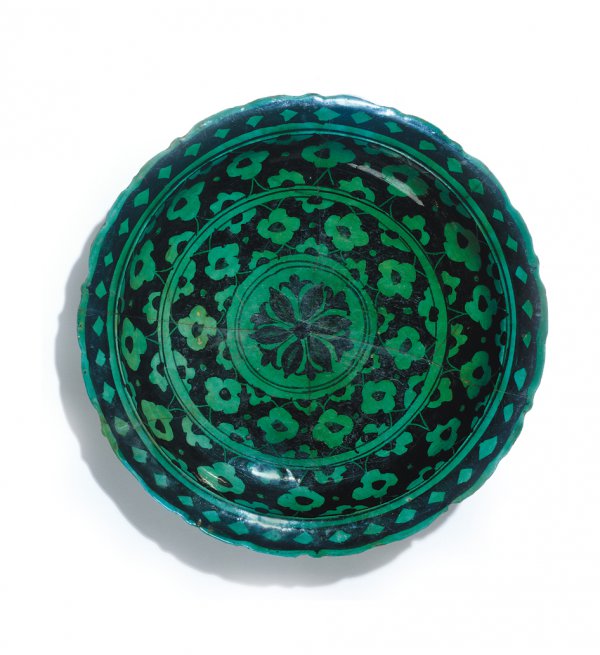
Dish, Persia, early 16th century, Fritware, painted in black under a green glaze, 2 1⁄4 x 13 1⁄4 in. (5.7 x 33.5 cm).
Featured Images: (Click to Enlarge)
-
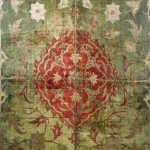
- Textile fragments (four), early 17th century, Mughal, velvet, 37 3⁄4 x 27 1⁄2 in. (96 x 70 cm);
-
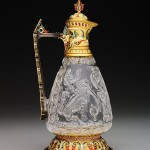
- Rock crystal ewer, Egypt, late 10th-11th century, Fatimid, with mounts by Jean-Valentin Morel, Sèvres (France), 1854, rock crystal, with enameled gold mounts, 12 1/8 in. (30.7 cm).
-
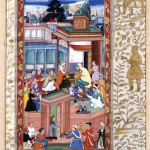
- Miniature from a manuscript of the Akbarnama of Abu’l Fazl, attributed to Dharm Das, Mughal school, c. 1605, ink, and pigments on paper, 4 7/8 x 9 1/8 in. (12.5 x 23.2 cm);
-
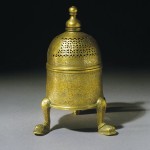
- Incense burner of the Ayyubid Sultan al-Adil II Mosul (Iraq), 1238-1240, brass, inlaid with silver, 7 7/8 x 3 5/8 in. (20 x 9.3 cm);
-
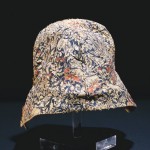
- Hat, Persia, early 17th century, Safavid, silk, brocaded, 7 1⁄2 x 12 1⁄4 in. (19 x 31 cm);
-

- Dish, Persia, early 16th century, Fritware, painted in black under a green glaze, 2 1⁄4 x 13 1⁄4 in. (5.7 x 33.5 cm).
As a boy growing up in Budapest soon after World War I ended, Edmund de Unger became enthralled by Persian carpets. At first, he noticed their intricate patterns and vibrant depictions because his father, Richard, forbid him from treading over the pieces in the family home. By the time he was nine, de Unger was at his father’s side at museums examining rare carpets harvested from around the Middle East. He had learned enough by then, de Unger recalled in Claus-Peter Haase’s 2007 book, The Collector’s Fortune, that “I was quite a good companion to him in the salesrooms” also. The wunderkind collector soon turned his refined eye toward amassing a stockpile of his own. As a teenager, de Unger bought his first carpet, the seed of a collection that grew over 60 years into one of the largest and most extensive private holdings of Islamic art in the world.
“He fell in love with a carpet,” says Sabiha Al Khemir, the Dallas Museum of Art’s senior advisor for Islamic art, who first met de Unger three decades ago and can trace the collection down to its root. Before de Unger died in 2011, he outlined a vision for the future of his collection—an expansive mix of carpets, ceramics, metal pieces, manuscripts and other works numbering 2,000 in total and spanning 13 centuries—that it remain intact and, for the first time in its entirety, be available to the public.
A four-year residence for about 100 pieces from the collection at the Pergamon Museum of Islamic Art in Berlin ended in 2012, the same year Al Khemir took her post at the DMA—an institution, Al Khemir says, that is more concerned with sharing fine art than possessing it. Already familiar with its depth, Al Khemir jumped at the chance to bring the collection to Dallas, an art-hungry city, albeit one with little acquaintance to Islamic art. She was pivotal in brokering an agreement with de Unger’s sons to house the Keir Collection (named for de Unger’s English estate) at the DMA for the next 15 years, and is sifting through artifact after precious artifact to curate the first wave of pieces to go on display next fall. With the loan of this collection, the museum has elevated itself to a position of prominence in the field: it now holds the third-largest collection of Islamic art in North America. And considering the ongoing efforts of deep-pocketed sheikhs to bring as many Islamic objects as possible to the Persian Gulf states, landing the Keir Collection is even more of a coup.
“Though there are a lot of Islamic art collections in the West, there is still a need for this cultural dialogue and more learning about Islamic culture, and this art is a wonderful window into that,” Al Khemir says. “The aesthetic expression of this whole culture in a collection like this that covers centuries, to have it in an encyclopedic museum like the DMA that covers other cultures, it is a very meaningful act.”
The broad scope of Islamic art—pieces produced from the 7th century onward by people in culturally Islamic regions sweeping from northwestern Africa to central Asia—makes fostering a collection with genuine depth a rigorous challenge. Running through all of these expressions and media like a thread through a carpet is an aesthetic derived from the Arabic script, the vehicle of Islam. Lustre-painted pottery, for instance, is a complex technique that traces to 9th-century Basra, in present-day Iraq. To create a shiny, lustre-like effect, craftsmen fired the ceramics then painted over the body of the vessel with metallic pigments. When the pottery emerged from the kiln a second time, it had a vibrant golden or bronze sheen. The technique traveled among craftsmen from Basra to Egypt, then to Iran, Syria and Spain, and is still practiced today. “The harmony is within the pieces,” Al Khemir says. “It is across time and place, and that in itself is a spoken visual language, like echoes between centuries.”
De Unger had a wide-ranging appreciation for every compartment of Islamic art, and his unusual habits
of accumulation are reflected by the tremendous scale of the Keir Collection. Al Khemir said that monetary value was not de Unger’s primary consideration. Instead, he sought out pieces he deemed rare and beautiful, and he lived among them. The surfaces in de Unger’s home couldn’t keep up with the rapid pace of acquisition. The floors of his estate were layered in carpets unfurled one on top of the other. Not only luxurious pieces but brilliant shards and tiny objects happened upon during his travels from the Mediterranean deep into central Asia were arranged on shelves. “He had a relationship with every piece,” Al Khemir says.
Many of the Keir’s pieces have a narrative element. A ceramic bowl 9 ½ inches in diameter, from 11th-century Egypt, is one of the collection’s finest examples of lustre-painted pottery. The bowl has a bronze-like finish and depicts two scowling men, each crouched and clutching a rooster ornamented for battle. An intricate textile fragment dating to Safavid Persia (early 17th century) tells another story. It is brocaded velvet, silk and metal thread, and illustrates men dressed in stately clothes hunting in the wild.
The finest examples of figurative representation are presented in the manuscripts de Unger collected. A number of them retell the story of Shirin, a pre-Islamic Persian queen in the 7th century who became a romanticized heroine in Persian literature. Shirin is idealized as a faithful wife who committed suicide instead of marrying again after her husband died. One of the Keir’s brilliantly colored manuscripts, dating to 1505, illustrates Shirin, a golden dagger in her torso as she lies dying with attendants in mourning circling around her.
Other pieces are both ornamental and functional. There is a brass incense burner from Iraq inlaid with silver, and an ornate brass lantern from 14th-century Morocco that brings to mind the tower of a palace. The centerpiece of the collection was acquired three years before de Unger’s death. It is a ewer hand-carved from a chunk of rock crystal, made under the Fatimid dynasty in north Africa in the late 10th century. The painstakingly etched crystal shows two leopards, their coats composed of tiny dimples instead of spots. An intricate floral pattern rolls along the edges of the ewer around the cats. The French goldsmith Jean-Valentin Morel mounted a gold handle, spout and base painted with more colorful flowers to the crystal in 1854.
The Fatimid ewer went on display at the DMA in late May, the first piece from the Keir collection available to the public in downtown Dallas. Al Khemir is in charge of curating the first installment of the collection, a 300-piece introductory exhibition that will open next fall. After that, new pieces will rotate into the Keir’s gallery at the museum.
With a collection so rich in stunning artifacts, Al Khemir said her plans change each day. For every piece worthy of inclusion, another is left on the shelf. “Some pieces really talk for themselves and choose themselves,” she says. “I don’t think I’m the only one doing the choosing—some pieces say, ‘You can’t, you can’t leave me here.’ They make the choice for us, and speak. You just humbly oblige.”
By Michael Fensom

Subscribe to Art & Antiques for your Digital or Print copy