Subscribe to Our Newsletter
Physical Graffiti
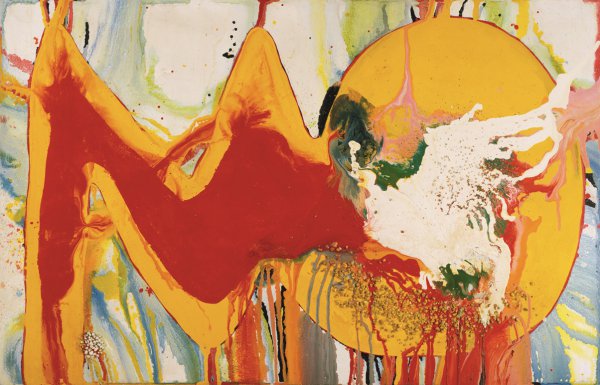
Pushing their materials and sometimes their bodies to the limits, Kazuo Shiraga and Sadamasa Motonaga helped redefine art in postwar Japan.
Motonaga Sadamasa, Red and Yellow, 1963, oil, synthetic resin, and gravel.
Featured Images: (Click to Enlarge)
-
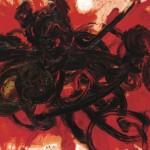
- Kazuo Shiraga, Work II, 1958, oil on paper.
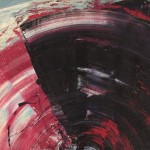
-
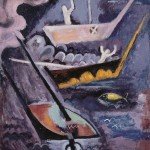
- Shiraga Kazuo, Difficult Voyage, 1949, oil on canvas;
-
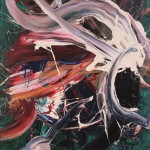
- Shiraga Hisao, Daiitokuson, 1973
-

- Motonaga Sadamasa, Red and Yellow, 1963, oil, synthetic resin, and gravel.
-
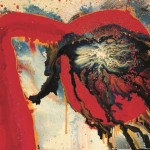
- Sadamasa Motonaga, Work, 1960
“In the postwar period [in Japan], to be an individual was the priority, but before the war, to be a subject, part of the national body, was the priority,” says Gabriel Ritter, the Nancy and Tim Hanley Assistant Curator of Contemporary art at the Dallas Museum of Art, and the co-curator of the exhibition “Between Action and the Unknown: The Art of Kazuo Shiraga and Sadamasa Motonaga” (February 8–July 19). “There was a revelation in the postwar period about subjectivity.” Gutai, the first and most influential avant-garde collective in postwar Japan, was instrumental in forging an environment of creative freedom for contemporary Japanese artists. Founded by artist Jiro Yoshihara in 1954, the group channeled its ethos of individuality into performance, painting, publication, and environmental installation.
In the inaugural issue of Gutai’s journal, Yoshihara wrote, “The thing that is most important to us is for contemporary art to act as a free space that provides people living in these severe times with the greatest emancipation. It is our deep-seated belief that creativity in free space will truly contribute to the development of the human race.” Gutai and its artists expressed freedom and “free space” through the creation of new and unprecedented work. Much of it was created through confrontational physical performances between the artist and his material—i.e., throwing bottles filled with paint against a canvas or running through successive sheets of kraft paper. In Gutai’s manifesto, Yoshihara addressed the group’s relationship to material, writing, “Gutai art does not alter matter. Gutai art brings matter to life.” In searching for a newfound sense of individuality, Gutai artists were concerned with testing the limits of their humanity, perhaps more so than the limits of their materials.
Kazuo Shiraga, one of the most prominent Japanese artists associated with Gutai, captured the very meaning of the group’s name—which is both or either “concrete” and “embodiment”—with his 1955 performance Challenging Mud. Staged for the first time at the “1st Gutai Art Exhibition” in Tokyo (Shiraga would do the performance more than once), Challenging Mud consisted of a loin-clothed Shiraga throwing himself into a one-ton slab of wet earth and unset concrete and shaping it with his entire body. Shiraga’s body served as the tool sculpting a medium into the desired artistic form, while also acting as the agent of chaos, destroying order and safety for the sake of creation. His finished “painting,” which was the form he had wrestled the mud into, stayed on view for the remainder of the exhibition. The process, which was documented with photographs and films, was intensely physical, leaving bruises on Shiraga’s body and exhausting him. Elements of corporeality and fatigue would remain part of Shiraga’s work for the rest of his career.
Sadamasa Motonaga was more interested in pushing the physical boundaries of nature than those of his own body. His first exhibition with Gutai, before he was a full member, took place in a park in Ashiya at the 1955 show “Experimental Outdoor Exhibition of Modern Art to Challenge the Midsummer Sun.” He took a vinyl sheet that measured just under 4 ft. square and filled it with water. He colored the water red with ink and drew up all four corners of the sheet together, tying them with a rope. The rope was fixed to the limb of a pine tree that sagged with the weight of the vinyl bag, which by then resembled a heavy red teardrop floating in the landscape. Liquid: Red was the genesis for many projects throughout Motonaga’s career. In the same year he created 20 smaller water-filled bags dyed various colors for the “1st Gutai Art Exhibition.” In 1956 at the “Outdoor Gutai Art Exhibition,” Motonaga created Work [Water], a project which used hammock-like vinyl sheets that were stretched between trees and filled with colored water. Shortly before his death in 2011, the Solomon R. Guggenheim Museum in New York commissioned Motonaga to create a version of Work [Water] to hang between the levels of its rotunda during the 2013 exhibition “Gutai: Splendid Playground.”
Both Shiraga and Motonaga became outstanding abstract painters during their tenure with Gutai, which lasted for 18 years, up until Yoshihara’s death in 1972. In the decades that followed, until the early 2000s (Shiraga died in 2008; both he and Motonaga kept working late into their lives), both artists developed substantial careers in Japan, with some international recognition, though certainly not enough considering the quality and concerns of their work. The DMA’s exhibition will consider the whole breadth of their careers, shining a light on the global development of modernism and making these two artists part of the conversation on abstract expressionism.
Motonaga first made figural work. He was self-taught and originally intended to be a manga artist. When he discovered abstract paintings at the Ashiya City Art Exhibition in 1953, he began experimenting with non-representation. His first projects with Gutai were largely impermanent, using water and smoke as media—both can be made to take a shape but either dissolve or overcome their form eventually. Motonaga’s initial abstract paintings were landscapes depicting the light over the mountains he saw from his window, but when he began using oil-based industrial paint instead of oil paint, a marbling technique emerged that became characteristic of many of his paintings. Letting the paint flow naturally, he felt he could, in his words, “tap into the power of nature and create works that transcended my own thoughts.” He wanted to show the essential liquidness of the paint, and even likened the stream of the paint in his “flow paintings” to the course of a river. This can be seen in Work (1963), an oil and gravel piece that seems almost like a topographical map of a solar landscape with pooling, marbleized layers of paint converging on each other.
Most of Motonaga’s paintings began with a small sketch that he would carefully, though quickly, jot down on a piece of memo paper. He called them his “shapes,” and each lay in wait in his studio with the potential to become a full-scale painting. In the mid-’60s Motonaga discovered airbrushing. Though still considerably unwieldy, spray paint allowed him more control when creating his shapes. Some of his airbrushed works, like Z Z Z Z Z (1971), have a playful cartoon-like quality, while others, like Piron Piron (1975), have such a minimalist sophistication and meticulous color gradation, it’s as if Rothko tagged up a subway car.
Shiraga is known primarily for painting with his feet. Using supports fastened to the ceiling, he would suspend his body right above a canvas that was on the studio floor and use his feet to create dynamic, abstract forms. Trained in the style of Nihon-ga Japanese painting, Shiraga first used his fingers to paint before he began his foot technique. In 1955 in the Gutai journal, Shiraga wrote, “I want to paint as though rushing around a battlefield, exerting myself to collapse from exhaustion.” Physical exhaustion and violence were a means to personal freedom and hedonistic joy for him. After his paintings were completed, he would often name them for folk heroes, and later for Buddhist gods. Later in his career, Shiraga gravitated toward Esoteric Buddhism or Mikkyo—probably because it was so physically demanding. Before he began painting he would chant and pray at a shrine, become fully physically incensed.

Subscribe to Art & Antiques for your Digital or Print copy