Subscribe to Our Newsletter
Latin American Original

Joaquín Torres-García discovered avant-garde art in Europe and then returned to his native Uruguay to forge a synthesis of Old World and New World aesthetics.

Joaquín Torres-García, Puerto de Barcelona, 1918, oil on cardboard, 20 1⁄2 x 28 3⁄4 inches;
Featured Images: (Click to Enlarge)
-
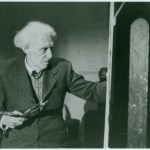
- Torres-García painting, Montevideo, Uruguay, circa 1940.
-
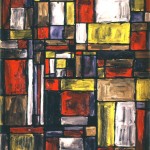
- Joaquín Torres-García, Estructura en colores, 1930, oil on canvas, 24 x 16 1⁄2 inches;
-
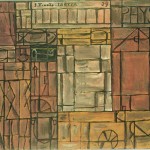
- Joaquín Torres-García,
-
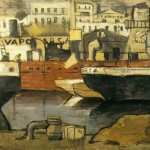
- Joaquín Torres-García, Puerto de Barcelona, 1918, oil on cardboard, 20 1⁄2 x 28 3⁄4 inches;
-
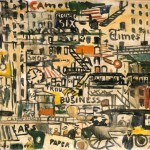
- Joaquín Torres-García,
Before there was Diego Rivera, before there was José Clemente Orozco, before there was Wifredo Lam, there was Joaquín Torres-García. The original, the true progenitor of Latin American modernism, Torres-García blended European avant-garde concepts with New World aesthetics in an art characterized not so much by lush tropicality as fierce intellectuality. Completely uninterested in folklore or local color, his search for Latin American roots led him to Pre-Columbian art, whose austere symbolism and ideographic writing resonated with his earlier interest in Platonic philosophy, geometry, and number. And while Torres-García’s rarefied approach might have made him a lonely visionary, in fact he became a great teacher, a founder of a school of art and a fosterer of future talent. While he well known to aficionados and scholars of Latin American art, Torres-García is not as famous in North America as he should be.
He was born in 1874 in Montevideo, the capital of Uruguay, a small country in the extreme south of South America largely populated by descendants of immigrants from Spain, France, and Italy. While remote from the major centers of Western intellectual and artistic endeavor, Uruguay had already produced a few important avant garde figures—the French poets Jules Laforgue, Jules Supervielle, and Isadore Ducasse, known as the Comte de Lautréamont. Like them, the young Torres-García combined a rebellious attitude with an orientation toward the Old World, generally considered among Uruguayans to be the sole source of culture. In 1891 his family, beset by financial problems, decided to leave for Spain. They settled in Mataró, the father’s ancestral town, but soon moved to Barcelona. Here Torres-García’s art education began, at the city’s School of Fine Arts.
The instruction there was heavily influenced by French Impressionism and focused on plein air painting, but Torres- García was soon finding his way to other influences and ideas. He hung out at the famous bar Els Quatre Gats (The Four Cats), which was frequented by a bohemian crowd that included the pre-Blue Period Pablo Picasso. In Barcelona Torres-Gar- cía became an enthusiast for a local “Mediterranean” style of painting distinct from Impressionism, and his townscapes from this period show a proclivity for warm colors and sharp outlines that prefigure his later, abstract work. The Mediterranean concept led him to Greek Classical art, whose formalism and simplicity inclined him toward Platonic idealism.
In Barcelona, Torres-García began doing mural painting and was hired by none other than Antoni Gaudí to decorate walls and help out on stained glass for church commissions. It was an exciting time for Catalan cultural revival, but Torres-García, never a joiner, was moving farther and farther away from this sort of nationalism. By around 1910 he had become a major figure in the Barcelona art world as an artist and art theorist—one of his followers was the young Joan Miró—but financial success eluded him. He tried founding a school of mural painting in 1913, but it went bankrupt in 1914. Finally, in 1920 he moved with his wife and three children to Paris, briefly, and then to New York, where he found exciting new ideas percolating and associated with an international avant-garde that included Marcel Duchamp, Man Ray, Max Weber, and Joseph Stella. Fascinated by the energy of New York, he filled sketchbooks with street scenes.
But New York was only a way-station for the peripatetic painter, and he soon moved on to Italy, where he did something that seemed out of character but actually was anything but—he went into busi- ness manufacturing toys. This was partly due to a need to make money—at which it notably failed—but it also had a great deal to do with an interest in education and the effects of art on growing minds. Also, an interest in experimental or non-industrial toys was prevalent in the early modernist years—Picasso, Paul Klee, Alexander Calder, and Bruno Munari all made them, embracing the notion of play as essential to creativity. Torres-García’s toys were mainly wooden building blocks, foreshadowing, it seems, his later wooden-box-like abstract compositions and his distinctive take on Constructivism.
Torres-García’s encounter with that school of art, which was transformative, began after he returned to Paris in the 1920s and met three Dutch artists, Piet Mondrian, Theo van Doesburg, and Georges Vantongerloo. With them he shared a distaste for Surrealism, which was then at its high point of energy and polemical activity. For Torres-García, the problem with Surrealism was its embrace of disorder, its abandonment of geometry, which he believed embodied universal cosmic laws. Surrealism, he wrote, was “the aberration of the dark soul” that only became possible because Cubism had given up on geometry too soon.
Like the Surrealists, Torres-García was an enthusiast for occult and mystical ideas—he was strongly influenced by Theosophy, as were Mondrian and Kandinsky—but he absolutely rejected Surrealist automatism. He believed that ideas from the visionary realm had to be carefully processed, recollected in tranquility, and physically constructed in accordance with universal laws. Thus Constructivism—Mondrian and company, it seemed to Torres-García, were incarnating pure Platonic ideas with their strict geometry, primary colors, and austere rejection of any figuration. Torres-García remained geometry-obsessed all his life; in the 1930s he hung a sign at the entrance to his studio that read, “Non-geometers get out!”— a reference to the famous inscription at the gate of Plato’s Academy. However, he became frustrated with what he saw as a certain coldness and remoteness in Constructivism. There was something missing from these pure compositions, an element of humanity, something to which viewers could relate themselves, their time and place. Looking for a way to restore this cultural element without resorting to “decadent” Renaissance-inspired figuration, Torres- García hit on a solution that would change his life and art and propel him back to Uruguay and into a new role as teacher. It was ancient and primitive art.
In 1928, in Paris, he saw the exhibition “Les arts anciens de l’Amérique” (Ancient Arts of the Americas”) at the Musée des Arts Décoratifs. This show was the catalyst for Torres-García’s realization that the missing element could be restored by using ideo- graphic writing, like that of Pre-Columbian cultures. The famous Incan Gate of the Sun from Tihuanaco in Peru was in the show and inspired Torres-García to invent his own system of signs and symbols that could be incorporated into abstract constructions.
With this breakthrough, Constructivist Universalism was born.
Torre-García’s new concept of art was based on a method that involved dividing a canvas (or a block of wood or stone) into variously-sized rectangles constructed according to the “golden section,” a proportion, prized by the ancients and enthusiastically adopted in the Renaissance, of approximately 1.618 to 1. Some of the rectangles would contain simply color (especially but not exclusively primaries), some would contain simple shapes, and others would contain Torres-García’s self-invented ideographs or conventional letters and numbers. A classic example of this style is his Constructivist Painting #3, from 1937. A whole vocabulary is nestled among the colored rectangles here, like pieces of lead type in an old-fashioned printer’s tray. After starting at the top with a row of ordinary Latin letters and the numerals 1 through 7, as if to introduce the viewer to the basic building-blocks of conceptual thought and communication, Torres-García proceeds to more arcane symbolism.
A brief explication of some of these symbols, according to Torres-García’s own writings, is as follows: The equilateral triangle represents divinity, harmony, and proportion. The serpent signi- fies the unconscious and psychic energy (shades of Surrealism); the clock functions as a mandala and a symbol of perpetual motion; the knife means execution, vengeance, and sacrifice; the hands mean opening and closing, a means of access to a higher spiritual state, initiation and knowledge; the ladder means progress towards wisdom, the unification of psychic planes; the ascending arrow symbolizes thought, the exchange of energy between sky and earth, and liberation from earthly conditions; the fish, a symbol of life and fertility, swims in the depths of the unconscious. The astrological symbols for the planets and the Hebrew letters are basic elements of the vocabulary of Western occultism, and the mysterious word “Abraxas” is the name of a deity, first among the 365 cosmic rulers according one system of Greek Gnosticism (note also the presence of the number 365 in the painting). The eye, the heart, the cross, and the scales are all so basic in our common experience as to need no definition. Torres-García had to go to Europe to discover the ancient culture of his own home continent; now he wanted to bring it home. He had come to believe that “art should be the product of a particular land and period.” He no longer wanted a completely abstract, timeless and placeless art, floating somewhere above the human condition. In 1934, after 43 years away, he returned to Uruguay, hoping, as he told a reporter at the time, “to create in Montevideo a movement that will surpass the art of Paris.” Whether or not it did surpass Paris, the school he founded, El Taller Torres-García (meaning the Torres-García atelier or workshop), shook up the city’s deeply conservative art world—one of the journals he published was titled “The Paint Remover”—and attracted a nucleus of talented students. They took up the master’s challenge to create art that united formal rigor and human vitality, deriving its strength from the earth beneath the artists’ feet— “telluric force,” as Torres-García called it. This “School of the South” aimed at a re-orientation according to which South American artists would place themselves at the center rather than at the periph- ery. To drive home the point, in 1935 the artist published a hand- drawn map of South America that placed south at the top instead of north. “Our North,” he wrote, “is the South….This is a necessary rectification; so that now we know where we are.”
From 1934 until his death 15 years later, Torres-García surrounded himself with students, who included Gonzalo Fonseca, José Gurvich, Julio Alpuy, Guido Castillo, and his son Augusto Torres. Fonseca later recalled that Torres-García, right from the outset, made them feel like painters rather than students. Among the projects he encouraged them to take up were some large mural commissions. Public art was very much a priority for Torres-García during his Uruguayan period; one of his best known works, in fact, is a monumental stone construction, Cosmic Monument (1937–38), in Montevideo’s Parque Rodó, which translates the symbol-laden rectangle conception into a wall reminiscent of a Incan stone wall at Cuzco, with ideographs that look more Pre-Columbian than Western like the ones in Constructivist Painting #3.
In 1944 the school got a commission for a large, 27-mural project, executed in primary colors, from a hospital, of which seven were completed. Thirty years later, they were removed from the walls for conservation. Mounted on canvas, they were exhibited at the Rio de Janeiro Museum of Modern Art, in Brazil, where a fire broke out and destroyed them. El Taller Torres-García itself continued to nurture artists until the early 1960s. Though the school ceased to exist and the murals went up in smoke, its founder’s legacy survives, running like a subterranean—or telluric, as he would say—current through Latin American art.

Subscribe to Art & Antiques for your Digital or Print copy