Subscribe to Our Newsletter
Kenny Harris’s Interiorscapes
By David MaMasello

One of Harris’s favorite colors, teal, is used in his Burgundy, Teal, and Pink, Normandy, 2010, oil on linen, 24 x 20 in.
Kenny Harris is not an interior decorator, but some of what he does to create his subject matter has similarities to that profession. While the Venice, California–based Harris is best known for his evocative, poetic depictions of the interiors of rooms and unassuming cityscapes, what he reveals on panel or canvas is often a scene that has been edited. Select furnishings, the positions of structural elements, the colors are usually altered somehow—all in the cause of greater visual effect.
When showing, for instance, a view of a porte-cochère in Paris, Harris admits to having moved the actual locale of a church visible through the archway to the opposite side so as to create a better sightline and overall composition. He readily changes an expanse of white wainscoting in a Normandy house to blue for added vibrancy. And whenever it makes sense, he’ll introduce a burst of teal, his favorite hue. He undertakes this process of fictionalizing because, as he admits, “If I’m not careful, I can go too monochromatic. I love neutrals, I love how white and gray create beautiful cool grays. But I also make sure to include pure, saturated color.”

One of the few instances in which a figure appears in a Harris work, A Dutch Interior, 2025, oil on canvas on ACM, 24 x 16 in.
Although the interiors and street scenes he paints—in locales as disparate as those in Turkey, France, Italy, Ireland, China—are devoid of people (with some exceptions), every one of his rooms and sidewalks carries a charge of occupancy. Something about the composition he creates—the brush strokes, the colors, the rendering of natural light streaming in—makes his works feel occupied by people. You feel as if you’ve just missed the person or persons who had been there. They’ve left something of themselves behind.
When asked how he achieves this mysterious effect of occupancy when no one is present, he says, from the garage studio he shares with his artist wife, Judy Nimtz, “It’s about being able to paint the atmosphere of the light.” He goes on to outline two other surprising techniques he employs with every painting. “I try to have what I call a twitching stroke and a shaking hand.” He qualifies this decidedly unconventional statement by explaining that “an active hand is what gives energy to a scene.” The actual movement of a hand as it applies paint to a surface creates a force, an energy, a kind of spiritual essence. “That twitch of the hand and brush replicates how our eyes are picking up light as it is bouncing off of objects. If I’m able to do it right, the viewer might be willing to go along for the ride with me as I was painting it. You can see the layers I’ve added, the corrections I’ve done, the decisions I’ve made.”

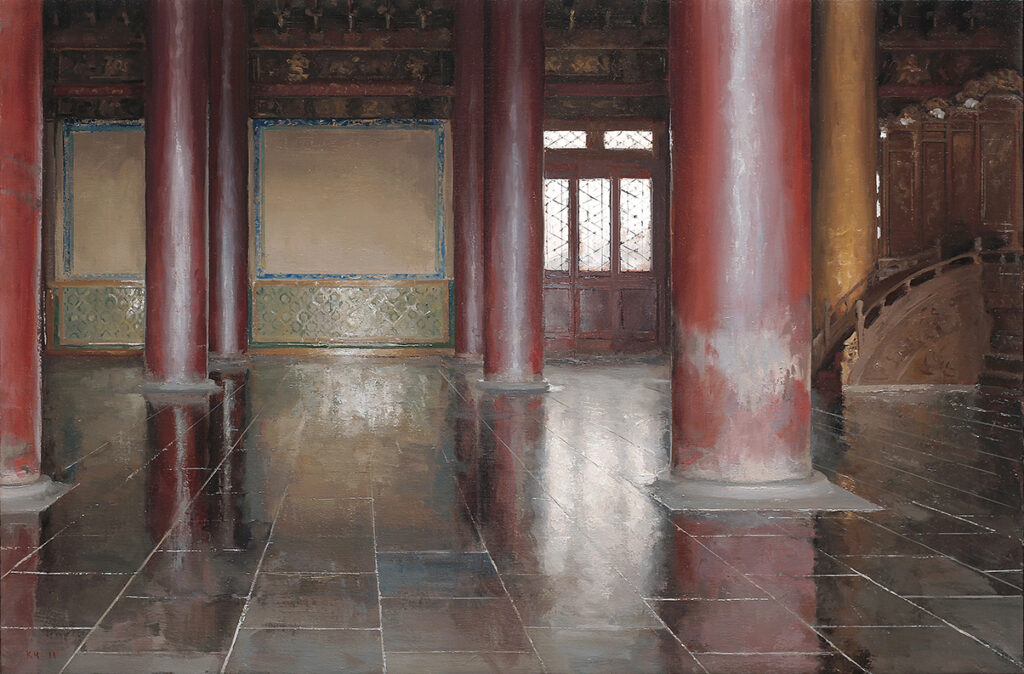
Hall of Supreme Harmony, Forbidden City, 2011, oil on linen, 24 x 36 in.
Apart from being able to articulate such painterly ideals, though, Harris is a cool guy, hip, energetic, handsome, even boyish as a 50-year-old. When he is not painting his interiors or cityscapes, especially when he is abroad for extended periods of time in search of material, he might likely be found playing volleyball on the beach or riding his mountain bike in his tranquil Venice neighborhood, a mile inland from the ocean. He and his wife share that garage studio they made at their house, and when together, they work on canvases simultaneously, a podcast about history playing or mellow jazz wafting in the air as they each apply brushstrokes. Even though Harris says, emphatically, “I’m a very sociable person, I love people, I like teaching students how to draw figures and I like portraiture,” he rarely includes a person in one of his rooms or streets. “I think it might have something to do with being on the road and being in the right mood for painting light and shapes—or that I need to be alone.” His wife does appear, however, in a haunting work, in which she stands in the main room of an Amsterdam canal house.
For the full story click on the link below for your Digital subscription:

Subscribe to Art & Antiques for your Digital or Print copy