Subscribe to Our Newsletter
Brother Act
The realistic yet mysterious paintings of the Le Nain brothers get a rare showing at the Kimbell Art Museum.
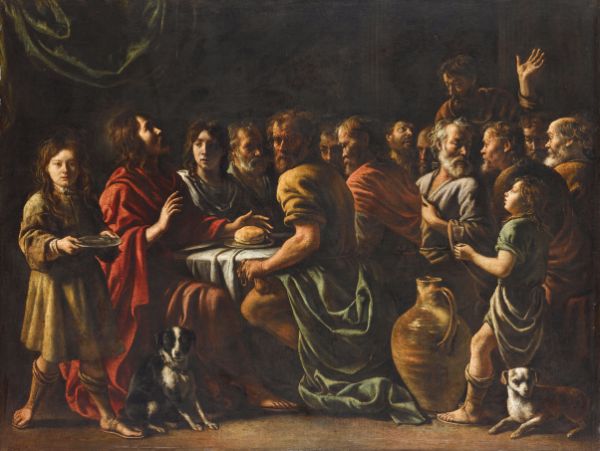
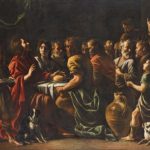
Le Nain, The Last Supper, 1650s, oil on canvas.
Featured Images: (Click to Enlarge)
-
- Le Nain, A Quarrel, circa 1640, oil on canvas.
-
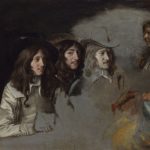
- Le Nain, Three Men and a Boy, circa 1647–48, oil on canvas;
-
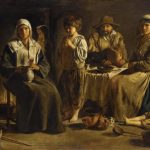
- Louis Le Nain, Peasant Family in an Interior, circa 1642, oil on canvas.
-
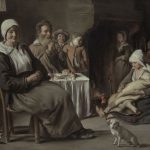
- Le Nain, Peasant Interior with an Old Flute Player, circa 1642, oil on canvas.
The Le Nain brothers, Antoine, Louis, and Mathieu, who flourished in France in the early 17th century, are among the most mysterious Old Master painters. In terms of biography, very little is known about them, and that small amount only serves to increase the mystery. None of the three artistic siblings ever married or had children, and they not only lived together but worked together, signing their paintings with their last name only, so that it has always been extremely difficult for art historians to figure out which brother painted which picture. Most likely the Le Nains would have wanted it that way; over time their individual abilities and styles apparently merged into an artistic celebration of family. Among Old Masters, only the Carracci of Bologna—two brothers and a cousin who worked a generation before the Le Nains—come close in terms of collectivity. The phenomenon of the Le Nain brothers reminds one of the observation that in harmony singing, the voices of people who are related to each other by blood blend best.
The subject matter for which the Le Nains are most famous is, if not mysterious in the sense of weird or arcane, at least question-provoking. The brothers devoted painting after painting to genre scenes of French peasant life, rendered with painstaking, delicate realism. However, they were not completely realistic in terms of social observation—the Le Nains’ peasants, while painted with pathos, are just a bit more trig and comfortable than one would expect them to be. In Peasant Interior With an Old Flute Player (1642), the walls are bare and gloomy gray and the faces are somber (except for one mischievously grinning boy catching the viewer’s eye), but there’s a nice glass of red wine on the table, brass andirons (an expensive item at the time) in the fireplace, and the dog and the cat look well-fed. This is typical of the Le Nains’ peasant scenes—what we get is a kind of heightened, if not hopeful, reality in which the dignity and soulfulness of the rural poor are rewarded with an unusual level of prosperity.
This Peasant Interior is one of around 50 works—not only genre pieces but history and devotional paintings, landscapes, and portraits—that will go on view late this month at the Kimbell Art Museum in Fort Worth, Tex., in “The Brothers Le Nain: Painters of Seventeenth-Century France” (May 22–September 11). The first Le Nain show in the U.S. since 1947, it is only the second in the world to give a comprehensive account of the brothers’ work; the first was a retrospective at the Grand Palais in Paris in 1978–79 that was organized by the great art historian Jacques Thuillier. The current show, organized by the Kimbell’s C.D. Dickerson III and Esther Bell of the Fine Arts Museums of San Francisco, was originally conceived as a survey of Le Nain works in U.S. collections, but then the Louvre expressed interest in lending paintings and partnering with the American museums to create a truly encyclopedic international exhibition. The breadth of the show (which will travel to San Francisco and to the Louvre’s outpost in Lens, in northern France) is such that viewers will be able to judge for themselves what the brothers’ artistic intentions were and even try to match wits with the curators, who have used all available physical and documentary evidence, plus connoisseurship, to distinguish the artistic hand of each brother and attribute specific works to each wherever possible.
Born at the turn of the 17th century (the exact birthdates are unknown), the Le Nains themselves came from a relatively well-off farming family, in the northern French province of Picardy. Their father, Isaac, was probably a wine-grower, and the family lived in the city of Laon, where the boys took their first steps in art around 1618. After about 10 years of painting there, they moved to Paris, where they redefined themselves as urbane artists with a high-end clientele that included Anne of Austria, mother of the future king Louis XIV. Membership in prestigious artists’ associations followed; Antoine, Louis, and Mathieu were among the first to join a new organization, the Académie Royale de Peinture et de Sculpture, which sought to enhance artists’ independence as against the traditional guild system, which imposed restrictions on them and treated them like skilled tradesmen rather than creative artists.
In Paris, where Italian art was popular and patronized by the Queen, the Le Nains absorbed influence from Italian masters such as Caravaggio and Orazio Gentileschi, more than from their fellow French painters. The sometimes brutal realism and sympathy for the common people that characterize these Italian Baroque artists were more appealing to the Le Nain brothers than the austere, Classicizing purity of Poussin. One French artist they did admire was Georges de la Tour, whose habit of illuminating his domestic scenes with a single candle flame inspired the Le Nains to attempt similar feats of contrasty, dramatic lighting. But as the curators of the show point out in their catalogue essays, the Le Nains changed their styles fairly frequently in response to the public’s shifting tastes, before settling on the rustic realism for which they are now remembered. As for their single-subject portraits, only one has survived, so it is hard to assess their work in this vein (a number of small group portraits are extant, including a collective self-portrait of all three brothers.)
Based on extensive research and analysis, the curators of the present show have isolated three distinct hands in the oeuvre of the Le Nains, which they label “brother A,” “brother B,” and “brother C.” They have not been able to go further, however, and definitively match each letter with a named brother—although they have a strong presumption toward identifying B with Louis, who French art historian Pierre Rosenberg calls “the unquestionable genius of the family.” To him the curators ascribe such masterworks as The Forge (circa 1640), which shows a blacksmith at work against a background of fire emitting sparks, surrounded by a group of companions, male and female. The fairly loose paint handling and the way some of the figures lock eyes with the viewer are considered typical of the B painter, as is the dynamic, slightly off-center composition. The aforementioned Peasant Interior With an Old Flute Player is also given to brother B.
To brother A (probably Antoine) is attributed The Card Players (circa 1640–45), a genre picture that directly inspired Paul Cézanne’s famous series of Card Players paintings of the 1890s. After seeing the Le Nain painting, the modernist pioneer said, “That is how I would like to paint.” Cézanne was not alone among 19th-century French painters in his admiration of the Le Nains. Around the time of the revolutions of 1848, there was a resurgence of enthusiasm for their work, which was thought to incarnate some elemental quality of Frenchness as well as a kind of leftist, proto-revolutionary concern for the masses. New apostles of uncompromising realism such as Courbet and Manet were inspired by the Le Nains. Writing in the 1850s, the critic Champfleury dubbed the brothers “worker-painters.”
This is all a far cry from the polished courtier-painter image that the brothers themselves cultivated in their business life, but it does touch on something important and essential in their work. The Le Nains’ style was not social realism, but it was psychological realism, an attempt to see the true humanity and individuality in the poor rather than casting them as victims to be pitied or types to be categorized. The Le Nains clearly wanted to give their peasant subjects dignity, and the intimacy of their portrayals invites us to think of ourselves as right there alongside the poor, not different from them in any essential way.
The brother act came to an end in the fateful year of 1648, when Louis and Antoine died within days of each other. Mathieu lived on until 1677, and it must have been a very lonely existence. He continued to have success as a painter and was even elevated to the nobility, but his work from those later years shows a sad falling off in originality and verve. Without his brothers in blood and in paint, Mathieu’s creativity withered away.
—
By John Dorfman

Subscribe to Art & Antiques for your Digital or Print copy