Subscribe to Our Newsletter
Lucid Dreaming
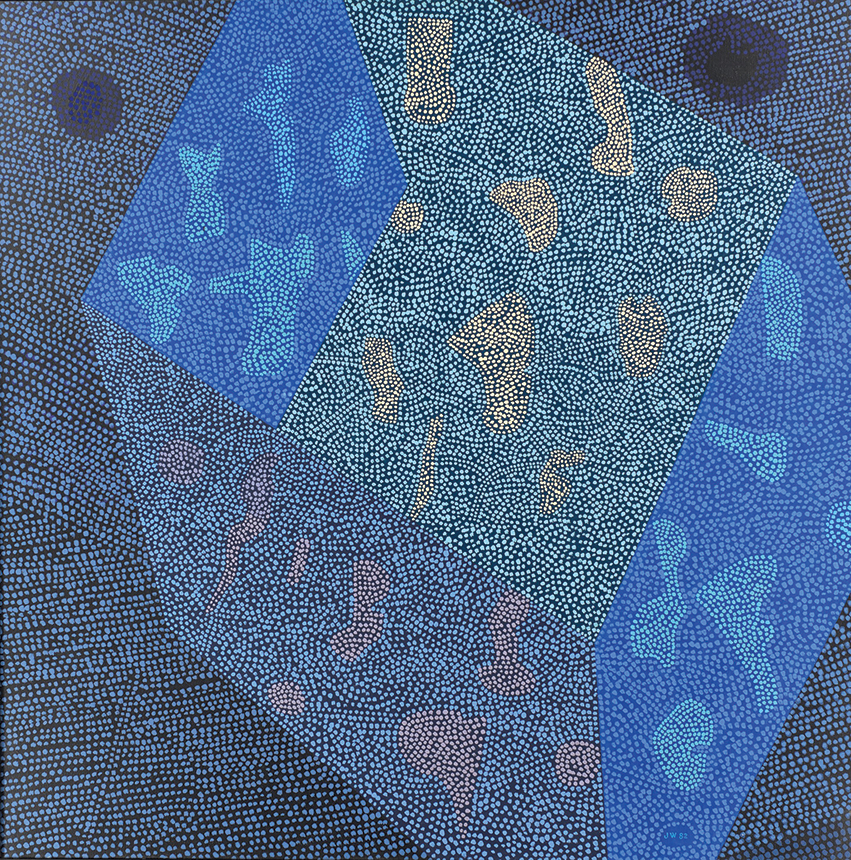
Jack Wright’s abstract paintings open a portal into a realm of inner vision and beatific light.
By John Dorfman
Jack Wright’s studio in the hills of northern California’s Marin County had a such a beautiful view that he had to slather a window with white paint to block the distraction. That’s because Wright was painting not the outer but the inner world, a visionary space suffused with a light that shone from the depths of the unconscious mind. Wright had lucid dreams—an unusual state in which one becomes aware of dreaming without waking up—in which, he said, “color is more brilliant, and vision much more acute.” Wright’s dream imagery, which he used in his work, wasn’t the phantasmagoria of Surrealism but raw material for intricate, meditative abstract painting. In a six-decade-long career, he developed a method of painting in dots and small lines in a way that conveys a sense of color as energy and vibration, with an almost audible quality. Wright was blessed with inherited wealth, which enabled him to pursue his art throughout his life without needing to conform to the demands of the marketplace. The result was a unique and independent oeuvre that, while not particularly well known outside some relatively small circles, is a worthy and enriching contribution to the corpus of abstract art in the 20th century.
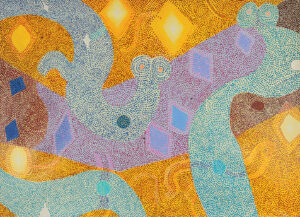
Jack Wright, Dragons, 1987, acrylic on canvas, 91 x 126 in.
Courtesy the Estate of Jack Wright
He was born John Cushing Wright in St. Paul, Minn., in 1919, and was interested in painting even as a young child. In his teens, he studied at the St. Paul School of Art, where his teacher was Cameron Booth, a painter who was traditional in his own methods but nonetheless felt it was important to introduce his students to avant-garde modernism. From Booth, Wright learned about artists such as Picasso, de Chirico, Klee, and Matisse. But it was an American artist only a few years older than Wright himself who made the biggest impact: While wandering through the galleries at the Art Institute of Chicago, he came across a painting by Morris Graves, a Northwestern artist with mystical sensibilities. “When I saw the painting,” he recalled years later, “it was as if a gong rang way inside my brain. It was a very moving experience. I never had another painting affect me like that.” The Graves painting not only strengthened Wright’s resolve to be a painter himself, but it also opened his mind to the idea that in doing so, he could depict what he saw inside.
After service in the military from 1942–45, Wright got married to Helen Partridge “Patty” Ordway, a childhood sweetheart and fellow student at the St. Paul School of Art. They had four sons and remained together until her death in 1999 (Jack Wright died in 2003). Patty Wright placed her artistic aspirations on hold to raise their children, but eventually established a serious practice in ceramics. In 1950, the Wrights, in search of greater freedom and beauty, moved to Marin County. At first, Wright had a job as a color consultant for an architecture firm that specialized in public buildings, but soon left to dedicate himself full-time to his painting. He began to do quite well in the art world, exhibiting his work at the Walker Art Center and the Minneapolis Institute of Art. The Betty Parsons Gallery, a major venue in New York, showed his paintings as early as 1948.
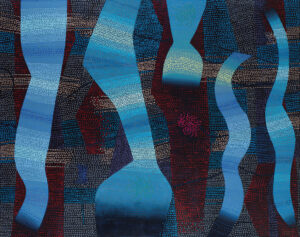
Group of Five, 1984, acrylic on canvas, 91 x 114 in.
Courtesy the Estate of Jack Wright
In 1952, Wright experienced a breakthrough when he began to use a modified “pointillist” technique. His first painting in this style is not an abstraction but a still life, a representation of two tangerines set against a distant mountain view. The small colored dots in complementary hues of orange and blue, create a shimmering effect, similar to that achieved by Seurat and Signac with their original pointillism (or more properly, Divisionism) in the late 19th century. The difference is that for Wright, the shimmering optical qualities have the effect of subtilizing or spiritualizing the objects, as they were made translucent to reveal an inner light.
Another important early pointillist work of Wright’s, more abstract than the still life, is Cloud Chamber (1952); the title is a reference to the device physicists use to observe atomic-level events, and indeed the tiny white dots in the painting could be quantum particles moving along lines of force. But it’s also likely a reference to the work of a friend of Wright’s, the highly unconventional avant-garde music composer Harry Partch, who made a special musical instrument called the Cloud Chamber consisting of Pyrex bowls suspended from a wooden frame. Wright saw clear analogies between visual art and music, which informed his art practice throughout his life. Of his pointillism, he said, “You get an optical mixture of color besides the pigment mixture on the canvas, a richer color than you could get otherwise….You can get what I call a tremolo effect, which would compare to sound.” Many of Wright’s paintings do appear to move, just as they can seem almost to emit musical notes.
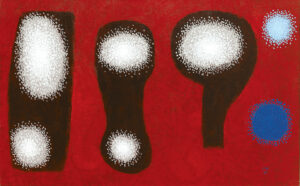
Signals from Where, 1985, acrylic on canvas, 30 x 48 in.
Findlay Galleries and the Estate of Jack Wright
During the mid-1950s, Wright came into contact with another artist who would have a major influence on him in the years to come—Gordon Onslow Ford. An Englishman and former naval officer, Onslow Ford had begun as a Surrealist in Europe, associating with artists including Roberto Matta, Wolfgang Paalen, and Yves Tanguy, before emigrating to the New World at the start of World War II. He spent time in Mexico, a place that had been extremely inspirational to modernist artists of various stripes during the 1930s and ’40s. In 1947, he moved to the Bay Area. Like Wright, Onslow Ford was an indefatigable explorer of what he called “the inner-worlds,” conveying what he saw in a self-created abstract vocabulary of dots, lines, and circles. Onslow Ford introduced Wright to like-minded artists including Lee Mullican, Richard Bowman, J.B. Blunk, and Fritz Rauh, a group whose importance to American art history is still not fully taken into account. Wright felt at home in the bohemian atmosphere of San Francisco and its environs, and while his personal style was never bohemian—he preferred neckties and tweed coats—he became friendly with major Beat-generation figures such as the philosopher Alan Watts and the writer Henry Miller.
Despite their contentedness with the Bay Area arts community, in 1957 the Wrights decided to move to Mexico for a change of scene and artistic inspiration, motivated by what they had heard from Onslow Ford about the country. They stayed two years, in San Miguel de Allende and Morelia, and during that time Wright’s art made another leap forward. The bright light and opens landscapes of Mexico fascinated him, and accordingly he increased the scale and luminosity of his paintings. In Mexico Wright also had a dedicated studio for the first time in his life, and when he returned to the U.S. he decided to have one for himself. He chose a spot near the family home in Inverness, Calif., on the appropriately named Mount Vision, and constructed a standalone wooden structure, perched on a ridge, which served as his center of operations for the rest of his life.
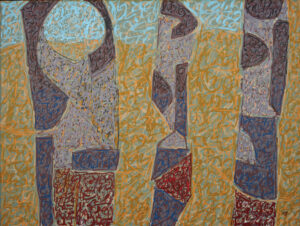
Second Gate, 1994, acrylic on canvas, 50 x 67 in.
Courtesy the Estate of Jack Wright
As Wright grew more self-assured in his use of dots, he increased their size somewhat, making them bolder, brighter, and more easily visible, and arranged them in geometrical patterns rather than using them in the classic pointillist way. His paintings of the 1960s and ’70s can resemble Australian Aboriginal paintings, which also use very complex arrays of colored dots. Wright acknowledged this similarity and explained the differences, saying, “I find the Aboriginal art of the Australians very stimulating and very much like some of the things I’ve been trying to do, the difference being that their content is quite different from mine, and it’s all very symbolic and has meaning. But their colors and their shapes, I think, are very much the sort of thing that I’m striving for all the time.” Aboriginal painting is symbolic in the sense that it encodes ritual knowledge and legends, while Wright’s paintings are communicate directly via color and form; there is no “code” to crack. The content of his paintings is an open secret.
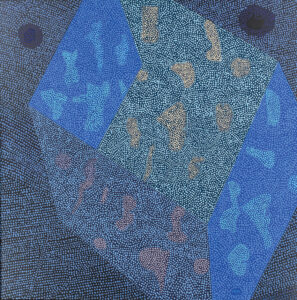
Reliquary, 1982, acrylic on canvas, 48 x 48 in.
Courtesy the Estate of Jack Wright
In Wright’s paintings, thousands of dots coalesce and overlap with larger-scale abstract shapes that sometimes suggest life forms such as microscopic cells or serpents or dragons. In other works, the forms are purely geometric. The special power of the dots lies in the way they impart a layered quality, a complexity to the fields of color, which often creates a sense of three-dimensionality or depth within a flat, patterned composition. Another frequent motif is a rectangular form that suggests a doorway or window, a portal. Wright’s preoccupation with passing through the wall of ordinary vision and experience into something beyond finds expression in these portals, which invite the viewer to open them.
In the 1990s, Wright made his final major stylistic change. He extended his dots into relatively short lines that wriggle energetically across his paintings. They may evoke lines of physical or psychic force or, on occasion, calligraphic lines from Islamic or Asian traditions. The dense patterning of the works from this late period is not busy or hyperactive; rather, it conveys a deep sense of peace and harmony. As the artist himself put it, “There is another world we can all experience that has nothing to do with logic and thinking. It’s something you can’t verbalize about. You experience it in one way or another.” One of those ways, undoubtedly, in in the paintings of Jack Wright.

Subscribe to Art & Antiques for your Digital or Print copy