Subscribe to Our Newsletter
Making a Good Impression
Although Mary Cassatt is regarded as one of the great Impressionists, it was later in her career that she created the masterpieces that continue to define her
By David Masello
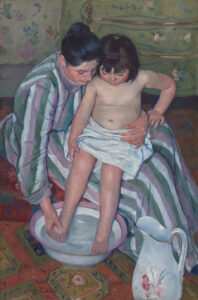
The Child’s Bath (1893), the centerpiece of the exhibition at the Art Institute of Chicago.
There’s a strategy to visiting the Art Institute of Chicago. The museum has so many iconic works in its collection, paintings you’ve seen as images for as long as you can remember, that a visit there often requires a plan so that you don’t miss what you’ve come to encounter. First-time visitors, as well as veterans of the collection, head often to Edward Hopper’s Nighthawks or Georges Seurat’s A Sunday on La Grande Jatte, Grant Wood’s American Gothic or Gustave Caillebotte’s Paris Street; Rainy Day. And each work is strategically positioned in galleries or set at the ends of hallways for maximum visual effect. The works attract as magnetically as lodestones.
Another one of the key works there, though, that so many seek out the moment they’ve paid their admission fee—and find immediate satisfaction at having done so since it was acquired by the museum in 1910—is Mary Cassatt’s The Child’s Bath (1893). It’s a painting that serves as the centerpiece of a new show there, “Mary Cassatt: After Impressionism” (September 6, 2026—January 3, 2027).
As James Rondeau, the President and Eloise W. Martin Director of The Art Institute, says of the painting:
“The Child’s Bath is a captivating canvas featuring Cassatt’s signature subject of a woman and child as well as her daring aesthetics. More than one hundred and fifteen years later, Cassatt’s painting continues to inspire visitors to engage meaningfully with her art.” Adds Annelise K. Madsen, the museum’s Gilda and Henry Buchbinder Curator, Arts of the Americas, and the curator of the exhibition: “In The Child’s Bath, Mary Cassatt transformed an everyday subject into something extraordinary. An exceptional painting, The Child’s Bath nevertheless feels altogether familiar.”
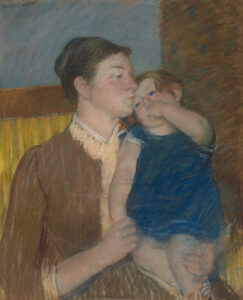
Mary Cassatt found her subject matter. Among her masterpieces are Mother’s Goodnight Kiss (1893)
After all, what Cassatt depicts is an act of affection we have likely all witnessed, some of us have performed with children of our own, or that we recall our own mother’s having done for us.
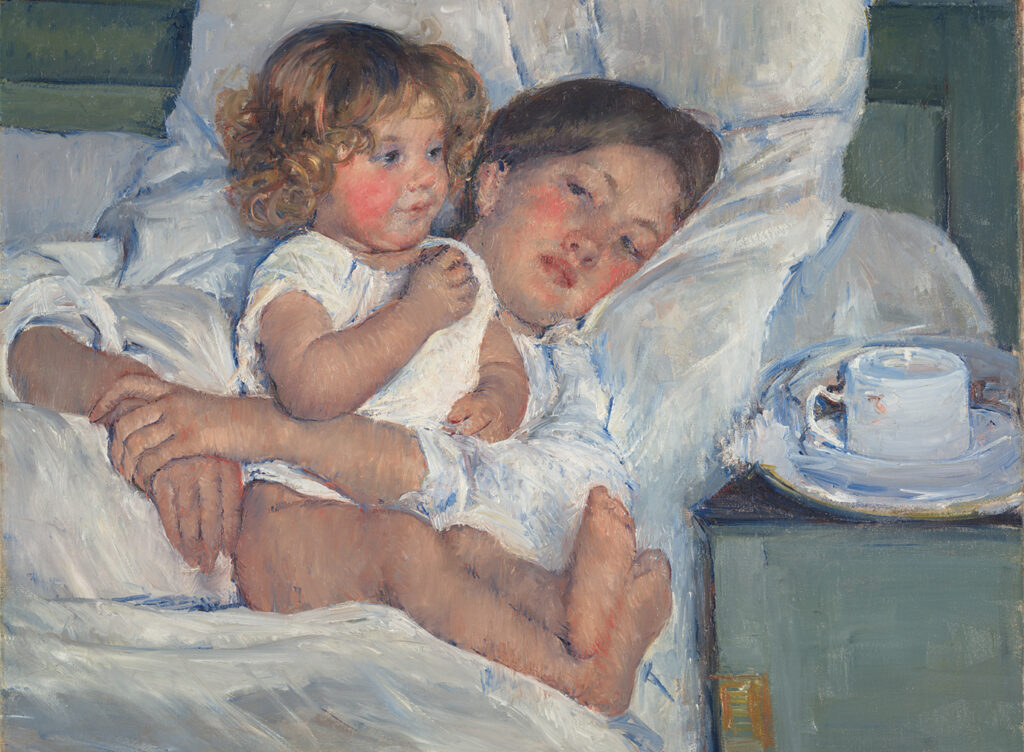
During Cassatt’s painting career, which lasted from the late 1880s into the early 1900s, she continued to transform such maternal scenes into an ongoing, ever-evolving series of paintings that define her as one of the great artists. In the show, we find a woman having breakfast in bed with her young daughter; another mother picking apples from a branch with her baby; a nursemaid knitting with her two young charges; girls fashioning sandcastles at a beach; a mother issuing a goodnight kiss to her child; a child gazing over her mother’s shoulder as she receives a banjo lesson. While many of Cassatt’s works include such figures, every one of her works is a unique, poignant depiction of the interactions, as are her other works that reveal girls and women alone performing various quotidian tasks. There is nothing ever repetitious or derivative about her paintings, one from another. “Cassatt held firm to her strengths as a figure painter,” Rondeau adds, “largely portraying women amid their daily activities, while unfolding dramatic explorations of form, color, pattern, and brushwork in the process.”
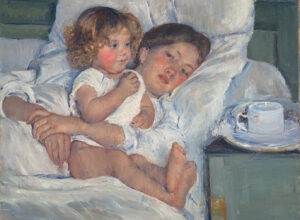
Breakfast in Bed (1897) is a particularly popular work of Cassatt’s, in the permanent collection of the Huntington Library, Art Museum, and Botanical Gardens.
Of The Child’s Bath, it was the first Cassatt work that The Art Institute purchased. Cassatt had already forged a relationship with the museum, having helped convince its then-president, Charles L. Hutchinson, in 1906 to acquire El Greco’s The Assumption of the Virgin (1577–79), yet another of the iconic works that distinguish the museum. Four years later, the museum purchased her work, whereupon it became an immediate highlight of the collection. At present, more than 60 paintings, pastels, prints, and drawings by Cassatt are part of the museum’s permanent collection. Even though Cassatt spent nearly her entire career living in France, the artist maintained a close relationship with the Chicago institution.
Cassatt proved herself early on by being one of the very few women, and the only American, to exhibit with the French Impressionists in the 1870s and ’80s. The exhibition Madsen has mounted seeks to reveal how Cassatt continued to thrive after the last Paris Impressionist show, in 1886, in which she participated. The 80 works included in Madsen’s exhibition, both early pieces and later ones, makes the case convincingly, especially since most of Cassatt’s signature scenes were done just as Impressionism, as a movement and style, began to fade. However, while Cassatt did experiment with other forms and mediums later in her life, her consistency in subject matter largely prevailed. Yes, she grew and expanded, but she did return to, adhere to, and revel in what she did best—showing mothers and children together, as well as women by themselves, thereby becoming heroines of painted and drawn scenes. (As an intriguing footnote: Cassatt never married or had children.) Rondeau emphasizes that after 1886, “Cassatt was just getting started. This show celebrates the artist and the experimental paintings, pastels, and prints that define the next chapter of her career.” And as Madsen comments, the show, “examines the artist’s daring work in the late 1880s through the early 1900s, a critical period when she took her career in new directions,” and where she exhibited an “all-out fearlessness in her artistic pursuits.”
For the full story click on the link below for your Digital subscription:

Subscribe to Art & Antiques for your Digital or Print copy