Subscribe to Our Newsletter
Masters of Metal
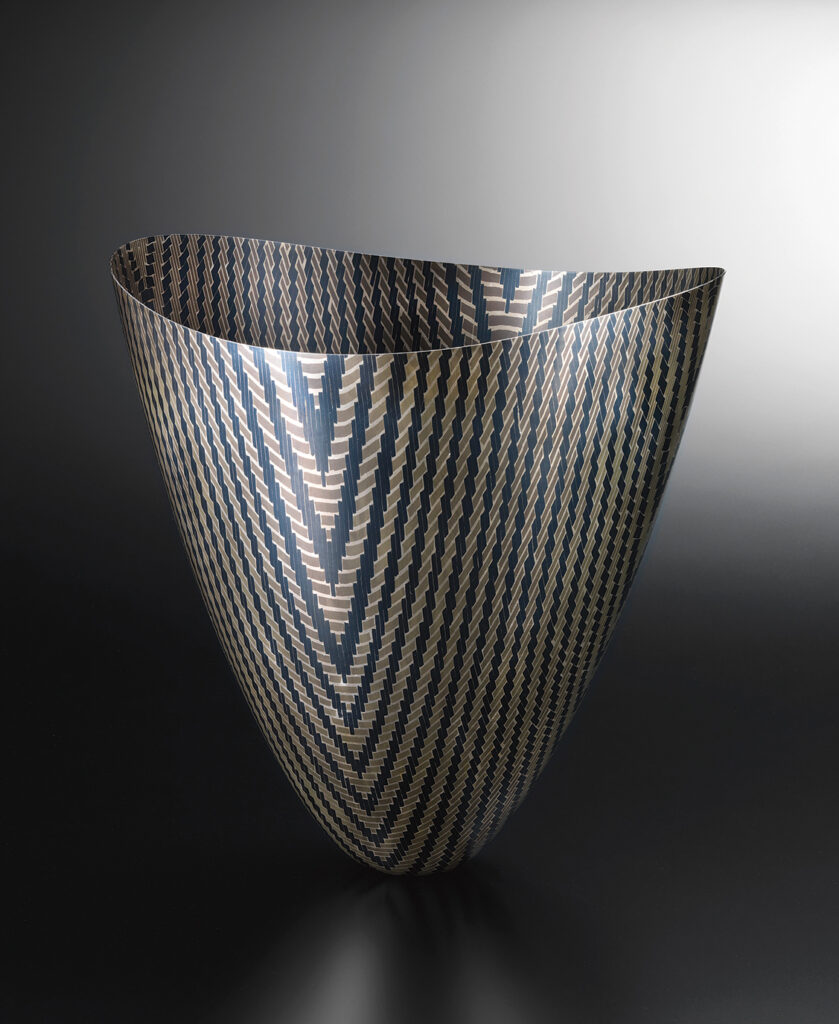
Working with amazingly intricate techniques, contemporary Japanese artists conjure the essences of nature in gold, silver, and a variety of alloys.
By John Dorfman
In Japan, it is not only a precious object that can be classified as a national treasure, but also a human being. The government has established a category, “Living National Treasure,” for artists whose mastery over their field makes them embodiments of its techniques and traditions. Not only that, but they are considered “preservers of important intangible cultural properties,” capable of transmitting these assets—knowledge that cannot be written down but must be learned first-hand from a master—to the next generation. At any given time, there can only be 58 Living National Treasures, working in the various craft media (wood, ceramics, lacquer, bamboo, etc.) as well as in music, dance, and drama.
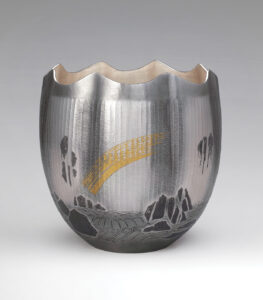
Osumi Yukie (b. 1945), Living National Treasure, Silver Vase Bakufu (Waterfall), 2011, hammered silver with nunome zōgan (textile imprint inlay) decoration in lead and gold, 25.4 x 25.1 cm.
Courtesy of the artists and Onishi Gallery
Among the crafts in which achievement is honored this way is metalwork. With incredibly painstaking attention to detail, Japanese artists create vessels—flower vases, tea kettles, boxes, incense burners, and more—in which graceful form and sumptuous surface almost, but not quite, eclipse function. Today’s fine metalwork is rooted in centuries-old tradition, and yet it is very much a contemporary art, in which innovation and individual expression are given free rein. There is a tension between the hardness and glint of metal and the softness of the natural forms that the imagery on their surfaces often invokes, such as flowers, forests, mountains, and clouds. Sometimes the inlaid decorations are abstract, either gestural, suggesting the stroke of a brush, or geometrical, evoking textile designs or even Art Deco streamlining.
Gold and silver are the key materials for this art form, with the supporting role taken by alloys of various colors made from copper and other metals combined with gold or silver. Precious metals have a long history in Japanese culture and loom large in the earliest European accounts of the country. In the 13th century, the Italian traveler Marco Polo wrote, “They have gold in the greatest abundance, its sources being inexhaustible, but as the king does not allow of its being exported, few merchants visit the country, nor is it frequented by much shipping from other parts.” This isolation reinforced the legendary status of Japan’s riches. In the 17th century, another Italian traveler, the Jesuit priest Matteo Ricci, marked Japan on his map as a land replete with gold and silver. The use of gold for decoration goes all the way back to the Yayoi period (300 BCE–300 CE), but the art developed significantly during the martial Kamakura (1185–1333) and Muromachi (1392–1573) periods, when gold was lavished on armor and sword fittings. The art of the sword assumed great importance in Japan during the Tokugawa shogunate, the techniques of forging, casting, and chasing being developed to a point of great refinement.
With the fall of the shogunate, the era of the warlords came to an end, and the Meiji Restoration of 1868 closed the book on traditional warrior culture by abolishing the samurai class entirely. Since the wearing of swords was declared illegal, the sword-decorating artisans lost their patrons and needed to find a new source of livelihood in a hurry. Naturally, they turned to Europe. Interest in Japanese art was growing rapidly there; for example, the French Impressionists were profoundly influenced by Japanese color woodblock prints, and Japanese decorative arts such as lacquerware and screens were having a major impact on the fashionable—thus the term japonisme. At World Expositions and other artistic venues, Japanese craftsmen offered gold and silver objects designed to please Victorian taste, including flower vases, incense burners, and even cigarette cases. The success of these offerings contributed to an upsurge of interest back home in Japan. In 1889, the Tokyo School of the Arts was founded, with metalwork a prominent part of the curriculum, marking the beginning of the modern era of Japanese metalwork. The school divided metalworking technique into three categories—hammering (tankin), chasing (chokin), and casting (chukin)—that define the three major approaches to metalwork today, although of course artists use more than one technique in making any given piece. So detailed and labor-intensive is the work that one work can take hundreds or even thousands of hours to make, and even one wrong stroke with the hammer can ruin the entire thing, compelling the artist to start all over again.
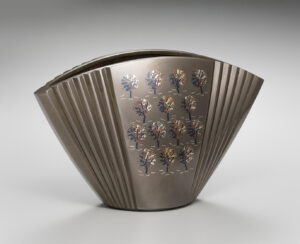
Nakagawa Mamoru (b. 1947), Living National Treasure, Flower Flower Vase Hayashi (Trees), 2019, cast alloy of copper, silver, and tin with copper, silver, and gold inlay, 22.2 x 35.6 x 7.6 cm.
Courtesy of the artists and Onishi Gallery
Some of the finest achievements of today’s Japanese metal artists were recently on view in a special exhibition at Onishi Gallery in New York, titled “Earth, Air, Fire & Water: The Four Elements of Japanese Arts.” Several of them—Osumi Yukie, Nakagawa Mamoru, Tamagawa Norio, Uozumi Iraku III, and Katsura Morihito—are Living National Treasures, while the other artists in the exhibition—Miyata Ryohei, Hata Shunsai III, Hannya Tamotsu, Iede Takahiro, Otsuki Masako, Oshiyama Motoko, and Sako Ryuhei—are great masters of the medium in their own right. All of their pieces testify to the amazing skills, refined aesthetics, and formal diversity of contemporary Japanese metalwork. The reference to the four elements has to do with the incorporation of mythic and symbolic aspects of nature in the vessels, which manage to convey in pure metal the subtle qualities of non-metallic phenomena.
Nakagawa Mamoru is recognized as a master of the technique of metal inlay (zogan), which he uses to bring an unprecedented amount of color into metalwork. He was named a Living National Treasure in 2004, at the age of 56, which makes him the second-youngest artist ever to attain that honor. The particular form of inlay that Nakagawa used is called flat inlay (hirozogan), and it involves carving out portions of the metal surface so as to make a shallow area with square sides and a flat bottom, which then receives and grips the inlay. After all the inlays are hammered into place, the entire surface of the piece is filed, burnished, and polished to complete smoothness. Nakagawa achieves his special look by creating nested inlays, one on top of the other. He uses some 250 different chisels, each for its own special purpose, which he makes himself. The base material of many of his works is an alloy of silver, tin, and zinc called shibuichi (meaning “four parts to one”), while the inlays are of gold, silver, or other variations of shibuichi. His Hayashi (Trees) Vase, made in 2019, depicts 14 trees with red blossoms and white highlights on a base of shibuichi. Kanazawa, Nakagawa’s home city, has a long tradition of hirozogan, while the artist has shown a keen interest in the metalworking techniques of Turkey, where the inlay technique is believed to have originated.
Osumi Yukie’s speciality is “textile imprint inlay” (nunomezogan), in which wire or metal leaf is hammered into a fine grid in the surface of the vessel, to create the fabric-like effect. Osumi is the first woman metalworker to be named a Living National Treasure, which occurred in 2015. She favors a silver ground highlighted with vivid dashes of gold, as in her Silver Vase Bakufu (Waterfall), from 2011, which represents the cascade with a gold inlay of such refined technique that it seems as if it had been painted. The rocks that protrude from the pool of water at the bottom of the vase are inlays of lead.
Flower Vase Yamakage (Mountain Reflection), 2009, cast alloy of copper, silver, and tin with copper, silver, and gold inlay, 27 x 27 x 17 cm.
Courtesy of the artists and Onishi Gallery
Tamagawa Norio, also a Living National Treasure, specializes in hammering, with copper as his base material, heightened with silver and shakudo (an alloy of gold and copper). He is heir to a long lineage in his art, as the Tamagawa family in 1816 founded the Gyokusendo Company, which still makes hammered copperware. In the 1960s, after completing his apprenticeship, Tamagawa Norio joined the family business, where he remained until 1996, when he left to devote himself entirely to his own work. His pieces, such as Mokume-gane Vase (2012), have a rough, earthy quality—of the four elements, they relate most to earth.
Like Tamagawa, Katsura Morihito comes from a lineage of metal masters, in his case dating back to the 17th century. The Katsura School of Tokyo was known for its tobacco cases and obi sash clips. His Silver Incense Burner (1984), made of gold, silver, copper, and shakudo, resembles a box with curved sides, and the decorative lines on its surface suggest radiating heat and smoke.
The works of Okuyama Hoseki are floral and have an ethereal lightness about them. He specializes in kiribame, a technique that involves creating designs in metal by hammering them and then cutting the design out and applying it to a different surface. His Flower Vase “Dew Grass”, made in 2003 of gold, silver, shakudo, and shabuichi, has delicate flowers over a silver ground on its main part, while the neck of the vase has black and gold portions that interpenetrate in an effect resembling stippling.
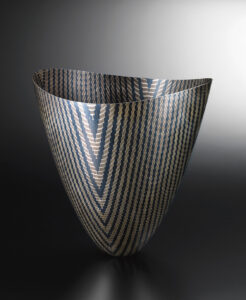
Iede Takahiro, a true innovator, has imported methods from bamboo weaving into metalwork. His technique was inspired in part by the brocade looms that, when he was growing up, he watched his grandfather make. For his own work, he uses shakudo and shibuichi, which he cuts into very narrow strips that are heated and then hammered into a woven structure. After that, Iede pours onto it a silver adhesive called ginro, which melts at a lower temperature than the woven strips of alloy and therefore flows into the grooves between them. He affixes the woven metal “fabric” onto a shaped base to make a vessel. In some, such as Vessel Hibiki (Resonance), from 2018, the striped pattern covers the entire surface of the vessel, while in others, such as Vessel Ritsu (Rhythm), from 2019, the silver is exposed at the bottom to create a two-tiered effect.
The warp and woof of Iede’s metallic weavings are like the strands of tradition and innovation that run through the modern metalwork of Japan. The loving attention to detail, the integrity, and the aesthetic vision that the artists bring to these pieces allow them to unite the human and natural realms in a way that is both contemporary and timeless.

Subscribe to Art & Antiques for your Digital or Print copy