Subscribe to Our Newsletter
Metal Star
The sculptor and interdisciplinary artist Harry Bertoia manipulated form, space, and metal to create a unique and lasting version of Modernism.
By Sarah E. Fensom
The Italian-born American artist Harry Bertoia entered into the midcentury modern design pantheon with his Diamond Chair. The famous design incorporates a bent wire-mesh grid in the form of a large diamond (with many miniature diamonds formed within the grid) supported on a rod frame. Permeable yet solid-looking, formally complex yet visually simple, “indoor” yet “outdoor,” the Diamond Chair sits at the same hallowed table as the Wassily chair, the Eames lounger, and the Saarinen “Tulip.”
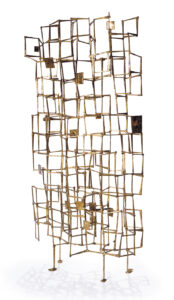
Untitled, 1953, bronze-coated iron, 33 x 17 x 10 in.
Albright-Knox Art Gallery, Buffalo, Gift of Mr. and Mrs. Gordon Bunshaft, Harry Bertoia © 2021 Estate of Harry Bertoia / Artists Rights Society (ARS), New York
Knoll released the chair in 1952. Then a growing design firm run by Florence Knoll, Bertoia’s former classmate at the Cranbrook Academy of Art in Bloomfield Hills, Mich., and her husband Hans, Knoll invited Bertoia to come East. They were based in New York and Pennsylvania; he was in California, where he had moved in the early 1940s to work with Charles and Ray Eames, also Cranbrook classmates. The open invitation asked Bertoia to design pretty much whatever he wanted. In Pennsylvania, Bertoia initially set up a woodshop, with no metalworking tools. But the artist, who had trained first in jewelry making and mastered working with metal in his sculpture practice, eventually pieced together the early wire-mesh chairs with a simple hand jig and soldering and welding tools. Meaning, in their initial run, these eventually ubiquitous chairs were unique—a form of metal sculpture with sequential logic, but subtle variation.
“In a sculpture,” Bertoia said, “I am concerned primarily with space, form and the characteristics of metal. In the chairs many functional problems have to be satisfied first…but when you get right down to it, the chairs are studies in space, form and metal, too.” The Diamond Chair was part of Bertoia’s first and only collection for Knoll (though his sculptures were later offered through the firm). But the pieces in the wildly successful collection weren’t a one-off, they were rather a part of the long, interconnected project that was the artist’s hulking career.
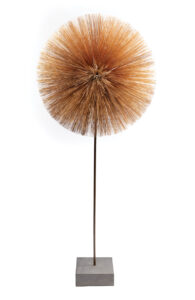
Harry Bertoia, Untitled (Sunburst), 1960, polished bronze wire and rod, 76 x 32 x 32 in.
Nancy A. Nasher and David J. Haemisegger, Collection Photo: Kevin Todora, courtesy Nasher Sculpture Center, Harry Bertoia © 2021 Estate of Harry Bertoia / Artists Rights Society (ARS), New York
Throughout his four decade-long career, Bertoia created more than 50 commissioned public sculptures that adorned or still adorn libraries, churches, office lobbies, and public plazas—many of them designed by leading 20th-century architects like Gordon Bunshaft, Edward Durell Stone, and Eero Saarinen (yet another Cranbrook classmate). Outside of these public works, he made thousands of unique sculptures, among them his signature sounding sculptures of tall, vertical metal rods on flat bases. He created the “Sonambient Barn” on his property in Barto, Pa.—a structure where he housed 100 of these pioneering sound works and staged concerts in which he played the pieces. He produced 11 albums of music made by his sculptures and created a large body of unique works on paper that he called monotypes. He even picked jewelry-making back up in the mid-1970s (his portfolio of one-of-a-kind pieces nabbed him his full scholarship to Cranbrook; he famously later made Ray Eames’ wedding band).
Still, despite the magnitude of Bertoia’s output and his nimble fusion of art, design, craft, and sound, the artist has only been the subject of one major retrospective in the United States. The Allentown Art Museum, then a new institution located near Bertoia’s home in Barto, mounted a career survey in 1975—three years before the artist’s death. Though he was widely collected during his lifetime, interest in Bertoia waned after the 1970s. A number of his large-scale commissions were eventually removed from public view as buildings changed ownership or were demolished, pieces were neglected, and the taste for midcentury modernism was supplanted by Minimalism and Conceptual Art. As with many multidisciplinary artists, the variety in Bertoia’s oeuvre made him difficult to contextualize in posterity. What’s more, the popularity of the Diamond Chair instigates a lazy comprehension of the artist as a designer.
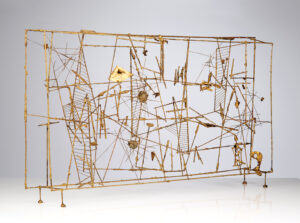
Untitled, 1953, steel base with brass melt coating, 17 3⁄4 x 29 1⁄2 x 4 in.
Harry Bertoia Foundation, Harry Bertoia © 2021 Estate of Harry Bertoia / Artists Rights Society (ARS), New York
“Harry Bertoia: Sculpting Mid-Century Modern Life,” which opens at the Nasher Sculpture Center in Dallas on January 29, is the first Bertoia retrospective in nearly 50 years and the first to examine the full scope of the artist’s broad, interdisciplinary practice. The exhibition posits that perhaps we’ve yet to comprehend the impact of Bertoia. Jeremy Strick, the Nasher’s director, writes in the exhibition catalogue that “it seems as if familiarity with his work has bred…a false sense of security in our understanding. We think we know the work of Bertoia, but how well do we really understand its scope and reach?”
“Sculpting Mid-Century Modern Life” features more than 100 works. Drawn from public and private collections throughout the country, the pieces on view examine every corner of Bertoia’s output. Included are important examples of his furniture, jewelry, works on paper, and varied sculptural production, as well as several large-scale commissions. The show boasts a significant group of sounding sculptures from the Sonambient Barn. In February, the Nasher will present a series of concerts titled “Sculpting Sound: Twelve Musicians Encounter Bertoia” programmed by writer and music producer David Breskin.
Bertoia was born in San Lorenzo, Friuli, Italy in 1915. His artistic and technical talents were recognized early, and reportedly local brides would ask the young Bertoia to embroider their wedding-day linen. When he was in fifth grade, an art teacher told his parents their son was too talented for him to teach. In 1930, rather than study art in Venice, he moved to Detroit, where his older brother had relocated. He attended a technical high school before receiving a scholarship to the School of the Detroit Society of Arts and Crafts to study painting and drawing. In 1937, he started at Cranbrook. Initially studying painting, he was convinced to re-open a metalworking shop at the school. Because of wartime constraints, he concentrated on making jewelry, which didn’t require the use of too much metal, while also experimenting in sculptural forms. One highlight of the Nasher’s show is Ornamental Centipede (circa 1942, hammered brass), a lithe and dynamic brass sculpture made during his time at Cranbrook, which is in the school’s own collection. The piece forecasts Bertoia’s inventive and abstract use of the material.

Untitled, c. 1960, brazed steel wire and rod, 53 x 88 7⁄8 x 22 in.
Whitney Museum of American Art, Gift of Dr. and Mrs. Sheldon C. Sommers Harry Bertoia © 2021 Estate of Harry Bertoia / Artists Rights Society (ARS), New York
While at Cranbrook, where he was able to make a myriad of connections and experiment liberally, he also sent 100 prints to the Solomon R. Guggenheim Museum of Non-Objective Painting for evaluation. The acquisitions director, Hilla Rebay, offered to purchase the whole group for $1,000. In 1943, 19 of those prints went on view at the museum, alongside work by Laszlo Moholy-Nagy, Charles Smith, and Werner Drewes. Bertoia’s prints, or “monotypes” as he called them, were really the evolution of his painting practice. He made these unique, handmade prints in his time off from the metal shop. Sydney Skelton Simon writes in the exhibition catalogue that Bertoia was essentially a self-taught image maker: “He worked alone in the printmaking studio at Cranbrook. No formal instruction was offered, and there was no community of printmakers—nor even any abstract painters—encouraging his efforts.” Works in the Nasher show like Untitled, a 1946 monotype on laid paper, corroborate Bertoia’s predilection for abstract, organic shapes, as in his sculpture, but also showcase his facility with color.
Two sculptures dated to 1953 are among the highlights of the show. Untitled, constructed of a steel base with Byzantine-like brass melt coating, incorporates an expressive, abstract configuration of line and ladder-like forms. Untitled, a vertically-oriented bronze-coated iron piece, stacks metal squares up and outward, creating a labyrinth of freeform cubes. These works are notable not just because Bertoia created them after his Knoll collection, when he redirected himself completely to sculpture, but also because they were made the same year as the artist’s first major public commission for the General Motors Technical Center in Warren, Mich. The center was one of Saarinen’s earliest and most significant architectural projects, and the architect conscripted Bertoia, Alexander Calder, and several other artists to develop pieces for the 25-building campus. Bertoia created a 36-by-10-foot, multiplane screen sculpture. It epitomized, as Bertoia put it in a 1955 article, “the interplay of void and matter, the void being of equal value to the component material units.”
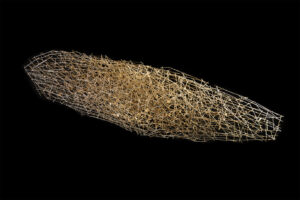
Untitled, c. 1958, bronze, 53 x 98 x 12 in
Collection of the University of Michigan Museum of Art, Ann Arbor, Michigan
In the exhibition’s catalogue, Glenn Adamson argues that Bertoia “managed to bridge the art-historical space from Abstract Expressionism to Minimalism.” An aesthetic kinship with Ab-Ex is certainly viewable in Untitled, the 1953 brass melt coated sculpture, while the General Motors screen and Untitled, the 1953 bronze-coated iron sculpture, could easily be viewed as precursors to Minimalism. But Adamson is also quick to note that Bertoia’s work, though it might bear similarities to work by, say Donald Judd, has never been formally considered a proper forerunner to Minimalism. “Bertoia did too much,” writes Adamson. His output was too varied, his materials, like bronze, were too traditional, and his pieces, though formally akin to Minimalism, were too handmade, creating a sense of uniqueness amid their serial and modular components that wasn’t in line with Minimalism’s manufactured look and philosophy. “Above all,” Adamson writes, “Bertoia sought to give too much pleasure.”
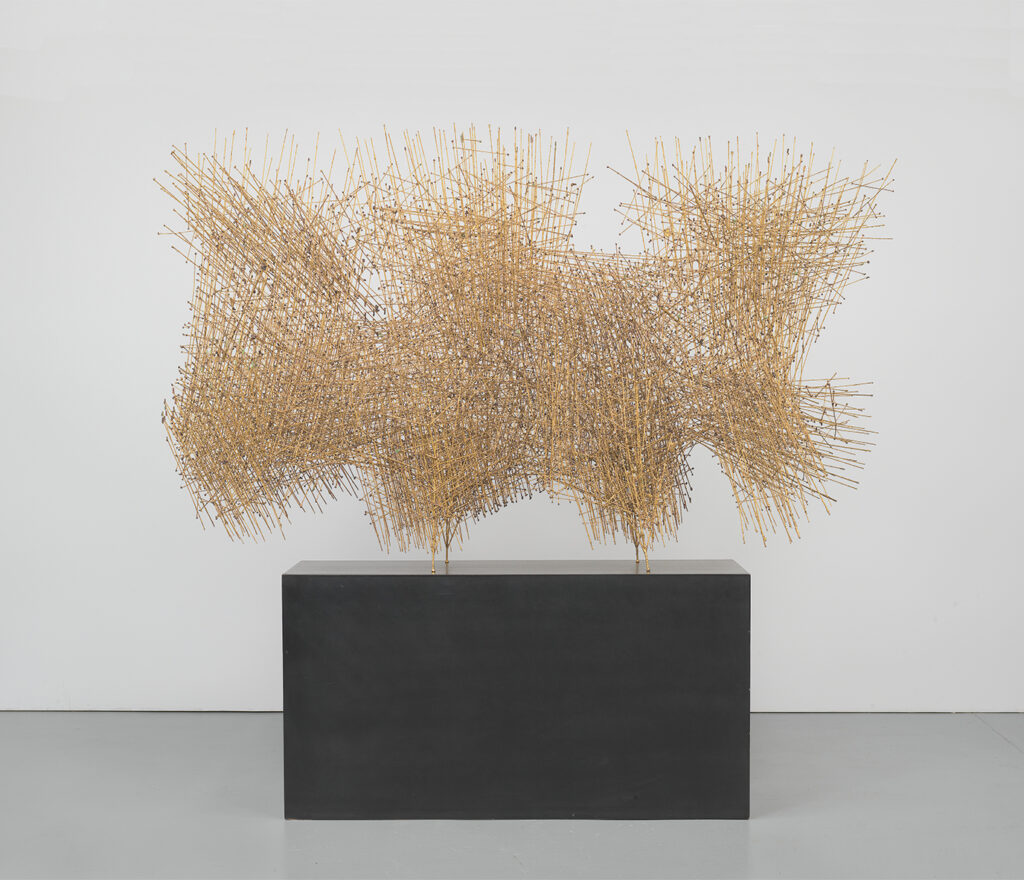
Other highlights in the show include Untitled (circa 1958), a complicated bronze sculpture that looks like a bundle of gold-hued sticks, and Untitled (circa 1960), a large brazed steel wire and rod work on a black rectangular stand that bears a similar quality. Around the beginning of the 1960s, Bertoia began creating his “bush” sculptures (he resisted naming his works, though general titles or terms sometimes stuck to his series). To create these pieces, Bertoia welded intricate arrangements of branching bronze rods to a central core, which usually consisted of copper tube.
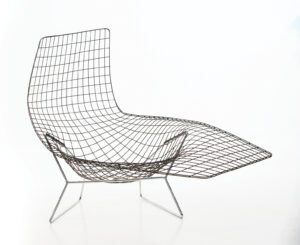
Hand Made Chair Prototype (Asymmetric Chaise Lounge), c. 1952, bronze brazed steel rods on chrome-plated steel base, 37 x 53 x 32 1⁄2 in.
Collection of Wilbur and Joan Springer Harry Bertoia © 2021 Estate of Harry Bertoia / Artists Rights Society (ARS), New York
Around the same time, Bertoia began developing his “sunburst” and “dandelion” sculptures, other series in which the artist manipulated metal into organic forms. “Bertoia was imitating the underlying logic of nature, not simply imitating its forms,” writes Adamson. “In this respect, he can be compared to others involved with ‘organic design’ at midcentury, who were similarly inspired by the integral logic of natural forms, and also to more recent designers who have employed the language of algorithmic calculation in a way that repressed biological growth processes in the digital context.” One example, Untitled (Sunburst), a 1960 polished bronze wire and rod sculpture, is a highlight of the show and the Nashers’ own collection.
The exhibition also features Hand Made Chair Prototype, an asymmetric chaise lounge dated to 1952. This piece elongates the Diamond Chair design into a form that’s even more sculptural. Like the other early prototypes for his Knoll collection, the chair is meticulously made by hand, showcasing Bertoia’s bravura facility with metal and control of space and line. Surrounded by so much of the artist’s sculptural work, it’s easy to forget one could sit in it.

Subscribe to Art & Antiques for your Digital or Print copy