Subscribe to Our Newsletter
Mothers of Abstraction
A current exhibition at the Denver Art Museum gives 12 female Abstract Expressionists the show they should have had during the art movement’s heyday.

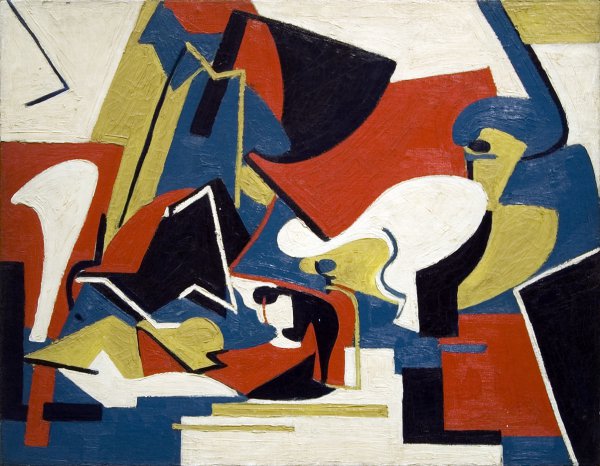
Lee Krasner, Untitled, 1942, oil paint on linen, 21 x 27 in.
-
- Sonia Getchoff, The Beginning, 1969, oil paint on canvas, 69 x 83 in.;
-
- Perle Fine, Early Morning Garden, 1957, oil paint and collage on canvas, 44 x 36 in.
-
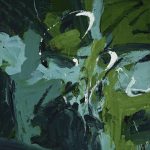
- Mary Abbott, All Green, about 1954, oil paint on linen, 49 x 45 in.
-
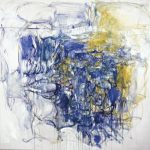
- Joan Mitchell, Hudson River Day Line, 1955, oil paint on canvas, 79 x 83 in.
-
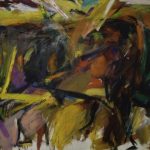
- Elaine de Kooning, Bullfight, 1959, oil on canvas
-
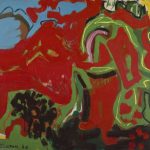
- Deborah Remington, Apropos or Untitled, 1953, oil paint on canvas, 39 x 51 in.
-
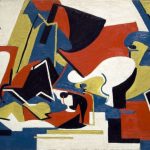
- Lee Krasner, Untitled, 1942, oil paint on linen, 21 x 27 in.
That any exhibition centering around one half of the population is necessary, can be illuminated by Linda Nochlin’s famous 1971 essay, “Why Have There Been No Great Women Artists?” Nochlin wrote, “The question ‘Why have there been no great women artists?’ has led us to the conclusion, so far, that art is not a free, autonomous activity of a super-endowed individual, ‘influenced’ by previous artists, and, more vaguely and superficially, by ‘social forces,’ but rather, that the total situation of art making, both in terms of the development of the art maker and in the nature and quality of the work of art itself, occur in a social situation, are integral elements of this social structure, and are mediated and determined by specific and definable social institutions, be they art academies, systems of patronage, mythologies of the divine creator, artist as he-man or social outcast.”
The “social situation” for women during the rise of Abstract Expressionism in America in the 1940s, was such that breaking out as a representative figure of the movement was unlikely or even impossible. This phenomenon is not particular to this movement or time period, but rather, as Nochlin notes, to the plight of women throughout art history and human history in general. Women working in abstraction took the same classes as men—be they summer courses with Hans Hofmann in Provincetown, or with Esteban Vicente or Clyfford Still—ruminated over ideas at the Cedar Street Tavern, attended meetings at The Club, and showed work at Betty Parsons and, on occasion, in notable MoMA exhibitions. Many of the most prominent female abstractionists socialized with their male counterparts, or were involved in relationships with male artists. Yet they were seen as supporting characters rather than stars because of their role as women in society rather than their levels of artistry. And thus, though female-centric museum and gallery exhibitions can be frustrating because they serve as reminders that all other shows are “male-centric,” they also create opportunities to celebrate art that was always equal, even if its creators weren’t treated equally.
“Women of Abstract Expressionism” opens at the Denver Art Museum on June 12, where it will be up through September 25, later traveling to the Mint Museum in October and to the Palm Springs Art Museum in February 2017. The show, which is the first full-scale museum exhibition of its kind, focuses solely on female artists working in the Abstract-Expressionist movement in mid-20th-century America. Over 50 paintings will be on view, by a select group of 12 artists: Mary Abbott, Jay DeFeo, Perle Fine, Helen Frankenthaler, Sonia Gechtoff, Judith Godwin, Grace Hartigan, Elaine de Kooning, Lee Krasner, Joan Mitchell, Deborah Remington, and Ethel Schwabacher.
Gwen Chanzit, the DAM’s curator of modern and contemporary art, began thinking about the show in 2008—though she says she never set out to do a “women’s show.” She had seen an exhibition in New York that included men of color and women—people whose works are rarely seen in Ab-Ex exhibitions. “This particular movement is very male-centric,” says Chanzit. “The textbooks are all about the paint-splattered man. When I started to think about who had been left out of the history of Abstract Expressionism, I realized that it was this whole group of women.” Chanzit surveyed well over 100 artists, and the exhibition’s catalogue includes over 40, but the curator chose to limit the presentation to 12 women. “The exhibition is divided into 12 spaces, and each artist has her own space,” says Chanzit. “Each one will be seen as an individual with a grouping of her own works; if we were to have 18 to 20 we couldn’t do that.” Each artist’s section has at least three major works; Krasner’s boasts seven.
Krasner, like Elaine de Kooning, is among the best-known artists in the show due in part to matrimony. Aside from being Jackson Pollock’s wife, Krasner has been widely shown at many of the most important museums in the world. Yet even in her retrospectives, which have largely been posthumous, the art-historical narrative has struggled to allow Krasner an individual identity. In the present exhibition, the seven painting on view provide a glimpse into the evolution of her work. Untitled (1942), a highly geometric oil painting on linen, nods to Cubism’s influence on the artist, while The Seasons, a 1957 oil and house paint on canvas piece that is nearly 8 feet wide and 17 feet long, is dramatically looser and more corporeal. Its pink shapes, which bring to mind the pinks in Willem de Kooning’s Woman paintings, resemble fruits swollen and heavy with ripeness.
Painted not long after Pollock’s death, The Seasons finds Krasner trying to forge her own identity—not only apart from Pollock but within a landscape of artists who were beginning to adopt signature imagery. In this painting, as well as others of the same year such as Listen and Sun Woman I, Krasner’s actual signature, scribbled in umber, is woven throughout the body of the painting. The desire to assert her individuality is not surprising. She had frequently exhibited with her husband—notably in the 1949 “Artists: Husband and Wife” show at the Sidney Janis Gallery—and recalled a studio visit from Betty Parsons in which the dealer largely ignored her in favor of Pollock.
For most of the female abstractionists working in New York—even Krasner, who seemingly had all the right connections—it was difficult to gain lasting support. Perle Fine, who was one of the only women asked to join The Club—a meeting place for artists on East Eighth Street—began showing with Parsons in 1949. Fine moved to Springs, East Hampton, N.Y., in the mid-’50s, around the same time she was dropped by Parsons for poor sales. Outside the city, Fine’s, who was heavily inspired by Mondrian’s Neo-Plasticism, had a breakthrough. Early Morning Garden (1957), an explosive oil paint and collage piece that will be on view at the DAM, substitutes natural forms for purely abstract ones. Grace Hartigan, whose bold 1960 oil on canvas New York City Rhapsody will also be on view, gained early support from the influential critic Clement Greenberg, who featured her work in a 1950 show at the Samuel Kootz Gallery. However, Greenberg withdrew his support after Hartigan introduced figuration into her canvases (which led Hartigan to call Greenberg a coward in one particularly pointed letter). Hartigan, who later received attention for her work seeming to resemble Willem de Kooning’s figurative compositions, was the only woman in MoMA’s 1958 “New American Paintings” exhibition among 16 male artists.
In San Francisco, which is the other geographical focus of the DAM’s exhibition besides New York, consistent support for female abstractionists seemed more tangible. Sonia Gechtoff—the exhibition’s bi-coastal Tiresias—enjoyed a lot of praise in the Bay Area, but after moving to New York in 1958 found that there was much less support there for female artists. Gechtoff’s richly colored 1960 oil painting The Beginning, in the exhibition, is so textural and blurred that it nearly seems like it was drawn with pastel, its composition so energetic that it seems like a shaking rendering of a cosmic explosion.
Gechtoff’s mother opened the East and West Gallery on Fillmore Street in San Francisco in 1954. Across the street was the Six Gallery, a prominent exhibition space co-founded by Deborah Remington and five men, which happened to hold Allen Ginsberg’s first public reading of Howl. Remington, who traveled extensively around Asia from 1956–58, imbued many of her subsequent canvases with influences from Chinese and Japanese brush painting. Exodus, a 1960 oil on canvas that will be in the DAM show, bears qualities of a sumi-e chrysanthemum, while Apropos or Untitled (1953), though painted before the artist’s trip, somehow suggests images of the East.
Abstract Expressionism shares several qualities with jazz. For one, its gestural spontaneity—which can be wrongly perceived as disorderly or simple—sits firmly on the bedrock of practice and honed skill. Like the musical genre, Ab-Ex is considered to be the first purely American art movement, and—as jazz did with music—shifted the art world’s center of gravity to the States. And both Ab-Ex and jazz promoted the image of the roguishly masculine freak of nature as the brilliant master of his craft. To the abstractionist or trumpet player physicality and stamina were part of the job, bad behavior an accepted occupational hazard. Pollock, who had affairs, bad moods, too many drinks, and (perhaps with the exception of his “black paintings”) a mountain of praise and recognition, was Ab-Ex’s man of action and genius. In response to Hans Hofmann suggesting he should paint from nature, Pollock is famously said to have responded, “I am nature.” But it was, in fact, Krasner who said it, or at the least recounted it, in a 1967 interview about her husband.
In a 1959 essay, the representational painter and critic Fairfield Porter wrote, “The Impressionists taught us to look at nature very carefully; the Americans teach us to look very carefully at the painting. Paint is as real as nature and the means for a painting can contain its ends.” The Abstract Expressionist artist takes on the role of nature—nature’s processes, movements, and creative powers are channeled into the act of painting and then into the painting itself. Though there may be a physical referent or memory on which an abstract painting is based—as for instance with Elaine de Kooning’s Bullfight (1959), which is inspired by bullfights the artist saw in Mexico—the gestural and corporeal nature of abstraction ensures that the image is inextricably tied to the artist’s hand, body, and mind. No other painter can create the same thing.
Barnett Newman said, “The first man was an artist.” Yet there is a group of people that is accustomed to creating something that without them couldn’t exist, a group that is born with the ability to take on the role of nature—women.
—
By Sarah E. Fensom

Subscribe to Art & Antiques for your Digital or Print copy