Subscribe to Our Newsletter
Never Too Late in Life
Grandma Moses became every American’s grandma through her quaint and poignant depictions of American life and landscapes
By Ashley Busby
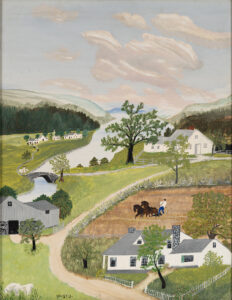
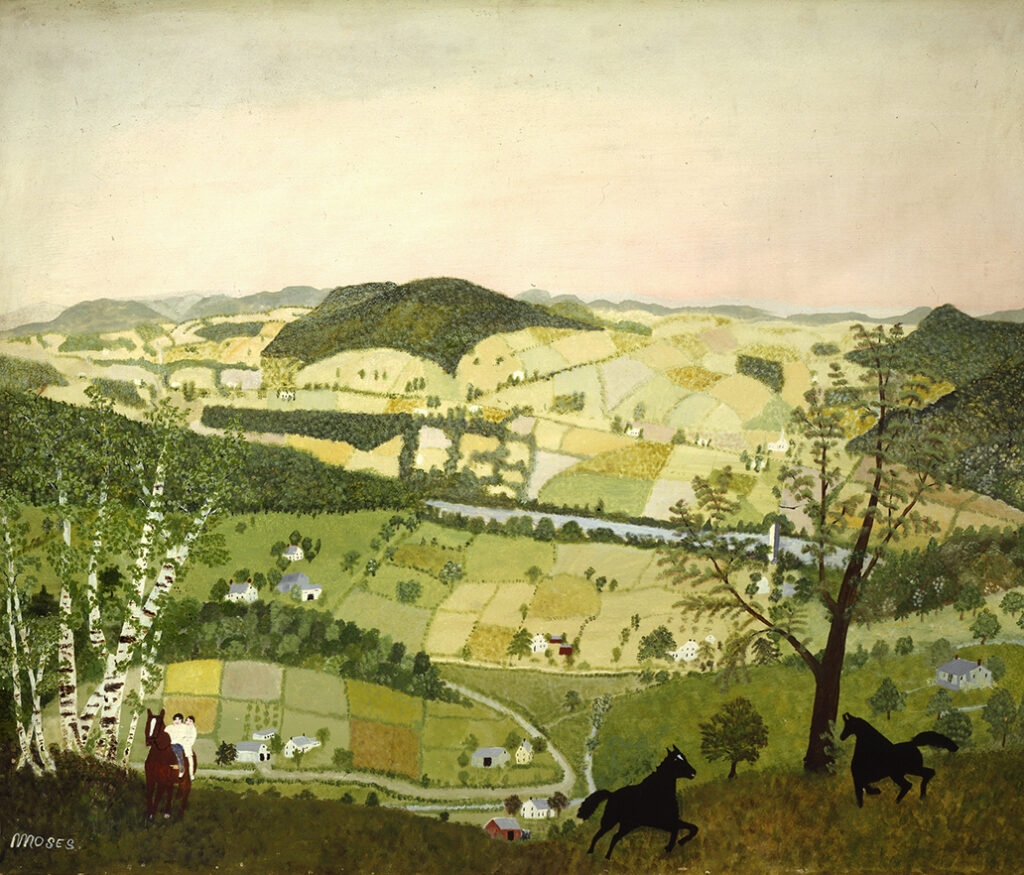
The Spring in the Evening, 1947, oil on high-density fiberboard.
In her 1952 autobiography, My Life’s History, Anna Mary Robertson Moses, wrote, “If I didn’t start painting, I would have raised chickens. I could still do it now. I would never sit back in a rocking chair, waiting for someone to help me.” For Grandma Moses, as she was popularly known, art was a new, late-in-life pursuit. She began painting in her late 70s, and it was, as she put it, a way “to keep busy and out of mischief.” While painting certainly brought her joy, it was also a part of a closely held idea that a life well-lived is one centered on work. By her death at 101 in 1961 she had produced over 1500 images.
“Grandma Moses: A Good Day’s Work” opens October 24, 2025 and remains on view through July 12, 2026 at the Smithsonian American Art Museum (SAAM). Curators reexamine this iconic American artist, recognizing the ways in which Moses’ ideas on art-making intermixed with her pursuit of creativity, labor, and the preservation of memory. Exhibited alongside photographs, ephemera, and Moses’ own words, the exhibition seeks to acknowledge the ways in which she saw herself and her work.
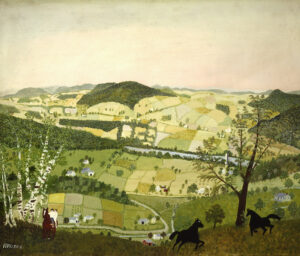
Black Horses, 1942, oil on high-density fiberboard.
Born in 1860 in rural Greenwich, New York, Moses left home and began working as a hired girl at 12. When she was 27, she married Thomas Salmon Moses, and the two settled in Virginia’s Shenandoah Valley. They established a dairy farm and had 10 children (5 survived to adulthood). Never idle, Moses also helped support the family with a butter-making business.
Eighteen years later, the couple returned to New York. Moses’ husband died in 1927, but she continued to oversee the family farm with help from her son. She also pursued needlework, embroidering pictures inspired by beloved Currier and Ives prints and postcards. When arthritis made that work impossible, she turned to painting. Her original compositions are a mix of observation, memory, national history, and family lore.
For the full story click on the link below for your Digital subscription:

Subscribe to Art & Antiques for your Digital or Print copy