Subscribe to Our Newsletter
New Nation, New Art
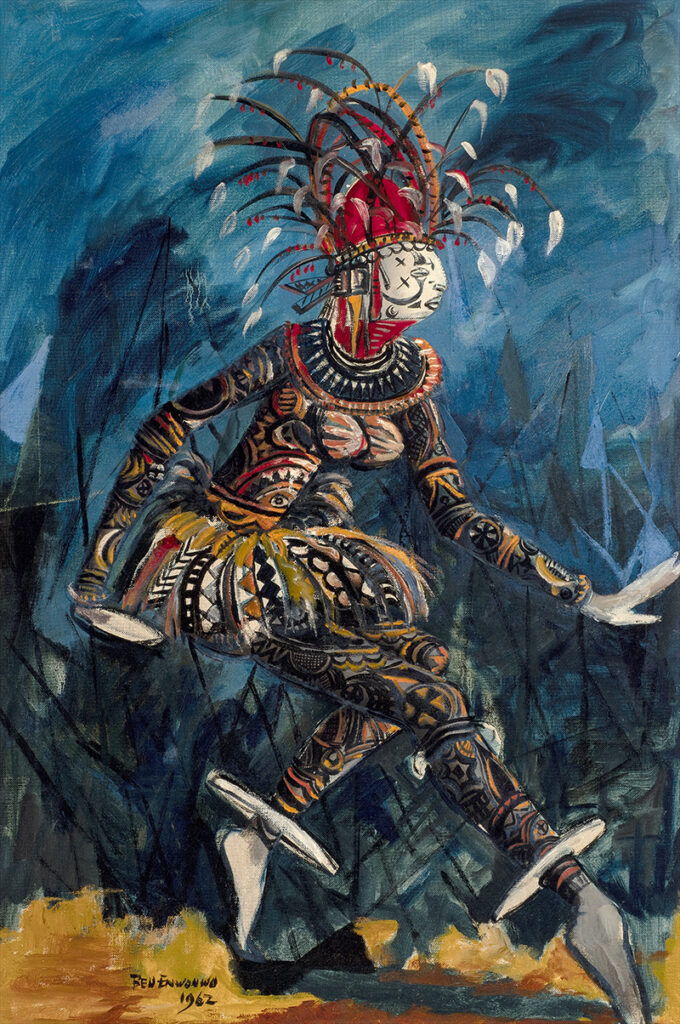
With Nigeria’s independence came new art. London’s Tate Modern tells the story of 20th-century art in the nation, highlighting unique, Pan-African aesthetics.
Written by Ashley Busby
On October 1, 1960, Nigeria established independence from British colonial rule, and just after that declaration members of the Zaria Art Society published a manifesto that charged the nation’s artists to establish a new post-colonial identity. In their manifesto, penned by the artist Uche Okeke, the members pushed for “a new culture for a new society,” one that blended indigenous and historical African art, iconography, and media with select Modernist European tactics to create new, explicitly Nigerian art.
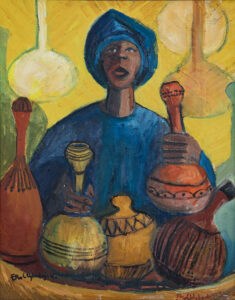
Clara Etso Ugbodaga-Ngu, “Elemu” Yoruba Palm Wine Seller, 1963.
© Clara Etso Ugbodaga-Ngu. Hampton University Museum
In succeeding years, Nigerian artists grappled with the political legacy of colonialism and created work that celebrated and unified the larger African diaspora while also revitalizing the region’s diverse pre-conquest art forms. On view at London’s Tate Modern (through May 10, 2026), “Nigerian Modernism” is the first major exhibition in the U.K. to track these developments. Including work from the 1940s through the 1990s, curators have assembled some 250 pieces by more than 50 artists. The show presents Nigerian Modernism not as a singular movement but, instead, as it reflects attempts to position Nigeria within the larger global art world. And as the country’s political situation continues to evolve, so, too, does its art.
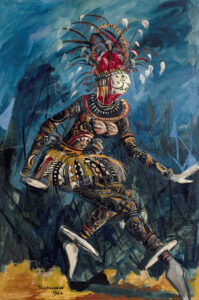
Ben Enwonwu, The Dancer (Agbogho Mmuo – Maiden Spirit Mask), 1962
© Ben Enwonwu Foundation, courtesy Ben Uri Gallery & Museum
Among the movement’s early innovators, Aina Onabolu’s paintings depicted Nigerian subjects while also upholding some of the Western techniques first introduced in colonial-era schools. Portrait of an African Man (1955) is one of several portraits by the artist where he consciously accepts Western-derived techniques but uses such tactics to express African subjects free from colonial stereotypes. Other early modern innovators, such as Justus D. Akeredolu, integrated Western training with local materials and approaches. His miniature figures allude to historical forms from the continent and are carved from the thorny protuberances found on native kapok or silk-cotton trees.
The exhibition also devotes a full section to Ben Enwonwu, often cited as the first Nigerian artist of international renown. Raised by a sculptor father and first trained at Nigeria’s Government Art College, Enwonwu went on to study at London’s Slade School of Fine Art. A burgeoning friendship with Senegalese poet and politician Léopold Sédar Senghor and a trip to the 1956 First International Congress of Negro Writers and Artists in Paris served to entrench Enwonwu within the Négritude movement, wherein his practice shifted to embrace his cultural heritage. The Dancer or Agbogho Mmuo – Maiden Spirit Mask (1962) depicts an Onishta-Igbo masquerade type who embodies ideal feminine beauty. One of several depictions of women dancers, she evokes Mother Africa, a vibrant and resilient stand-in for the continent’s past, present, and future.
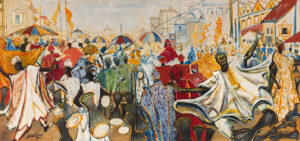
Ben Enwonwu, The Durbar of Eid-ul-Fitr, Kano, Nigeria (1955).
© Ben Enwonwu Foundation. Private Collection
Among the members of the Zaria Art Society, Jimo Akolo’s paintings stand out. Fulani Horsemen (1962) depicts people of the nomadic Islamic ethnic group found across West and Central Africa. Akolo’s keen handling of color, visual rhythm, and symmetry marries Modernism’s interest in the geometric and indigenous with Islamic aesthetic traditions.
Curators also make space for the recognition of female Nigerian Modernists. Ladi Kwali’s ceramic vessels blend British studio-pottery techniques with surface patterns derived from her Gwari origins. Over more than six decades, Nike Davies-Okundaye has explored traditional Yoruba textile formats, including adire, a form of batik or resist-dyed, indigo-printed cotton, as well as beadwork and embroidery. Animal World (1968) matches creatures drawn from Yoruba myth with hypnotic patterning and a kaleidoscopic, highly saturated
For the full story click on the link below for your Digital subscription:
color palette.

Subscribe to Art & Antiques for your Digital or Print copy