Subscribe to Our Newsletter
From Harlem to the New York School

Once overlooked, the painter Norman Lewis’ contributions to the New York School have come into the spotlight.
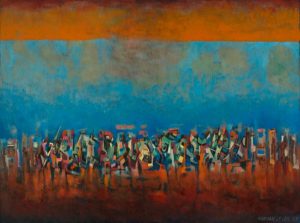
Norman Lewis, Title Unknown (March on Washington), 1965, oil on fiberboard.
-
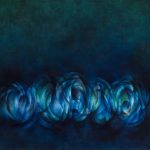
- Norman Lewis, Seachange, 1975, oil on canvas;
-
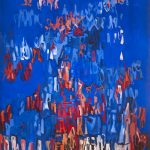
- Norman Lewis, Aurora Borealis, 1972–76, oil on canvas.
-
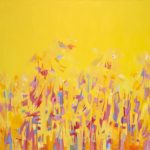
- Norman Lewis, Afternoon, 1969, oil on canvas;
-
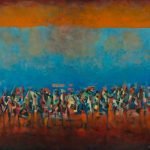
- Norman Lewis, Title Unknown (March on Washington), 1965, oil on fiberboard.
-
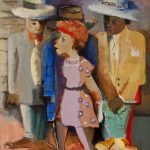
- Norman Lewis, Hep Cats, 1943, oil on canvas.
-
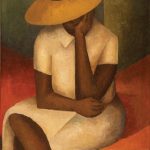
- Norman Lewis, Girl with Yellow Hat, 1936, oil on burlap;
It appears that the American artist Norman Lewis (1909–79) is having what is known as “a moment.” In Lewis’ case, the attention he has been receiving lately from the art establishment and, more precisely, from the art market, one of its biggest and most influential components, seems to be something more substantive than a mere “trending” blip on the radar screens of fickle social media. Instead, it seems to be the stuff of evolving cultural history, fueled by a recent series of high-profile exhibitions of the artist’s intriguing but still not very well-known oeuvre. Together these shows have prompted serious critical reassessment of Lewis’ contributions to modern art’s development in the post-World War II era, especially during the heyday of Abstract Expressionism from the 1940s through the early ’60s.
“Procession: The Art of Norman Lewis,” a comprehensive retrospective, was organized by and first presented at the Pennsylvania Academy of the Fine Arts starting late last year. It will be on view again at the Amon Carter Museum in Forth Worth, Tex., from June 4–August 21. Earlier this year in New York, Michael Rosenfeld Gallery, which represents Lewis’ estate, offered a fine selection of the artist’s paintings and drawings; that show coincided with a two-artist exhibition of works by Lewis and Lee Krasner at the Jewish Museum, which is also located in Manhattan. Last December, seven Lewis pieces appeared in an auction at Swann Galleries in New York, in which one of the artist’s untitled abstractions, a beige-colored, oil-on-canvas painting dating from around 1958, set a new record price for his work of almost $1 million.
Various factors may help explain why Lewis’ art has been attracting more attention from museums, collectors and the market. In recent decades, buoyed by postmodernist critical thinking, younger art historians, critics and curators—many of whom are not white and male—have looked beyond canonical art history’s pantheon and drawn attention to other innovative artists who were overlooked in the past.
As it turns out, in past decades, many of those inventive, fresh-thinking artists were female, homosexual, or black. Some came from Asian or other non-European ethnic and cultural backgrounds. Some were overlooked because they created their art in places where the mass media and mainstream institutions were less likely to become aware of them. Others, like Lewis, were well known to, friendly with, and active among their white-artist peers. Often, prominent curators, critics, and other art-world figures were aware of their activities, too.
Still, due to the prejudices that prevailed in the past, many of these artists did not earn significant critical recognition in their time as their careers were actually unfolding. Another reason why substantial bodies of work like Lewis’ are being appreciated anew is that, although many collectors might covet a painting, drawing, or sculpture by such heroic-historic figures of Abstract Expressionism as Jackson Pollock and Willem de Kooning, for all but the world’s wealthiest buyers, such works have become prohibitively expensive. Thus, a door has opened in the market for the appreciation and active handling of works of high quality by less well-known makers of abstract art from the same period.
Born in Harlem in 1909 to parents from Bermuda, Lewis grew up at a time when the New York neighborhood’s population was dominated by Italian and Jewish immigrants. (Harlem’s population changed dramatically following the so-called first Great Migration, which lasted roughly from 1916 to 1930, during which masses of Americans of African descent left the rural South and headed to urban centers in the Northeast, Midwest and West.) Even as a young boy, Lewis enjoyed making art. In high school, he studied drawing and commercial art. As a young man, after working as a cook and elevator operator, he became a merchant seaman and sailed throughout the Caribbean and to South America.
The long, tough years of the Great Depression had begun. After returning to New York, while still in his early 20s, Lewis approached the Harlem-based sculptor Augusta Savage and asked her to become his teacher. He worked in her basement studio, which she called “Savage’s Uptown Art Laboratory,” but was more interested in painting than in sculpture and eventually left. In time, Lewis taught himself to paint. Through his association with Savage, he had come into contact with such figures of the era’s Harlem Renaissance as the Jamaican-American writer and poet Claude McKay, the singer Roland Hayes, and the white writer and photographer Carl van Vechten, who became a champion of Harlem’s cultural movers and shakers.
In an interview in 1968 with Henri Ghent, who at the time served as the head of the Brooklyn Museum’s Community Gallery, Lewis recalled his childhood: “I always wanted to be an artist. […] I remember coming home and I said to my father that I wanted to be an artist, and he said this is a white man’s profession. It is a starving profession.” His parents, Lewis said, encouraged his brother to become a violinist but “couldn’t understand” his own “desire to be a painter.” He added: “I pursued [it] on my own…feeling as I did very inferior about becoming an artist, despite the fact that I eventually got a scholarship to the John Reed [Club Art] School, which I didn’t attend. I taught myself, which is a hell of a long way of going about it, because there are shorter ways of discovering what you are.”
In the early 1930s, Lewis became interested in the ideas of the Philadelphia-born philosopher Alain LeRoy Locke, one of the rare black men of his generation who had earned degrees at both Harvard University and the University of Oxford and whose vision of “the New Negro” helped fuel the spirit of the Harlem Renaissance of the 1920s and ’30s. In 1934, Lewis founded the Harlem Artists Guild along with Romare Bearden and others; that organization helped create professional opportunities for black art-makers while focusing on political and social issues affecting their community. During the ’30s in New York, Lewis also took classes at Columbia University, saw an exhibition of African art at the Museum of Modern Art that deeply moved him, taught at the Harlem Community Arts Center (where the young Jacob Lawrence was a student), and worked for the WPA as an art instructor.
As “Procession: The Art of Norman Lewis” makes clear, during the ’30s Lewis produced his own version of social-realist art. He created images like Dispossessed (1938), which showed a black couple with their belongings, stranded on a sidewalk. This picture expressed with more quiet exasperation than overt anger the artist’s awareness of the effects on his people of such abiding, pernicious forces as poverty, injustice and, of course, racism. But in such paintings as Meeting Place (1941) or Hep Cats (1943), Lewis celebrated life’s everyday pleasures and the personalities that gave his community its distinctive character, too.
In the 1940s, Lewis’ social-realist works gave way to an exploration of the language of abstraction as he found that his earlier, more explicitly political mode of making art would not vanquish racism. Still, however subtly, Lewis continued to fold references to his people’s aspirations and hardships into even his most abstract expressions, either through their titles or through certain colors and forms, which he employed symbolically. He continued refining this approach to his art, technically and thematically, throughout the rest of his career. Thus, many of his dense compositions or those in which clusters of vertical forms appear to be parading across an image’s pictorial space may be read as processions—sometimes he used the word “procession” in their titles—of human figures, evoking the marches of jobless men or of racism-weary black Americans who in hard times took to the streets to call attention to their plight and demand relief and social justice.
Lewis elaborated his abstract visual language in everything from wiry, lace-like drawings like Too Much Aspiration (1947), in opaque watercolor, ink, and graphite on paper, and luminous essays in vibrant color and form, such as the oil-on-canvas paintings Five Phases (1949) and Ritual (1962), to such atmospheric images as Study in Blue and White (1954), an oil on canvas in which a thicket of black and blue vertical shapes lumbers mysteriously through a bleached-out fog.
In the late 1940s, Lewis began a long-lasting relationship with Willard Gallery of New York; his first solo exhibition there took place in 1949. His artist friends included the abstract painter, teacher, and art theorist Ad Reinhardt, who was white, and like him and many other prominent white modern artists of the time, Lewis was a member of American Abstract Artists, a professional association that had been founded in 1936. Still, both because of his race and, ironically, probably because the abstractions Lewis was creating were not visibly “black” enough—they did not explicitly depict subject matter associated with the contemporary lives of black Americans—over time his work was overlooked. Still, Lewis embraced abstract art with gusto, reveling in the creative freedom and possibilities for personal discovery and expression it allowed. He went on to co-found SPIRAL, a group of black artists who supported the civil rights movement of the 1960s through their art, to teach at the Art Students League, and to win prestigious awards, including a National Endowment for the Arts grant and the Guggenheim Fellowship.
Jeffrey C. Stewart, a professor of Black Studies at the University of California in Santa Barbara, has contributed one of the more provocative and illuminating essays to the catalogue of “Procession: The Art of Norman Lewis.” In it, he observes that, given the nature of Lewis’ later work and the perceptions surrounding the kind of art it represented, the painter might have “seemed like an oxymoron to most people—a Negro abstract expressionist.” Stewart regards Lewis as having used “African and African-American aesthetic forms in his paintings to enact a spiritual message,” and that the artist continued to convey it, even when he “venture[d] into pure abstraction,” for his art consistently expressed the idea “that spiritual transcendence is always possible.” Indeed, Lewis’ abstract art, like that of many now-classic examples of the genre, which, critics and historians have long argued, may reflect their creators’ existential anguish or their search for soul-lifting transcendence, probably expresses and embodies more of the latter theme than the former.
About his art, in typewritten notes Lewis once observed, “It is my misfortune and probably my delight to use things as my passions tell me…. Not necessary for spectator to analyze. The ideal is when the spectator allows himself without knowing it to be engaged by the mechanism of the picture. The real function of art is to express feeling and understanding.” Unabashedly motivated by such concerns, which it still inevitably conveys, Lewis’ art may well be finding an appreciative new audience precisely because it offers some kind of antidote to the conflicted spirit of a cynical age. If so, it has earned its deserved moment in the spotlight—right now.
—
By Edward M. Gómez

Subscribe to Art & Antiques for your Digital or Print copy