Subscribe to Our Newsletter
Prints of the Modern World
An all-inclusive exhibition of Paul Strand’s work comes to Philadelphia, showing Modernism and modernity through a 20th-century lens.
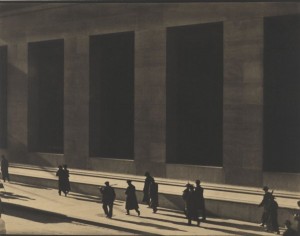
Paul Strand, Wall Street, New York, 1915 (negative), 1915 (print), platinum print.
Featured Images: (Click to Enlarge)
-
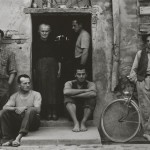
- Paul Strand, The Family, Luzzara (The Lusettis), 1953 (negative), mid- to late 1960s (print), gelatin silver print.
-

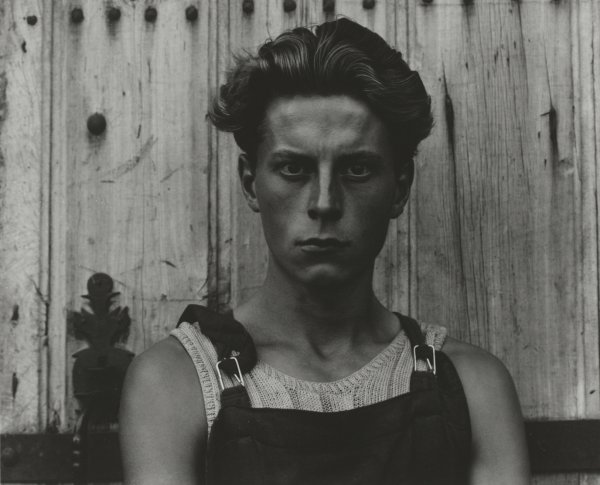
- Paul Strand, Young Boy, Gondeville, Charente, France, 1951 (negative), mid- to late 1960s (print), gelatin silver print.
-
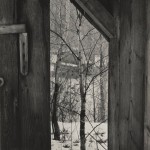
- Paul Strand, Toward the Sugar House, Vermont, 1944 (negative), 1944 (print), gelatin silver print;
-
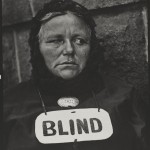
- Paul Strand, Blind Woman, New York, 1916 (negative), 1945 (print), gelatin silver print;
-
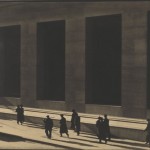
- Paul Strand, Wall Street, New York, 1915 (negative), 1915 (print), platinum print.
The Philadelphia Museum of Art is the first institution to stage a major Paul Strand retrospective in almost 50 years. It’s also the most fitting, and perhaps the only institution that could pull it off, as it has by far the largest public holdings of the photographer’s work in the world. A recent purchase of more than 3,000 prints adds to the major gift of about 600 that Strand made to the PMA after the museum staged his career retrospective in 1971, as well as other acquisitions over the years. The late Michael Hoffman, adjunct curator of photographs at the museum and former director of Aperture, initially spearheaded the relationship between the PMA and Strand. He approached the artist in 1968 with a proposal for Aperture to publish a book. He also suggested that the museum mount a retrospective. Decades later, in 2010, the PMA made a commitment to acquire Strand’s archive of prints and negatives, which had been entrusted to Aperture in an effort to keep a core group of his work together. The PMA’s collection, which now boasts some 4,000 photographs, is a rock-solid core. Peter Barberie, curator of photographs at the PMA and the curator behind this exhibition, says, “We have holdings of almost all of Strand’s output.”
As a result of the PMA’s hulking collection, the exhibition, “Paul Strand: Master of Modern Photography,” (through January 4), can span the full breadth of Strand’s six-decade long career. It will put some 250 works on display—a small slice of the collection, but a comprehensive, if ambitious, viewing experience for museumgoers. Though Strand cycled through different fascinations throughout his career—Pictorialism, Cubist abstractions, street photography, film, photobooks depicting remote places and their people—he always presents a humanist picture of an evolving, dynamic world frozen in rectangular space.
The exhibition at the PMA begins with Stand’s early forays into Pictorialism during the 1910s. While studying photography under Lewis Hine at the Ethical Culture Fieldston School in New York, Strand encountered Pictorialism on a field trip to Edward Steichen and Alfred Stieglitz’s 291 gallery, a pivotal moment in shaping his desire to pursue photography. After that visit, Strand began taking soft-lens landscapes—snowy scenes were a favorite, such as Winter Central Park, New York, from 1913–14, which is on loan from the Met—making gum bichromate prints, and eventually using the platinum process. “Through Pictorialism Strand mastered printmaking and technique,” says Barberie. “He was a very slow, methodical person. He thought about motifs and subjects, and if he liked something he would stick with it for a long time. In 1915, however, the butterfly comes out of the cocoon.”
That was the moment when Strand decided to shed Pictorialism, a choice inspired in part by a meeting with Stieglitz some time after the young photographer’s 1914 show at the Camera Club of New York. Stieglitz was critical of the prints Strand brought him, noting that many of the compositional elements were indistinguishable. Inspired by the historic Armory Show of 1913 and the motifs of contemporary painting, as well as by Stieglitz’s feedback, Strand began to play with scale and abstraction. He also started to bring some social consciousness into his work, depicting struggle and oppression in portraits and cityscapes.
When Strand returned a year later with a print of Wall Street (which would become his most famous picture) in hand, the typically ornery Stieglitz couldn’t have had much to criticize. He agreed to publish some photographs in his journal Camera Work and to give Strand a small show. In 1916, Strand brought Stieglitz Blind Woman (1916) along with some street scenes and cubist abstractions. In a dramatic flourish, Stieglitz, who was discontinuing Camera Work, published Strand’s new work in the magazine’s last issue, claiming that finally modern art had been achieved in photography. In White Fence, Port Kent, New York (1916), a photograph in the PMA’s exhibition, Strand destroys any sense of perspective, so that the white picket fence in front of the lawn almost seems pasted on top of a separate photograph. It is an image of something familiar, weathered, and American, yet its tonal planes and rhythmic patterns seem like a new invention in photographic imagery.
In 1921, Strand’s first film—and one of the earliest American artist films—Manhatta (also known as New York the Magnificent) was screened at the Rialto Theater in New York. The 10-minute work, which Strand made with artist Charles Sheeler, consisted of 65 shots of the city, compositionally abstract—both in image and structure. Though it utilized a relatively new medium, in some ways the film projected an “old-timey” air, with intertitles quoting Walt Whitman and a live accompaniment of 19th-century music during its run at the Rialto. This blending of contemporary images with traditional elements would become a thread throughout Strand’s work—particularly later in his career when he was traveling to remote or undeveloped locations to take pictures for photobooks.
In the 1920s, when he was photographing his wife Rebecca Salsbury Strand, often from extremely close angles, he was also snapping portraits of his film camera. In Akeley Camera with Butternut, New York (1922–23), which will be on view in the exhibition, there appears to be a probing fascination with the camera’s technical structure that seems akin to that of his wife’s body. Strand also made images of machines and mechanical structures, not unlike the paintings of gears by Arthur Dove, a fellow member of Stieglitz’s circle and a friend of Strand’s.
Strand continued to experiment with film. In the early 1930s, while he was in Mexico, he made Redes (released in 1936 and titled The Wave in the United States), which told of the travails of a fishing village in Mexico that had fallen under the shadow of a corrupt boss. Strand made Native Land (1942) with Leo Hurwitz after he returned to New York and established a leftist documentary production company called Frontier Films. This film dealt with American union-busting and blended fictional with documentary footage, a new concept at the time. Both films, which will be screened in parts or in full during the retrospective, give a sense of Strand’s politics and his desire to make socially conscious work. His communist and socialist sympathies would eventually drove him to decamp from the U.S. for good in the early 1950s.
A few years before his departure, Strand decided to create print publications that would marry images and text in a similar manner to his films. From 1946–47, Strand collaborated with Nancy Newhall on a project called Time in New England, which joined written excerpts with Strand’s portrayals of New England’s people, landmarks, and traditional idiosyncrasies. The result was a visual essay that bridged modern developments and long-established values. Strand repeated this formula elsewhere in the world, creating La France de profil (A Profile of France) with Claude Roy in 1952; Un Paese (A Village) with Cesare Zavattini in the Po River Valley in Italy two years later; Tir a’ Mhurain: Outer Hebrides with Basil Davidson in 1968; Living Egypt the following year; and Ghana: An African Portrait in 1976.

Subscribe to Art & Antiques for your Digital or Print copy