Subscribe to Our Newsletter
Playing with Color
For the full story click on the link below for your Digital subscription:
By Jesse Gkass
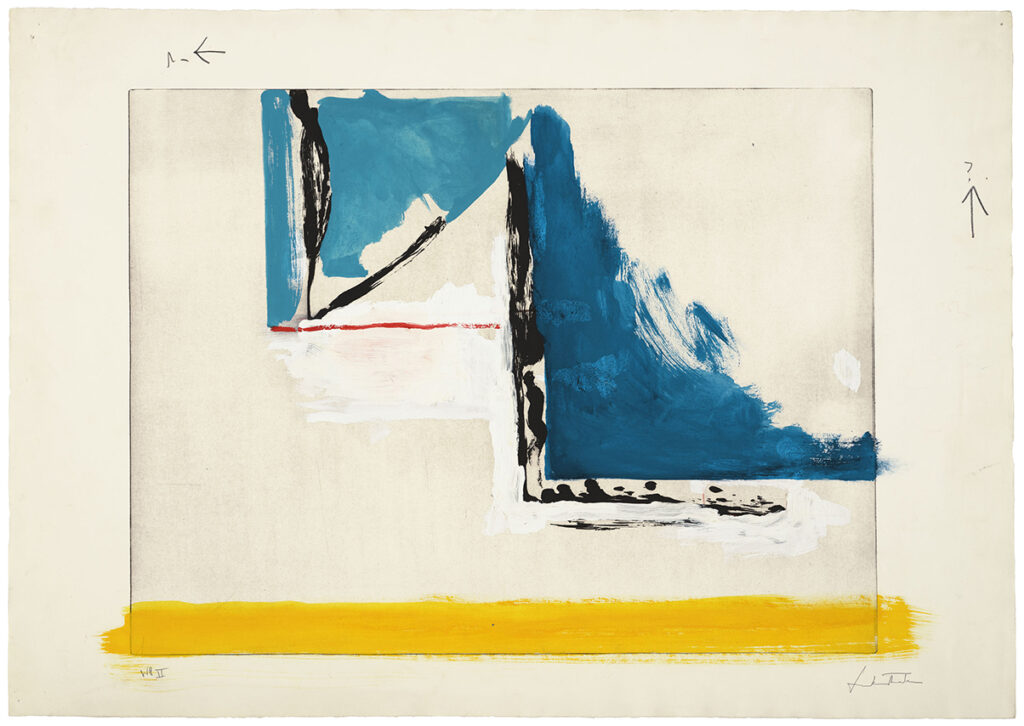
Helen Frankenthaler, who began making prints in 1961 and who is now regarded as instrumental in the postwar revival of American printmaking, called music the most abstract of all arts, and yet she transposed the feeling of music into bold, vivid works on paper. Making Music: Helen Frankenthaler Prints from the New York University Art Collection, a show at the school’s Grey Art Museum through July 3, 2027, brings together nine bright, dynamic pieces of her art. The collection aims to highlight Frankenthaler’s longtime involvement with, and physicalized interpretation of, music.
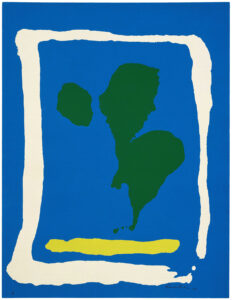
Helen Frankenthaler (1928–2011) responded to music on paper. Shown here: Air Frame, from New York Ten portfolio (1965).
Image courtesy of the Grey Art Museum, New York University
“When we first began looking at Frankenthaler’s prints in the NYU Art Collection, we were struck by her recurring musical references—an angle of her work that is rarely explored,” says Tyler Spencer, co-curator of the exhibition, along with Saskia Verlaan, Head of Collections. A screen print, for instance, that Frankenthaler was commissioned in 1978 by the Cleveland Orchestra to produce to commemorate the orchestra’s 60th season—Untitled (Cleveland Orchestra Print)—is particularly striking, with its broad, black, striped strokes that evoke a musical notation staff. By observing the way color increases left to right, one might surmise that the piece conjures music which begins quietly, builds to a crescendo, and ends fortissimo (“very loud”), illustrated by a sweep of dark and dramatic color.
“One of the greatest luxuries is to listen, and get filled with music,” Frankenthaler wrote, going on to add, “What a gift to receive! Its freedom makes you want to live because it is life; charged with energy, vitality. Moving! Inspiring.” Her enthusiasm for music is captured by the four 1987 pieces entitled La Sardana, a folkloric Spanish dance tradition. With varying vibrant colors, particularly aqua, green, and yellow, Frankenthaler’s experimentation seems to be a nod towards the many potential understandings of the community-bolstering dance. The arrows and triangular shapes could be imagined as dance-step notations, or feet themselves.
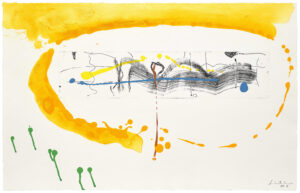
Making Music (2000)
Image courtesy of the Grey Art Museum, New York University
Her close relationships with arts institutions, music festivals, and theater, her involvements doing costume and set design, and her collaborations with other artists provided her with constant inspiration. Frankenthaler spent 10 months in 1983 working on Divertimento, with the famous lithographer John Hutcheson. The print borrows its name from a term from classical music, which translates from Italian as fun or amusement. She later related that the piece pays homage to two of her favorite composers, Joseph Haydn and Wolfgang Amadeus Mozart, with her chosen colors exuding a sense of joyousness, which those artists inspired in her.
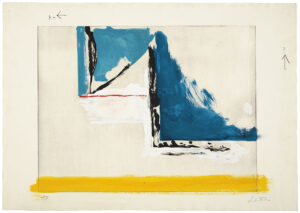
One of the four La Sardana (1987) works.
Image courtesy of the Grey Art Museum, New York University
Making Music, from which the exhibit gets its name, is the print that most clearly draws a viewer’s attention to the relationship between music and visual art. The work features a shape that resembles a musical staff surrounded by color and shapes that appear as abstracted notes. This piece had a special resonance for me, since I am a drummer in a jazz band. The phrase “play colors” comes up often. At first, it had been hard for me to understand as I was learning to play what was simply notated on sheet music. This Frankenthaler exhibition helps me understand this concept of “playing colors” more clearly. It is an artist’s job to tap into emotion and to subsequently create, embellish, and texturize.
For the full story click on the link below for your Digital subscription:

Subscribe to Art & Antiques for your Digital or Print copy