Subscribe to Our Newsletter
Quiet Revolutionaries

A new exhibition in The National Gallery of Art’s Cabinet Galleries provides an expanded view of 17th-century Dutch and Flemish painting.
By Sarah E. Fensom
In the second volume of his sweeping art-historical compendium The Lives of the Painters (1969), John Canaday includes a chapter titled “Vermeer and the Quietest Revolution.” “Of all the contrasts between schools of art in the seventeenth century,” Canaday begins, “the most extreme was surely the one between the grandiosity of official art in the princely tradition and the intimacy of the first art ever produced for consumption by burghers.” He continues: “The difference in physical dimensions between paintings that covered walls and ceilings of palaces or churches, and a painting that could be tucked under your arm and taken home and hung in your own room, was paralleled by the difference between the dramatic grandeur of an art dealing with gods, heroes, and saints, or the nature and fate of man, and the coziness of a Netherlandish art—usually Dutch—that depicted familiar scenes for their own sake.” While Rembrandt, Canaday writes, “pondered deep questions, his contemporaries by the dozen in Holland were content to record the activities, the landscape, and the appurtenances of daily life.” Citing Vermeer as chief among this new type of painter, Canaday conceded that he and his colleagues did not “think of themselves as revolutionaries (they were creating salable objects to meet an existing demand), but they were nevertheless the protagonists of a major revolution—the quietest revolution in art history.”
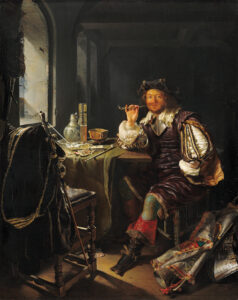
Frans van Mieris, A Soldier Smoking a Pipe, c. 1657/1658, oil on panel, overall: 12 3⁄4 × 10 in.
National Gallery of Art, The Lee and Juliet Folger Fund
This contrast that Canaday eloquently touches on—between the scale and subjects of masters like Rubens, the Flemish Counter-Reformation painter-cum-diplomat, and Vermeer, the Dutch provincial genre painter—plays out in the viewing rooms of the National Gallery of Art in Washington, D.C. John Russell Pope designed the Dutch and Flemish galleries in the NGA’s West Building, which were completed in 1941, for the grander style of paintings. He conceived of them specifically to house the large-scale paintings that belonged to the NGA’s original benefactors, Andrew Mellon and Joseph Widener. Mellon believed that these hulking masterpieces by Rembrandt, Frans Hals, and Anthony van Dyck required their own individual hanging environments. And so, Pope plotted out oak-paneled galleries with pilasters that divided the walls. The collection’s large paintings, which carried the implication of being of greater value than smaller paintings, sprawl out along the gallery walls in their own sizable and discrete planes. Pope only designed one room for smaller paintings, in which works like Mellon’s and Widener’s Vermeers were installed.
More than 50 years later, in 1995, the NGA opened its Dutch and Flemish Cabinet Galleries. Created under the guidance of Arthur J. Wheelock Jr., the curator of the museum’s Northern European Art Collection, the Cabinet Galleries provided a locus for Dutch and Flemish paintings “that could be tucked under your arm,” as Canaday put it. The new wing’s three adjoining rooms had previously been used as a storage area adjacent to the expansive Dutch and Flemish galleries in the West Building. But the museum transformed them into a cozy, wood-paneled viewing space reminiscent of the interiors of 17th-century urban homes in the Netherlands—the very spaces many Dutch and Flemish paintings were initially intended for. The wealthy mercantile class of the Low Countries commissioned works for in-home exhibition and drove the popularity of certain types of paintings—namely, meticulously rendered still lifes, genre paintings, landscape, and portraits, in a smaller-scale, “cabinet” size. In the last few decades of the 20th century, the NGA had begun to increase its store of such works. For instance, Rachel “Bunny” Lambert Mellon donated five extremely fine still lifes in 1992, including Flowers in a Basket and a Vase, the museum’s first Brueghel. These works—in contrast to the larger-scale Dutch and Flemish paintings bequeathed by Mellon and Widener—demand and reward the intimate environment the Cabinet Galleries provide.
The NGA created the Cabinet Galleries with the support of the Lee and Juliet Folger Fund and over the past two and half decades, the fund supported the acquisition of more than two dozen Dutch and Flemish paintings, as well. Now, some 26 years after the creation of the Cabinet Galleries, the NGA opens “Clouds, Ice, and Bounty: The Lee and Juliet Folger Fund Collection of Seventeenth-Century Dutch and Flemish Paintings” (October 17, 2021–February 27, 2022) in the space. This show highlights 27 17th-century paintings acquired through the fund and one painting from Lee and Juliet Folger’s own collection.
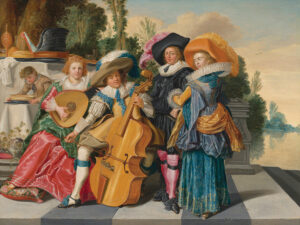
Dirck Hals, Merry Company on a Terrace, 1625, oil on panel, 15 1⁄4 x 20 1⁄4 in.
National Gallery of Art, The Lee and Juliet Folger Fund
The Folgers acquired the paintings for the NGA explicitly for the nation’s collection—meaning that none of the 27 works in the exhibition (not counting, of course, the painting in the exhibition from their own collection) have ever hung in the Folgers’ own home. Often, the Folgers have supported the acquisition of a work that the NGA was already in the process of procuring; other times, they have sought out a particular type of painting or particular artist on their own. But in a scenario in which collectors decide which paintings should go on public display in a (partially) government-funded museum, how do they choose? In the exhibition’s catalogue, Wheelock describes the Folgers’ strategy: “When assessing whether a painting is appropriate for the collection, the Folgers consider carefully the emotional impact of the art and its naturalism. They pay close attention to painting technique, admiring equally the delicacy of touch and boldness of approach, whether in a portrait, genre scene, landscape, or still life. They are receptive to works by artists previously unfamiliar to them, as long as the painting is among that master’s finest creations. If a painting meets all these criteria, the Lee and Juliet Folger Fund enables the Gallery to acquire the work so that it can be appreciated by art lovers from the United States and abroad.”
As much as “Clouds, Ice, and Bounty” is a peek into the Folgers’ work with the NGA, it’s an open window into 17th-century bourgeois life in the Low Countries. A period of relative peace and prosperity, the Dutch Golden Age was bookended by the birth of the Dutch Republic in 1588 and the Rampjaar or “Disaster Year” in 1672 (marking the beginning of multiple conflicts including the Franco-Dutch War). During this period, the Netherlands became a major maritime and economic power. With vast mercantile success came the rise of a new aristocracy and a wealthy middle class. Dutch patricians created the demand for a lively open art market that largely dismissed history painting, the genre typically thought to be of greatest importance elsewhere in Europe. That the Netherlands was primarily Protestant also meant that the bombastic Baroque style typical in Catholic countries during the Counter-Reformation period was of little interest to collectors. It was contemplative, secular subjects—scenes of everyday life or vistas of land and all important sea—that captured the Netherlandish imagination. These are the subjects that pervade the NGA’s exhibition.
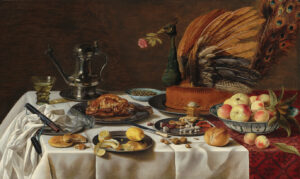
Pieter Claesz, Still Life with Peacock Pie, 1627, oil on panel, overall: 30 1⁄2 × 50 3⁄4 in.
National Gallery of Art, The Lee and Juliet Folger Fund
It is of no surprise that the show abounds with beautiful still lifes—the genre Flemish and Dutch artists elevated to its zenith. Pieter Claesz’s Still Life with Peacock Pie (1627), an early masterpiece by the Haarlem painter, is among the highlights of the exhibition. Claesz’s banquet spread features the titular meat pie decorated with the peacock’s own feathers, as well as a roasted pheasant, breads, peaches, apples, lemons, nuts, olives and candies. Many of these delicacies would have been imported and thus highlight the strength of Netherlandish trade. The scene’s vessels strike a similar tone of power and richness, with its sumptuous pewter pieces and Wan-Li bowls. The exhibition “Pieter Claesz: Master of Haarlem Still Life,” which was held in the Cabinet Galleries in 2005, sparked the museum’s desire for a work by the artist. When another Claesz painting became available on the market in 2012, it seemed an ideal choice. However, the Folgers suggested Still Life with Peacock Pie, a beloved work in the 2005 show, instead.
The Folgers discovered Clara Peeters’ Still Life with Flowers Surrounded by Insects and a Snail (circa 1610), another standout, in an auction catalogue. The small (6 9/16 x 5 5/16 in.) painting on copper panel was slated for auction at Sotheby’s London in July 2018. That this charming and colorful exploration of flowers and critters was executed by a woman artist was not lost on the collectors. What’s more, the Folgers had toured the London residence of Baron Willem van Dedem, the collector whose estate the painting had come from, just two years earlier.
Not much is known about Peeters, although she was active in Antwerp in the early 17th century and a successful still life painter. She excelled at painting flowers and likely did so from life. In the exhibition’s catalogue, Wheelock speculates that she likely consulted florilegia and scientific studies on insects. He also notes that the bouquet in this picture exhibits the obvious influence of Jan Brueghel the Elder, the “most important flower painter of the day” (Jan Brueghel the Elder joins Peeters in the exhibition with Wooden Landscape with Travelers, an oil on panel also dated to 1610). But even though “Peeters’s oval bouquet fits within a recognizable pictorial tradition,” Wheelock attests that the “symmetrical arrangement of insects and snail on the vellum-colored surround” has “no known precedent in painting.”
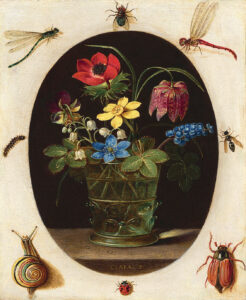
Clara Peeters, Still Life with Flowers Surrounded by Insects and a Snail, c. 1610, oil on copper, overall: 6 9⁄16 × 5 5⁄16 in.
National Gallery of Art, The Lee and Juliet Folger Fund
Among the portraiture highlights is Thomas De Keyser’s Portrait of a Gentleman Wearing a Fancy Ruff, an eight-sided oil on copper (rendered in 1627 and demurely sized at 11 x 8 11⁄16 in.). In this work, the sitter, a middle-aged man, maintains piercing eye contact with the viewer. His expression is serious, though ever so slightly softened—as if he has a witticism to share. De Keyser renders his face with a creamy fleshiness and his cheeks with an in-from-the-cold flush. His neck, of course, is encircled by a lace-tipped ruffle collar, which is as delicate and voluminous as carnation petals. Small-scale portraits like this one were De Keyser’s metier, though he painted large group and standing portraits as well.
Portrait of a Gentleman Wearing a Fancy Ruff entered the NGA’s collection at the suggestion of Ben Hall, the head of Old Master paintings at Christie’s. He had found it in a collection in Montana, to which it had passed by descent from the Count Gerard Joseph Emile d’Aquin, a buyer for William Randolph Hearst. Hall traveled to the museum with the portrait in his briefcase (a quite literal example of Canaday’s descriptor of paintings that could be tucked under the arm), and according to Wheelock, Julie Folger was immediately convinced that it belonged in the NGA’s collection.
A Soldier Smoking a Pipe (circa 1657/1658), an oil on panel by Leiden painter Frans van Mieris, was previously in the collection of August III, elector of Saxony. When the Folgers and the NGA acquired it, the painting was encased in an elaborate gilt frame from that period (the mid-18th century). Finding a more appropriate 17th-century frame for the painting became a pet project of the Folgers, who after a long search eventually located just the right one.
Van Mieris, who received patronage from Cosimo III de’ Medici, grand duke of Tuscany, and Archduke Leopold Wilhelm in Vienna, specialized in lively, convivial scenes. This work pictures a soldier seated at a table indoors in a state of satisfied relaxation. The interior, with its various accoutrements, allows for Van Mieris to mount a master class in light, texture, and surface. Writing in the exhibition catalogue, Wheelock encapsulates the scene perfectly: “Van Mieris rendered, without any visible evidence of brushwork, the smooth surface of clay pipes, the translucence of glass, the sheen of the soldier’s breastplate, and the shimmering satin of his eggplant-colored doublet with its gold-trimmed slit-sleeves. The painting’s naturalism is further enhanced by the soldier’s bemused expression and the wisps of smoke rising from his clay pipe. Light streaming through deep-set windows focuses and enlivens the composition, illuminating not only the tabletop and the soldier but also the banner, trumpet, and armor piled on the floor near his extended foot, paraphernalia indicating that the well-dressed soldier was trumpeter and standard bearer for the Leiden civic guard.” The civic guard, which was busy protecting the city from Spanish forces during the Dutch Revolt, had little to do after the Eighty Years’ War concluded in 1648. It became rather like a social club during peace years and one imagines the life of a soldier like the one pictured was considerably enjoyable.
Marine painting, both a specialty of Dutch artists and a favorite of the Folgers, is well represented in the exhibition. Among the standouts is Estuary at Day’s End (circa 1640/1645), a calm, gray-blue seascape by Simon de Vlieger, one of the most influential Dutch marine artists of the first half of the 17th century. De Vlieger also painted religious subjects, which likely explains the presence of “God rays” or “the fingers of God” in the painting’s cloud-filled sky. These thick rays of light, which illuminate the moody, cool-toned scene like a halo, create an undeniable sense of drama. Writes Wheelock about the God rays, “their presence here would have signified that God was looking out for and blessing the Dutch people as they go about their lives and work to maintain their livelihood.”
Estuary at Day’s End was the first painting the Folgers helped the NGA acquire for the Cabinet Galleries. This was in 1997, when the NGA had only two Dutch marine paintings in its collection—neither of which depicted a sense of everyday life. The work appealed to the Folgers as they had a personal interest in sailing and a fascination with the Dutch maritime world. Moreover, the way that De Vlieger’s painting exudes calm while exhibiting a divine luminescence worked its magic on them. Plus, it was the right size—19 3/4 x 28 1⁄2 x 2 5⁄8 in. A voyage had begun.

Subscribe to Art & Antiques for your Digital or Print copy