Subscribe to Our Newsletter
Romantic Realists
There’s far more to Biedermeier-era painting than domesticity and sentiment.
By John Dorfman
The term “Biedermeier” is usually applied to an almost modernistic-looking furniture design style that was popular in the German-speaking lands in the first half of the 19th century. But there is also a Biedermeier style of painting, and it is hardly proto-modern. In fact, it has often been characterized as a retrograde, petty-bourgeois, sentimentalist aesthetic, a symptom of reaction that set in after the defeat of Napoleon and the end of the Romantic era.
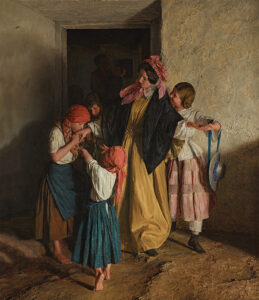
Ferdinand Georg Waldmüller, After Confirmation (The departure of the Godmother), 1859.
Belvedere, Vienna, On loan from the Society of Friends of the Österreichische Galerie Belve-dere
However, such a view is an oversimplification at best, as a new exhibition at the Belvedere Museum in Vienna argues. “Better Times? Waldmüller and Biedermeier in Vienna” (May 12–February 27) takes a close look at Austrian painting from the first half of the 19th century, through the lens of one of its greatest practitioners, Ferdinand Georg Waldmüller. The Belvedere, with the most important and comprehensive collection of Biedermeier painting, is the perfect institution through which to arrive at a better understanding of this relatively little-known aspect of art history.
Before one can understand Biedermeier painting, one must first know the historical context of the name and the concept of “Biedermeier.” The word is actually a literary inside joke, and a retrospective one at that, as it wasn’t applied to either the furniture or the art until decades later. The reference is to a fictional character, Weiland Gottlieb Biedermaier (with the “a” rather than the “e”), a bourgeois “common man” figure from a series of satirical articles in a mid-19th-century Munich newspaper that chronicled Biedermaier’s doings and featured naive poems purportedly written by him. During the 1890s, those who looked with a mixture of amusement and contempt at the aesthetic productions of the early and middle 19th-century dubbed them “Biedermeier,” with the implication that they catered to the taste of people who bore more than a slight resemblance to the silly little man from the old newspaper columns. At some point after the turn of the 20th century, Biedermeier lost most of its pejorative associations and became a descriptive term for an era in art and design.
In terms of the historical background, the Biedermeier period is sandwiched between the final defeat of Napoleon Bonaparte at Waterloo in 1815 and the outbreak of leftist revolutions across Europe (and especially in the German lands) in 1848. Those three decades were a period of comparative peace after the high drama caused first by the French Revolution and then by the Napoleonic Wars. In a sense they were a time of retrenchment during which conservative principles, epitomized by the Austrian statesman Klemens von Metternich, the chief diplomat of the Habsburg Empire and prime architect of the peace in Central Europe, held sway. The previous era had been one of intense political activism reflected in art and design; Romanticism, which went hand in hand with the revolutionary ideologies spread by Napoleon, espoused a search for mystical truth in nature, which it equated with the quest for liberation in human society. The Biedermeier period, on the other hand, saw a retreat from the public sphere and a growing emphasis on the virtues of domestic life. Cultural life and home life were intertwined more than ever, with salons becoming popular, and middle-class simplicity and coziness, rather than aristocratic panache or Romantic bohemianism, marked the mood of the time. The middle classes were rising in wealth and influence and therefore demanded an art that reflected and celebrated their values and achievements. This interiority, coupled with a love of order as a reaction to the upheaval of the previous era, was the motivating force for the low-key, graceful, and symmetrical designs of Biedermeier furniture. As for painting, artists were now interested in depicting ordinary life rather than Romantic dreams and dramas. It was a time of “cultivating one’s garden,” in the words of Voltaire’s Candide.
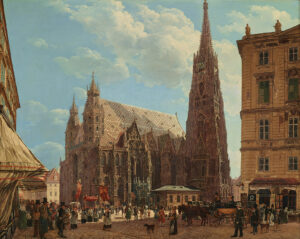
Rudolf von Alt, The St. Stephen’s Cathedral in Vienna, 1832.
Photo: Johannes Stoll / Belvedere, Vienna
Not surprisingly, genre scenes and family portraits prevailed in the German and Austrian painting of the Biedermeier period. Interiors were popular, as were subjects like flower pictures that sidestepped uncomfortable or even dangerous political overtones in a time of increased government repression. Sentiment took precedence over passionate advocacy. Still, the dichotomy between Romantic and Biedermeier can be—and often has been—taken too far. With “Better Times?”, Belvedere curator Rolf H. Johannsen calls into question the supposedly anodyne nature of Viennese Biedermeier painting by compiling a representative sampling of works, many of which, on closer examination, reveal unsuspected depths and unsettling agendas.
The emblematic figure here is Waldmüller, an artist best known for his landscapes and emphasis on observation of nature. He came into conflict with the establishment painters of Vienna for his belief in the importance of plein air work and his opposition to academic conventions. He began his career around 1810 and had a some affiliation with the Romantic movement—he was an enthusiast for the music of Ludwig van Beethoven and painted the great composer’s portrait. In his portrait work, as in everything he did, Waldmüller was a stickler for realism and precise depictions of surfaces and textures. He favored a crisp, golden side-lighting that brings out the contrast in the subject. His Self-Portrait as a Young Man (1828), in a bright yellow and green cravat and set against a rural landscape, is decidedly an image of a Romantic dandy.
Rather than depicting the bourgeois comfort said to typify Biedermeier taste, Waldmüller often chose to portray the rural poor, as in After Confirmation (1859), in which the barefooted girls wear peasant garb and emerge from what appears to be a dirt-floored house. On Corpus Christi Morning (1857) features contrasting social classes, with more than a suggestion of awkwardness. The rich girls, dressed in white with circlets of flowers on their heads, are greeted by an old peasant woman and smile at her, while ignoring the peasants of their own age. A poor girl turns away from them, wiping a tear from her eye, while a rich boy seems to taunt a poor girl who offers him flowers. While this painting, which is somewhat ambiguous, may not literally portray a Marxian notion of class conflict, it is uncomfortable enough to suggest that Biedermeier genre scenes can be more than just reassuring balm for the bourgeoisie.
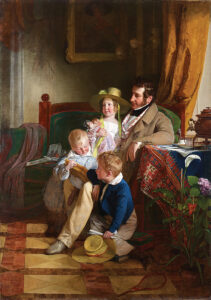
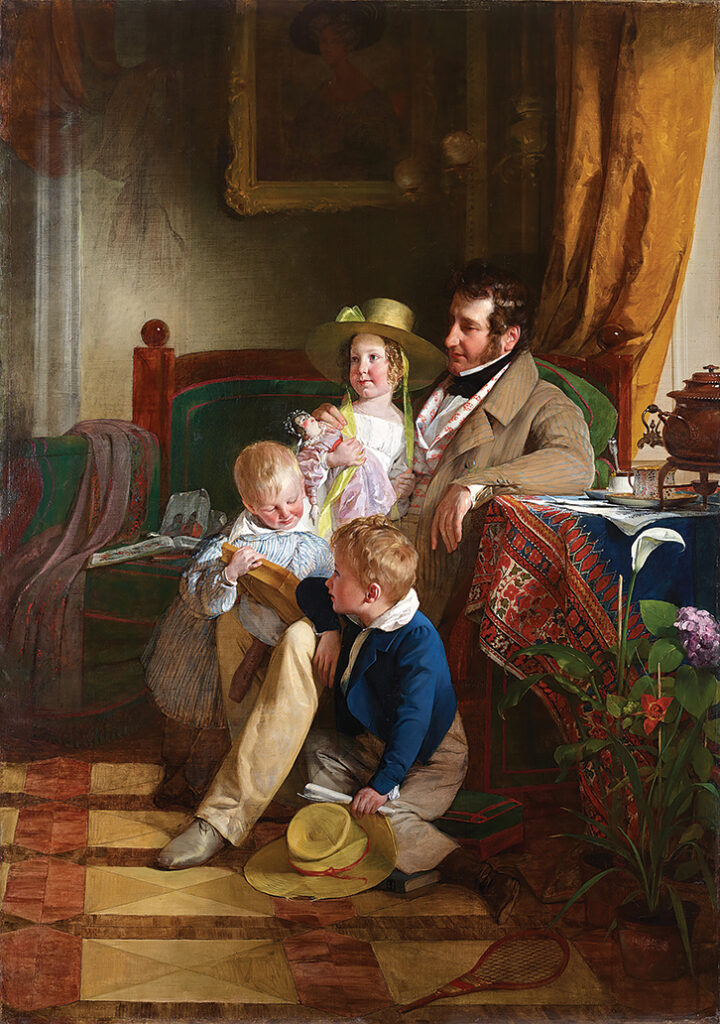
Friedrich von Amerling, Rudolf von Arthaber with his children Rudolf, Emilie and Gustav, 1837.
Photo: Johannes Stoll / Belvedere, Vienna
Waldmüller’s landscapes are interesting in that they partake of the Romantic “sublime” while also domesticating nature. His View of the Dachstein from the “Sophien-Doppelblick” Near Ischl (1835) shows a sleepy, charming country village in the middle distance, complete with thatched roofs, a very domesticated landscape. But in the far distance loom jagged, rocky mountains topped with snow, which seems very Romantic and wild. This juxtaposition of the humanized landscape with the non-human or even anti-human reveals some of the tensions inherent in Biedermeier culture. Even a flower painting by Waldmüller, Rosenstrauss am Fenster (1832), raises more questions than it answers. The pinkish-white roses are exquisitely painted, with a loving precision worthy of Albrecht Dürer, but one sags to the windowsill, imparting a suggestion of death and decay. There is a shadow over this warmly-lit still life.
Another painting in the Belvedere exhibition, Grossglockner With Pasterze Glacier (1832), by Thomas Ender, goes further into the Romantic realm of nature than Waldmüller’s View of the Dachstein. Here all human presence is eliminated, and all we see is craggy peaks full of snow and upheavals of cracked and dirty ice. The landscape seems so inhospitable to man that one has a hard time imagining where the artist would stand to make this picture. The principal emotion it evokes is not cozy cheer but awe.
A female Biedermeier painter, Pauline Koudelka-Schmerling, also used floral still life in a way that induces a bit of unease in the viewer. In her Garland With Madonna Relief (1834) the astonishingly vivid, almost trompe-l’oeil flowers contrast strangely with the monochrome stone of the religious carving. There is something eerie about the effect. It could almost be the “Nightmare Life-in-Death” that Coleridge wrote about in The Rime of the Ancient Mariner, published the same year as the painting was made, 1834.
Shades of Romanticism appear in Wallstein’s Grave (1828), a history painting by Josef Danhauser (son of the great Biedermeier furniture designer of the same name). Wallstein was a confidant of the Bohemian king Ottokar, who was at war with Rudolf von Hapsburg during the 13th century. Because of a love affair, he switched his allegiance to Rudolf and was sent on a mission to kill Ottokar. According to a legend incorporated in a heroic poem by Ladislaus Pyrker published in 1825, while on his way to perform the act of treachery, Wallstein realized the enormity of his sin and committed suicide. In Danhauser’s painting, the knight lies dead, wrapped in monk-like medieval garments, which are tugged at by his sad-eyed, faithful horse. The posture of the corpse is similar to that in Henry Wallis’ Death of Chatterton (1856), another depiction of Romantic suicide.
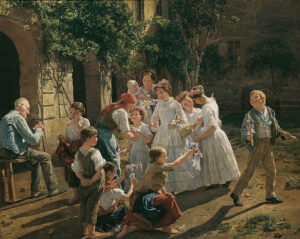
Ferdinand Georg Waldmüller, On Corpus Christi morning, 1857
© Belvedere, Vienna / On loan from the Society of Friends of the Österreichische Galerie Belvedere
In terms of style, rather than subject or subtext, the most salient trait of Biedermeier painting is meticulous realism. All the painters in this exhibition lavished intense attention and care on surfaces, small details of material culture or human appearance, and rendition of light. Yes, their works can be sentimental or flattering, as in Friedrich von Amerling’s Rudolf von Arthaber With His Children Rudolf, Emilie, and Gustav (1837), a domestic group portrait of the perfect burgher’s family, but there is something in the careful observation of everything from skin tone to fabrics to the Biedermeier chair in the background that elevates it and makes it real. Similarly, Rudolf von Alt’s The St. Stephen’s Cathedral in Vienna (1832), though painted seven years before photography was invented, has an almost photographic quality to its vision. The lens-like eye of the artist takes in everything, rendering everything from foreground to far distance with incredible sharpness. The power of Biedermeier painting lies in its ability to make the ideal real.

Subscribe to Art & Antiques for your Digital or Print copy