Subscribe to Our Newsletter
Subject and Style

A New Exhibition at the Muskegon Museum of Art Reexamines American Painting as It Confronted the Modern World and Modern Art
by James D. Balestrieri
After having a glance at the images of the artworks on the pages of this essay, you would be forgiven for flipping back to the title of the featured exhibition, “American Realism: Visions of America, 1900-1950,” and asking, in all seriousness: Just what exactly is “American Realism”? Unless, of course, we want to consider realism—and reality—in ways that exceed style and strict mimesis.
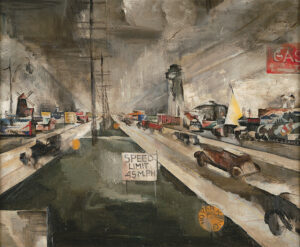
Zoltan Sepeshy, Woodward Avenue No. 11, 1931, oil on canvas, 25 x 30 in.
Collection of the Flint Institute of Arts,Flint, Michigan; gift of Pat Glascock and Michael D. Hall in memory of Collin Gabriel Hall, Inlander Collection.
By 1900, the year that marks the beginning of the period covered by the exhibition, which runs through August 27th at the Muskegon Museum of Art, photography had already made strong inroads into perceptions of verisimilitude or lifelikeness. While painters have always sought to depict the truths beneath the surface realities of the world, photography compelled them to seek new ways to do so. After 1950, Pop Art and hyperrealism would strive to reproduce reality, especially mundane reality, at scales large and small, making art out of perceived reality in order to scrutinize that reality. However, from 1900 to 1950, American artists seemed to agree on one thing—that painterly realism had to create and maintain a healthy distance and distinction from photographic reproduction.
Drawing as it does on artworks from the Detroit Institute of Arts, the Flint Institute of Arts, and the Kalamazoo Institute of Arts, as well as from Muskegon’s own holdings, one of the signal achievements of “American Realism: Visions of America, 1900-1950” is that it serves as a reminder of the strength of the collections in Michigan museums. The exhibition is divided along the lines of certain themes: “Black America,” which embraces the Great Migration and the Harlem Renaissance; “Changing Times,” having to do with the Progressive Era, urban growth, immigration, and industrialization; “New American Art,” beginning with the explosive introduction of European Modernism at the 1913 Armory Show in New York; “The Changing Face of Journalism” which describes the intersection of political illustration and the artistic urge to capture real people in everyday life; and “Women in America,” a visual chronicle of the suffrage movement and the increasing presence of women outside the home.
All but one of these themes clue us in not only to the meaning of the term American Realism but also its application. Apart from “New American Art,” the themes refer to the subjects of art, the “what,” as opposed to anything having to do with the “how” of art (e.g., style, approach, paint handling, technique, impulse, inspiration). Our outlier, “New American Art,” lets us know that Modernism will exert a heavy influence on the “how” of American Realism.
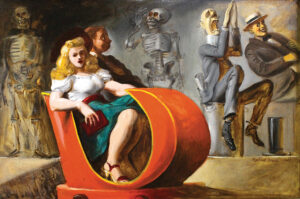
Reginald Marsh, Tunnel of Love (Spooks), 1943, oil on hardboard.
Collection of the Muskegon Museum of Art, museum purchase, through the gift of the André Aerne Estate.
Following the themes and considering the works in the exhibition in pairs offer insight into the dialogue between Realism in terms of subject and Modernism in terms of style. Beginning with “Black America,” imagine hanging Henry Wilmer Bannarn’s 1949 Ironing Day beside Charles Henry Alston’s Untitled (Couple), which was painted at about the same time, circa 1945-1950. That they were important painters of the Harlem Renaissance will come as no surprise; that they shared a studio and opened an art school together may come as something of a shock, given the disparities in their approaches. Bannarn’s version of American Realism in Ironing Day hearkens back to “The Ten,” to the gritty realties depicted in the works of John Sloan, George Luks, and others. Realism is in the details, sketched out though they may be. The woman bears down on the iron, her bare feet pressed flat against the worn linoleum. The curtains, parted to reveal a bleak factory, are threadbare; the towels are frayed. The tilted perspective increases the sense of claustrophobia.
Contrast this with Alston’s Cubistic portrait, Untitled (Couple), in which inner reality is expressed in an arrangement of planes. As close as the man and woman are physically, the realism in the portrait derives from Alston’s use of lines and colors to express the oppositions in their relationship. The woman stares out at the viewer while the man reads or dozes. Vital yellows, greens, and oranges compose and surround the woman; darker versions of those colors and a deep blue compose and surround the man, who is as exhausted, seemingly, as the artist’s palette. A thick diagonal line divides them. This, too, is American Realism, only here it is channeled through Modernism.
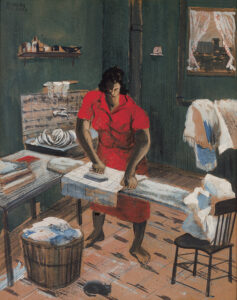
Henry Wilmer Bannarn, Ironing Day, 1949, gouache on board, 20 x 16 in.
Collection of the Flint Institute of Arts, Flint, Michigan; courtesy of the Isabel Foundation, In-lander Collection.
Though neither Virginia Cuthbert’s Movie Palace (1936) nor Zoltan Sepeshy’s Woodward Avenue No. 11 (1931) can be said to be strictly journalistic, each painting intends to chronicle a specific moment in a specific place at a specific time—journalistically, as it were. Nor does either work engage in overt politics, as we might expect from the theme, “The Changing Face of Journalism.” Cuthbert’s painting echoes aspects of the WPA photography projects—think Walker Percy and Dorothea Lange—condensing time to a glowing event horizon around the unknowable black hole of the present. She seems to want us to ask: What’s so important about this moment? and then realize that it is one of billions of present moments, the countless “nows” we go through without noticing what is around us. If you zoom in on the posters and placards in front of the “Rialto” movie theater—a “palace,” site of escape and dreams in 1936 Depression-Era America—you can read the titles of the films: Tough Guy, about a rich kid who runs away from home and finds friendship among mobsters with hearts of gold; Next Time We Love, about a well-to-do couple’s struggle to maintain their love while careers separate them; and A Face in the Fog, in which a woman reporter becomes the target of a killer. Cuthbert’s interest in the dichotomy between real life and the silver screen sees her on the cusp of her turn to magic realism later in her career.
As opposed to condensing time, Sepeshy compresses perspective in Woodward Avenue No. 11, thereby elasticizing the cars whizzing by on this famous Detroit street at speeds far exceeding the 45 MPH limit on the sign. Zepeshy, who would become Director of the Cranbrook Academy of Art, seems, in this painting, to be informed by the aim in Italian Futurism to depict speed, velocity, and the sheer vertigo of modern urban life. The subject of the painting is the speed of modernity, speed that turns reality into a passing blur. Signs and billboards compete for the attention of drivers, lining the road at either side with enticements to “Dine & Dance at the Wigwam,” drink “Strong Beer,” and buy a stole for your doll at “Marks Furs.”
Two paintings—both by men, ironically—seem to capture the spirit of the “Women in America” theme. Reginald Marsh’s Tunnel of Love (Spooks) revisits a classic Marsh subject—the Coney Island boardwalk, carnival. For Marsh, carnival finds its cognate: carne—that is, meat. In this 1943 painting, a woman—easily the most confident figure in the work—is on a date with a timid man, while a lecher in a straw hat leers ravenously. She looks out at the viewer, somewhat bored and bemused by the clumsiness of the whole scene and seems ready to break into her own rendition of “Is That All There Is?,” the classic Peggy Lee torch song. On the surface, then, Tunnel of Love (Spooks) finds us in a Hollywood horror comedy, a B-picture of the era. But the year, 1943, places the moment in the middle of World War II—a year when the outcome was far from certain. Able-bodied American men were away, leaving behind those who were too old, too infirm, essential workers, or deft shirkers. Slim pickings for young women as death, even if it takes the comic form of carnival death, hovers nearby. The work is almost amusing and yet, in the context of what was going on in countries around the world, it’s sobering. The “Spooks” in the title, perhaps, are the ghosts of the young men who aren’t there, the ghosts of war.
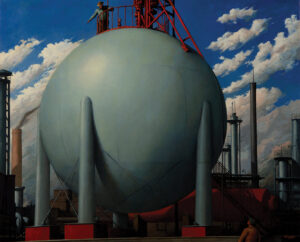
Robert Riggs, Chemical Plant, Wyandotte, Michigan, 1950, tempera on panel.
Collection of the Muskegon Museum of Art, purchased in honor of the 100th Anniversary of the Muskegon Museum of Art through the 100th Anniversary Art Acquisition Fund and the Shaw and Betty Walker Fund.
Instead of the all-male jurors seen in “12 Angry Men,” the 1957 film directed by Sidney Lumet, Pène du Bois’s 1950 canvas, Locked Jury, reveals eleven angry men and one unflinching woman. Her steely stillness tells the story; she is the lone holdout. The men are virtually indistinguishable from one another. Their identical suits, ages, and air of bourgeois respectability, nevertheless, are distorted by exasperation, anger, and the threat of violence—just look at the man at far right, fist poised to backhand the woman from behind. We know they think women shouldn’t be allowed on juries, yet her close-fitting ensemble and poise mark her as someone not to be trifled with, someone who isn’t going anywhere.
If Realism, especially American Realism, refers to subject, what then of the other “Realisms:” surrealism, hyperrealism, magic realism, photorealism, and so on? Are these, too, all about subject and not at all about style? Not really. These Realisms, once they acquire their “sur-,” “hyper-,” “photo-,” and “magic” qualifiers, share something in the space between the dreams some purport to represent and the “more real than reality” examination of everyday events and mundane objects others undertake. That something, especially after World War II, is sharp-edged drawing and flat fields of color; it is almost as if artists sought inspiration in lithography as a counterpoint to photography. Virginia Cuthbert’s late works—you should really look them up—offer excellent examples, while Robert Riggs’s otherworldly sphere in Chemical Plant, Wyandotte, Michigan, a painting done in 1950, opens the door between illustration and Pop Art. Compare Riggs’s work with Charles Burchfield’s Steel Mill Homes (Blast Furnace), a 1919 watercolor that has a kind of Merrie Melodies/1930s animation feel—the homes and factory seem as if they might come to life and sing and dance—and you will see American Realism’s “Changing Times” for yourself.
American Realism, then, might be said to start with subject and move to style, employing techniques from a medium that itself was once thought to challenge painting—printmaking—in order to subvert the authority of photography. “American Realism: Visions of America, 1900-1950” reminds us that realism, though it might seem simple, is a term that is often bandied about without much thought. But realism is much more than a representation of reality, much more than mere mimesis. The reality of the subject, it might be said, comes to life in the eye of the artist, while the realism of the artistic treatment resides in the eye of the beholder—nestled next to beauty. When it works, we become acutely aware that the “nows” of our lives are provisional moments of transitory beauty and wonder.

Subscribe to Art & Antiques for your Digital or Print copy