Subscribe to Our Newsletter
Surreal World

The Met spans the globe to reveal the unruly vastness of the Surrealist experiment over an eight-decade period.
By John Dorfman
According to a once-standard narrative, the Surrealist movement began in France
in the early 1920s, flourished in Europe and to a lesser extent in the U.S. until World War II, and then petered out in the late ’40s and early ’50s when Abstract Expressionism took over. Of course, we already know that this story isn’t true, that Surrealism never submitted to the strictures imposed on it by André Breton and that it never died. Recently, new attention paid to less-known women artists such as Leonora Carrington, Remedios Varo, and Ithell Colquhoun has expanded the Surrealist canon and made it clear not only that women were key contributors to the movement but also that places like Mexico, formerly considered to be off the Surrealist track, were actually important centers for some of its most creative practitioners.
But for the full picture of just how vast and diverse the Surrealist phenomenon really was and is, we had to wait for the new exhibition at the Metropolitan Museum of Art in New York, “Surrealism Beyond Borders” (October 11–January 30). Co-organized with the Tate Modern in London and made possible by the Barrie A. and Deedee Wigmore Foundation, it brings together a truly massive quantity of works, spanning 45 countries and eight decades. Some of these will be familiar, but most are not—viewers will likely be surprised to find out that there was Thai Surrealism, Egyptian Surrealism, and Afro-Caribbean Surrealism, among many other versions.
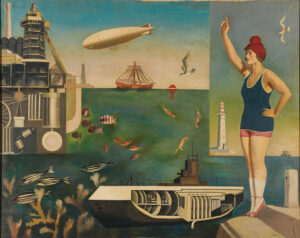
Koga Harue, Umi (The Sea), 1929, oil on canvas, 130 x 162.5 cm.
The National Museum of Modern Art, Tokyo
Met director Max Hollein says, “Surrealism is an ‘ism’ of the art world that really went global—and its universal and complex artistic language has had a lasting effect on creative imagination and production. Even those who are familiar with Surrealism will find this show to be full of surprises and discoveries. Surrealism is often presented as a canonical, monolithic movement, but in this important exhibition we see it as something more dynamic and connected, something that has enabled artists to imagine the world beyond their own artistic, cultural, social, or political situation—and continues to do so today.” The catalogue that accompanies “Surrealism Beyond Borders,” edited by the exhibition curator, Stephanie D’Alessandro, and Matthew Gale, comprises a very impressive collection of documentary and interpretive essays on many intriguing aspects of the global Surrealist phenomenon.
Surrealism was always an art of rebellion and liberation, so naturally it inspired and attracted artists from the countries that were emerging from colonialism before and after World War II. And yet with a few exceptions such as the Cuban artist Wifredo Lam, the Third World practitioners of Surrealism have been left out of the history or relegated to the footnotes. In the catalogue for “Surrealism Beyond Borders,” D’Alessandro and Gale write that their aim has been “to develop a more nuanced definition of Surrealism from the perspective of current transnational and transhistoric discussions. To do this we have suspended the well-charted narrative briefly traced here in order to challenge the hierarchies of cultural dominance that were—despite the radicalism of Surrealism—among its determining conditions, often related to race, class, gender, access, and privilege.” In other words, the European Surrealists, despite their hard-left politics, paid lip service to the idea of artistic-political liberation in the colonies while carefully guarding their own primacy as originators and arbiters of what counts as Surrealism.
A vignette from the little-known story of Surrealism in Egypt illustrates very well some of the cultural and political issues involved. In March of 1938, a cultural association in Cairo called Les Essayistes (al-Muhawilun, in Arabic) invited the Italian Futurist publicist Filippo Marinetti to speak before them. Futurism was revolutionary in many ways, but it had uncomfortable association with Italian Fascism and imperialism. Marinetti was a notorious acolyte of Mussolini, and Italy had just invaded Ethiopia, a near neighbor of Egypt. At the meeting, a Surrealist artist named Georges Henein stood up to denounce Marinetti, and before long a good number of his compatriots had also chosen Surrealism over Futurism. In December of 1938 Henein and his group published a manifesto titled “Long Live Degenerate Art,” riffing on the Nazis’ derisive epithet for modernist art.
Through the good offices of the American Surrealist photographer Lee Miller, who was married to an Egyptian and living in Cairo at the time, “Long Live Degenerate Art” was published in London in 1939 by Roland Penrose, an influential Surrealist artist and writer. As an example of the type of art being made by Egyptian Surrealists around that time, the Met show features Street Protests (1937) by Mayo (Antoine Malliarakis), a Greek-Egyptian artist who later moved to France. The painting, a large-scale horizontal canvas, dissolves the cheerfully lit outdoor scene into a chaos, with faceless humanoid stick-figures overturning tables and chairs at what appears to be a café, while some figures club others with batons. In this painting, the Surrealist project of disrupting ordinary reality and, by extension, the political order, is fully realized. In another work of Egyptian Surrealism in the show, the photograph L’entreinte (The Embrace) by the photographer couple Ida Kar and Edmond Belali (signing their work jointly as Idabel), two columns from an archaeological site appear to turn into living flesh and hug each other—surely a call to action in a nation dominated by the archaeological consciousness.
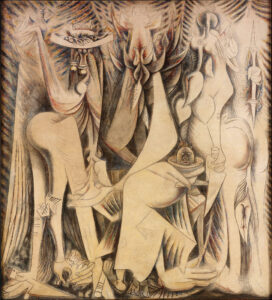
Wifredo Lam, Le présent éternel (Hommage à Alejandro García Caturla) (The Eternal Present [Homage to Alejandro García Caturla]), also known as The Eternal Presence, 1944, oil and pastel over papier mâché and chalk ground on bast fiber fabric, 216.5 x 195.9 cm.
Lent by Museum of Art, Rhode Island School of Design, Nancy Sayles Day Collection of Modern Latin American Art (66.154) © 2021 Artists Rights Society (ARS), New York / ADAGP, Paris. Photography by Erik Gould, courtesy of the Museum of Art, Rhode Island School of Design, Providence
Latin American Surrealism has been fairly extensively written about and exhibited lately, but there is always more to discover, and the Met’s exhibition presents some very important and fascinating works. Leonora Carrington’s Chiki, Your Country (1944) is an artistic expatriate’s paean to her newfound land, titled with reference to her husband, Emerico “Chiki” Weisz, a Hungarian-born photographer. The artistic couple themselves ride in a strange vehicle over the magical land of Mexico, led by a fantastical creature dangling from a kite. Beneath them, the ground opens up to reveal an underworld populated by occult symbols and figures of women, presumably the source of artistic inspiration in the creative unconscious. Since Carrington and her circle female friends were at the time playing a major role in defining Surrealism in Mexico, it seems likely that the symbolic realm depicted here is one that she believed women had special access to.
Another European-born Surrealist who migrated to Latin American was Eugenio Granell, born in Spain. A journalist and teacher as well as a painter, Granell became a spokesman for Guatemalan Surrealism in the 1940s, championing indigenous cultures as essential ingredients in a genuine national art. As in many countries, nationalism and internationalism vied with each other for cultural dominance in Guatemala, and Granell found himself on the wrong side of the local Stalinists. He fled to Puerto Rico, where his career again prospered. His painting The Pi Bird’s Night Flight (1952), a boldly delineated, archaic-looking rendition of a bird that evokes Pre-Columbian imagery, reflects the joy and relief he felt when he arrived in his new home.
Many other efforts in Surrealism are on view, by no means all from the former colonialist countries. The early Japanese Surrealist Koga Harue’s Umi (The Sea) caused a sensation when it appeared in 1929. A proponent of “Scientific Surrealism,” Koga filled the painting with mechanical elements, such as the submarine, the Zeppelin, and the factory, all seemingly directed by the swimsuit-clad woman at the far right. The segmentation of the pictorial space combined with the seeming blurring of the boundaries between human and machine gives the painting the desired uncanny effect, a hallmark of Surrealism. Japan in the 1920s was dealing with the rapid encroachment of modern technology, and Koga’s collage-like imagery both affirms it and raises questions about it. Umi caused a lot of discussion among artists at the time, with the proletarian socialists denouncing it as bourgeois escapism. Koga died in 1933, and Japanese Surrealism was generally suppressed during the militarist regime.
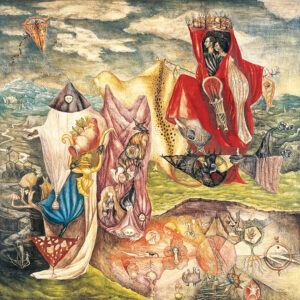
Leonora Carrington, Chiki, ton pays (Chiki, Your Country), 1944, oil, tempera and ink on canvas, 89.5 x 90.2 cm.
Private collection, Mexico City © 2021 Estate of Leonora Carrington / Artists Rights Society (ARS), New York. Photograph courtesy of Sotheby’s
Portugal, Serbia, Turkey, Thailand, Ethiopia, England, France, the U.S.—all contributed to the Surrealist movement. In addition to the new discoveries, this sprawling exhibition gives us a chance to revisit some classics from Western Europe, such as Giorgio de Chirico’s Dream of Tobias (1917), an eerie canvas starring a giant metronome with the artist’s trademark piazza galleries miniaturized in the background. While not a Surrealist himself, de Chirico was considered a predecessor and an inspiration by the Surrealists, and looking at this image, it is not hard to see why. French artist Marcel Jean’s Surrealist Wardrobe (1941) depicts a complex system of wooden doors penetrated by hinged panels, all of which open up to reveal a sort of Narnia within. Here is a perfect Surrealist image, taking things that are quite ordinary in themselves and making them extraordinary.
A perfect illustration of the ongoing appeal of the movement across time and place is a massive cadavre exquis—“exquisite corpse,” or collaborative Surrealist artwork—spearheaded by the American poet Ted Joans and featured in “Surrealism Beyond Borders.” Long Distance, a 36-foot-long accordion-folded drawing, was created from 1976–2005 by 133 artists from around the globe. Joans was a world traveler whose motto was “jazz is my religion, Surrealism is my point of view,” and he took the drawing with him through sojourns in London, Lagos, Dakar, Marrakesh, New York, Rome, Berlin, Mexico City, Toronto, and other destinations. Ultimately, it was finished two years after Joans’ own death, a testimony to the vitality and continuity of Surrealism, literally beyond borders. By discovering the magical in the everyday, excavating the roots of creativity, shaking up the established order, and insisting on freedom, Surrealism has found eager advocates all over the world for almost a century, and in some form or other it will certainly continue to do so.

Subscribe to Art & Antiques for your Digital or Print copy