Subscribe to Our Newsletter
The Great Spiritual

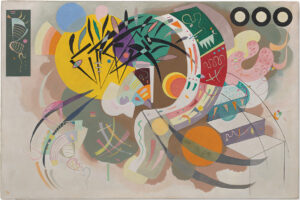
Dominant Curve, April 1936, oil on canvas, 129.2 x 194.3 cm.
Solomon R. Guggenheim Museum, New York, Solomon R. Guggenheim Founding Collection 45.989 © Vasily Kandinsky, VEGAP, Bilbao, 2020
An exhibition at the Guggenheim Bilbao gives occasion to reflect on Kandinsky’s message for the 21st century.
By John Dorfman
Vasily Kandinsky certainly needs no introduction. More than a century ago, he was one of the first artists to paint abstractly, and his theoretical writings not only explained the meaning of the new art but inspired generations of future artists to see the world and their task in a new way. Nonetheless, opportunities to see large concentrations of Kandinsky’s work don’t come along often, and fortunately, an exhibition has just opened at the Guggenheim Museum Bilbao, in Spain, that enables viewers to experience its power and freshness first-hand. Titled simply “Kandinsky,” it assembles works spanning 1907 to 1943, most of the artist’s career, with an emphasis on his path-breaking abstractions of the period from 1912 through the 1920s. Sponsored by the BBVA Foundation, the exhibition is drawn mainly from the collection of the Guggenheim and was organized by Megan Fontanella, Curator of Modern Art and Provenance at the Solomon R. Guggenheim Museum in New York. It will be on view through May 23, 2021.
The Guggenheim has a long and deep association with Kandinsky that makes it the ideal institution to mount a show such as this one. For one thing, its Kandinsky collection, consisting of over 150 artworks, is the world’s richest. Beyond that, though, it would not be an overstatement to say that the museum owes its very existence to Kandinsky. In 1927, the American businessman and collector Solomon R. Guggenheim was converted to the cause of modern art by Hilla Rebay, a German baroness, artist, and art promoter who had come to paint his portrait. Guggenheim, who previously had collected Old Masters, now fell under the spell of Rebay’s enthusiasm for what she termed “non-objective painting.” This kind of art—essentially abstraction without any vestige of representations of the visible world—was precisely that which was pioneered and championed by Kandinsky. Rebay was a passionate advocate of Kandinsky’s work, and in 1929 Guggenheim, who by now had retained Rebay as his art adviser, purchased his first Kandinsky painting, shortly afterward meeting the artist himself. Guggenheim’s collecting and Rebay’s curatorial direction bore fruit in the form of the Museum of Non-Objective Painting, which they founded in 1939 in New York. This institution, which lasted for 15 years, was the forerunner of the Guggenheim Museum, and its holdings passed to the Guggenheim when the latter opened in 1959.
Kandinsky was born in Moscow in 1866 into a privileged family; his father was a tea merchant. He came late to art, when he was 30, and did not begin to make the works he is most famous for until he was in his 40s. At university he studied ethnography, economics, and law, and his first career—quite a successful one—was as a lawyer. However, he gave it up to reinvent himself as an artist. From early childhood had been interested in color, but it was the experience of seeing Claude Monet’s Landscape With Haystack at an exhibition of French Impressionists in Moscow in 1896 that made him want to make art himself. Not only that; it also provided the germ of his concept of abstraction. “Previously, I had known only realist art,” he wrote in 1913 in an essay called Reminiscences. “And suddenly, for the first time, I saw a picture. That it was a haystack, the catalogue informed me. I didn’t recognize it. I found this nonrecognition painful.…I had a dull feeling that the object was lacking in this picture. And I noticed with surprise and confusion that that the picture not only gripped me, but impressed itself ineradicably upon my memory….Painting took on a fairy-tale power and splendor. And albeit unconsciously, objects were discredited as an essential element within the picture.”
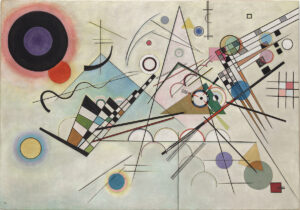
Vasily Kandinsky, Composition 8, July 1923, oil on canvas, 140.3 x 200.7 cm.
Solomon R. Guggenheim Museum, New York, Solomon R. Guggenheim Founding Collection, By gift 37.262 © Vassily Kandinsky, VEGAP, Bilbao, 2020
At around the same time, Kandinsky had another formative-transformative experience—hearing a performance of Richard Wagner’s opera Lohengrin. As the music played, he saw colors in his mind, and “wild, almost crazy lines were sketched in front of me.” It became clear to him “that art in general was far more powerful than I had thought, and on the other hand, that painting could develop just such powers as music possesses.” Throughout Kandinsky’s life as an artist, music would continue to be extremely important to him. He incorporated the concept of synesthesia into his art theory, and a creative friendship with the composer (and sometime painter) Arnold Schoenberg inspired him greatly in the years to come.
Kandinsky chose to study art in Munich, Germany, then a center of avant-garde art and design, rather than in Russia. At first he studied on his own but soon was admitted to the Munich Academy, where his teacher was Franz von Stuck, a Symbolist and leader of the Munich Secession. In the Bavarian capital, Kandinsky fell in with a group of like-minded young artists, including the Germans Franz Marc, Gabriele Münter (with whom he had a romantic relationship), and August Macke and the Russians Alexei von Jawlensky and Marianne von Werefkin. They called themselves the Blue Rider group (Der Blaue Reiter)—after a 1903 painting by Kandinsky showing a mysterious man clad in blue mounted on a horse charging across a field—and put out a publication called the Blue Rider Almanac, which combined essays on art and music with prints of their artworks. It was during this time that Kandinsky began his journey toward abstraction, increasingly moving away from naturalistic depiction and emphasizing the expressive properties of colors in themselves, apart from the colors of the things in the “real world” that they may be depicting. In fact, Kandinsky’s first major theoretical writing on abstract art, the book On the Spiritual in Art, was published in 1911, before his first fully abstract paintings. Works in the Guggenheim Bilbao exhibition such as Landscape With Factory Chimney (1910) still retain enough suggestion of the nominal subject to be readable as figurative painting; in this one, the landscape and the buildings appear engulfed in rainbows, as if the material world were being transformed into a spiritual one, or being seen with eyes of the spirit.
In 1912–13, Kandinsky made the breakthrough into fully abstract, or “non-objective” painting. In the battle of the “firsts” that critics and historians like to wage, Kandinsky certainly has a credible claim, along with Frantisek Kupka, Robert Delaunay, Arthur Dove, Hilma af Klint, Kazimir Malevich, Stanton Macdonald-Wright, Morgan Russell, and a few others, but primacy is not the point. Abstraction was happening right before World War I, in several places simultaneously, for a number of reasons that go beyond the perceptions and talents of any one person. Besides, Kandinsky was not interested in claiming intellectual property rights over abstract painting. That would have made no sense, given that he believed abstract art was the expression of a universal perception that transcends the individual. For Kandinsky, the forms and colors of abstract art were eternal things that inhabit a pure realm of ideas. In On the Spiritual in Art, he asserts that the motivating force behind true art is “inner necessity,” not practical needs such as representation and communication and certainly not imitation of the outer forms of other artworks. He analyzes inner necessity under three aspects—that the artist must express that which is specific to his personality; that which is specific to his or her own time and place; and that which is specific “to art in general (element of the pure and eternally artistic, which pervades every individual, every people, every age…and which, being the principal element of art, knows neither time nor space).”
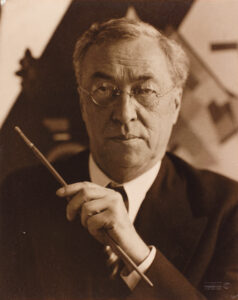
Hugo Erfurth, Portrait of Kandinsky.
Paris, Centre Pompidou – Musée national d’art moderne – Centre de création industrielle, Photo (C) Centre Pompidou, MNAM-CCI, Dist. RMN-Grand Palais / Guy Carrard © Vasily Kandinsky, VEGAP, Bilbao, 2020
It should be pointed out that Kandinsky never insisted that abstraction was the only way to heed the call of inner necessity, even in his own time. But it was his way, and he identified it as the particular achievement of the modern era in art. His work from 1912 and after explores the depths of pure form and color in an absolutely unique way, with a sense of freedom and vibrant emotional power that simply has to be seen to be believed. Despite the huge expense of effort Kandinsky put into his writings, no theory is necessary to appreciate and understand his painting. As he advised viewers in an article late in life, “Open your ears to music, your eyes to painting. And don’t think! Examine yourselves, if you like, when you have heard and seen. Ask yourselves, if you like, whether the work of art has made you free in a world unknown to you before. And if it has, what more do you want?”
Kandinsky’s “Improvisations,” aptly named, approach closest to music; in Improvisation 28 (1912), the black lines convey a lyrical sense of vibration and movement against a background of colors in both harmony and dissonance. On the other hand, the “Compositions,” of which Kandinsky made only 10 in his lifetime, are his most finished and complex productions. Composition 8 (1923), is panoramic canvas, six feet wide, in which hard-edged geometric elements in various colors interpenetrate in an almost neutrally colored flat field. As explained in his theoretical writings, Kandinsky used abstract shapes in a symbolic manner—indeed Platonic-Pythagorean—manner, with the circle representing eternity, the square solidity, and the triangle energy, evolution, and aspiration. The direction of a triangle was particularly significant for the artist, and in Composition 8, the fact that the triangle is upward-pointing signifies spiritual evolution.
When World War I began, Kandinsky had to leave Germany and return to Russia. Several of his friends from the Blue Rider group were killed in the war. Back in Russia, he continued to develop his art, resisting the Constructivist strain in abstraction, as its essentially mechanistic quality ran contrary to his Romantic spirit. He did not flee Russia at the Revolution, but by 1921 the Soviets’ initial embrace of avant-garde art was on the wane, and Kandinsky returned to Germany, accepting a position as a teacher at the Bauhaus in Dessau. At the avant-garde art and design academy he developed his theoretical treatise Point and Line to Plane (1926), which had a more explicitly mathematical orientation than his previous book and became part of the Bauhaus curriculum. It was during this time that he met Solomon Guggenheim, who purchased Composition 8 directly from the artist. Kandinsky’s Bauhaus period, and his life in Germany, came to an end in 1933, when Hitler came to power and the Nazis shut the Bauhaus down.
Kandinsky and his wife, Nina, took refuge in Neuilly-sur-Seine, a suburb of Paris, and this is where he spent the remaining 11 years of his life. In France, he continued to be creative as both an artist and a writer, despite becoming somewhat more reclusive than during his busy German years. Although a great innovator and elderly besides, he was by no means impervious to influence from younger artists, such as Joan Miró, Jean Arp, and the Surrealists. They inspired him to make abstract paintings in which the forms are much more explicitly biomorphic than before, as is clearly visible in works such as Dominant Curve (1936) and Fragments (1943). The personal hieroglyphs included in in these paintings have something of the enigmatic quality of Surrealist automatism. The palette of Kandinsky’s late works features dark backgrounds and pastel-like pinks, turquoise, gold, and other hues that recall the Russian folk art that the artist had always held dear. In his earliest figurative work, such as the woodcut Church (1907), he had used these themes explicitly; in the last works, such as Around the Circle (1940), they return transformed into abstraction, as if they had passed through another dimension.
Like quite a few of the artists who pioneered abstraction, Kandinsky was strongly influenced by esoteric and mystical thought, in particular the Theosophy of Madame Blavatsky and the Anthroposophy of Rudolf Steiner. This gave his art a millenarian quality, a sense that its purpose was not just to give aesthetic stimulation but to change the world for the better. This sense of mission was very much shared by Rebay and informed the founding of the Guggenheim’s precursor institution, the Museum of Non-Objective Painting.
As the 20th century dawned and art underwent a radical shift, Kandinsky was convinced that what he called “the epoch of the great spiritual” was at hand. In On the Spiritual in Art, he quotes Blavatsky saying that “in the twenty-first century this earth will be a paradise by comparison with what it is now.” If that prophecy is to come true, it will have to be much later in the century, but without a doubt there is something about Kandinsky’s art that bears a message for today. More than most of the founders of abstraction, he infused his work with a feeling of joy and freedom that transcends its time and place and inspires artists to look within and find their own inner necessity.

Subscribe to Art & Antiques for your Digital or Print copy