Subscribe to Our Newsletter
The Message of the Medium
An exhibition at the Museum of Fine Arts, Boston, shows why some consider Winslow Homer the greatest American watercolorist of the genre
By Fred Voon
The art of Winslow Homer (1836–1910) is well known, but his mind is a bit of a mystery. Famously reclusive, he left no diaries, avoided mingling with other artists, and had no patience for explaining his work.
The Dunes (1894) illustrates two women on Old Orchard Beach, Maine, close to Homer’s residence in Prouts Neck.
When a few women—clutching their pearls, no doubt—inquired, after a lecture he had delivered, as to the fate of the sailor tossed by the waves and taunted by sharks in The Gulf Stream (1899), Homer replied to the gallery, “I regret very much that I have painted a picture that requires any description.” When a devoted critic proposed a biography, the idea was instantly shot down: “I think that it would probably kill me to have such a thing appear—and as the most interesting part of my life is of no concern to the public I must decline to give you any particulars in regard to it.”
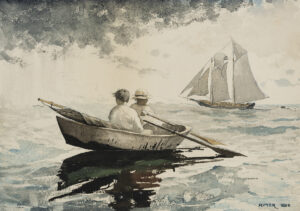
In Two Boys Rowing (1880), the weight of the boat’s reflection is offset by the ominous clouds above.
Notably, Homer’s retreat from public life in his late 30s was accompanied by an immersion in painting with watercolors that endured for three decades. The masterworks that emerged are the focus of “Of Light and Air: Winslow Homer in Watercolor” (November 2, 2025–January 19, 2026) at the Museum of Fine Arts in Boston, the city of his birth. Close to 50 of his watercolors—the largest such collection in the world—are on display, along with early illustrations and a handful of oils. Owing to the sensitivity of watercolor to light, this is the first time in nearly half a century that these paintings are being exhibited en masse.
The second of three sons, Homer grew up in a household that encouraged his pursuit of art. His father, Charles, was a businessman whose risky ventures, including in the California gold rush, mostly foundered. His mother, Henrietta, a botanical artist, taught him to draw and paint, and introduced him to watercolor at an early age. After her death in 1884, Homer continued to display her paintings in his studio. They were the only art he ever collected.
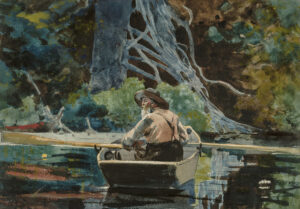
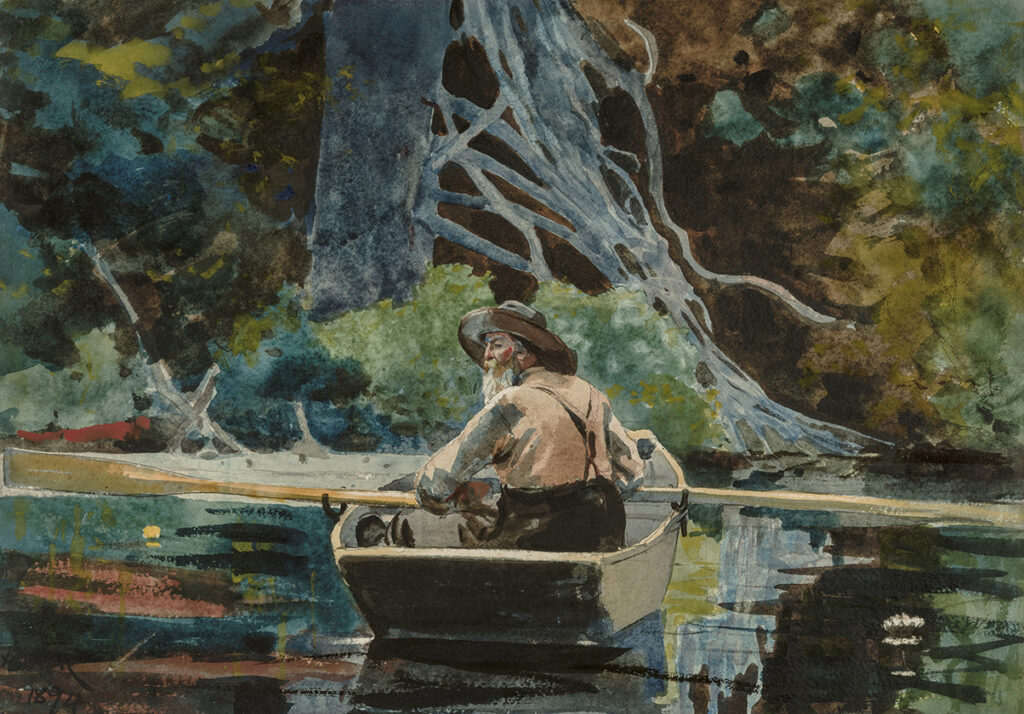
The Adirondack Guide (1894) portrays Homer’s guide Rufus Wallace with a spectacular reflection of his surroundings on the lake’s surface.
Homer began his career as a lithographer’s apprentice, then worked as a magazine illustrator, moving to New York City in 1859. After two years, Harper’s Weekly sent him to the front lines of the Civil War in Virginia to sketch soldiers in and out of action. The oil paintings he later produced on the same subject propelled him to fame and acclaim.
Thereafter, Homer adopted what became his signature subjects: rural life and the great outdoors. He developed a particular fascination with aquatic scenes, painting fishermen at work, trout leaping through the air, and waves crashing on rocky coasts. Watercolor was a natural fit—a fluid, translucent medium that could express the freshness and vivacity of nature.
Most of these landscapes and seascapes were observed along the East Coast. In the old fishing town of Gloucester, Massachusetts, Homer produced his first set of watercolors, applying paints in a saturated manner, as if they were oils. From 1883, he lived by the ocean in Prouts Neck, Maine, on a family property built by his older brother, Charles Jr., while regular fly fishing trips took him inland to the Adirondack Mountains in upstate New York.
For the full story click on the link below for your Digital subscription:

Subscribe to Art & Antiques for your Digital or Print copy