Subscribe to Our Newsletter
Vivian Tsao
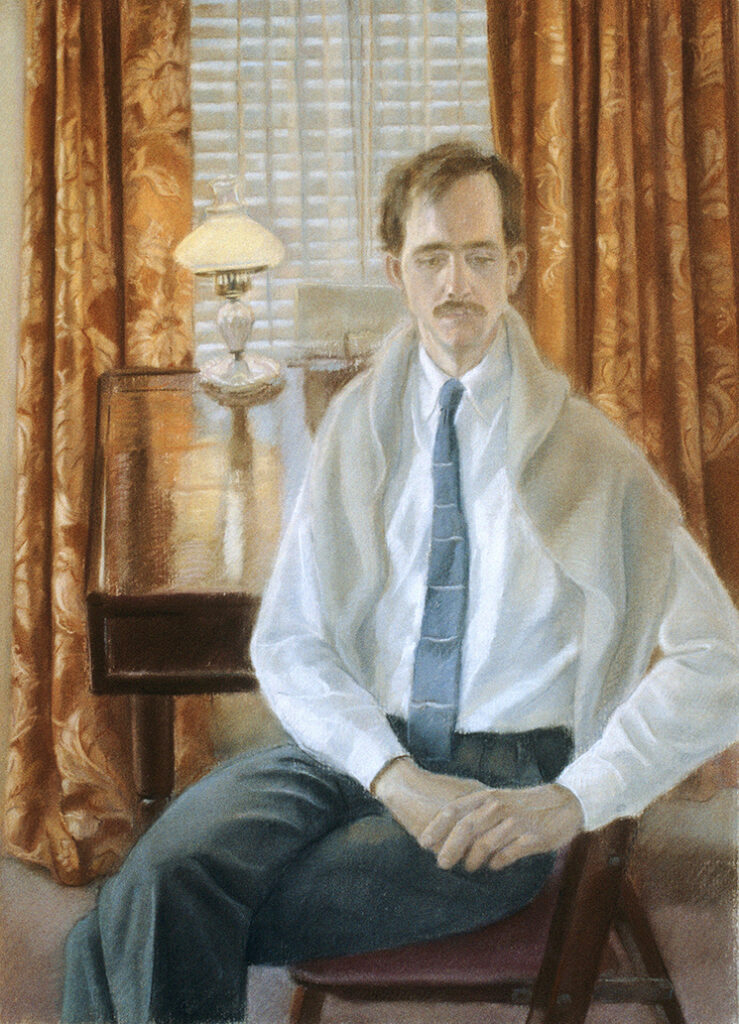
Whenever she is painting, Vivian Tsao is immersed in deep conversation. It’s not with a fellow artist or even with herself, but, rather, with the natural light that streams through the windows of her Brooklyn home, a century-old, two-story townhouse on a shady street in the neighborhood known as Windsor Terrace.
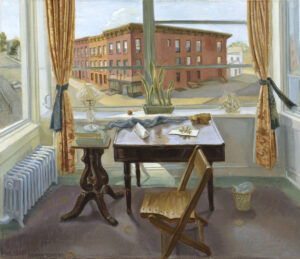
Vivian Tsao has lived in her Brooklyn home for 35 years and responds to her neighborhood through work, such as The Studio (1983), an oil on canvas.
“I am always dialoguing with light,” she says, when describing the daily routine she adopts as a painter. She usually works in the afternoon, when the light is warmest, either in her upstairs studio space that faces west or in another room of her small house. “When I find that moment that speaks to me, that I want to paint, I will set up my easel right there and work. I am always chasing the light, never working with artificial light.”
She will paint as long as the daylight lasts, but then, sometimes, she arises at four or five in the morning to turn on a lamp to see what she had painted earlier. Often, she has already brought that work-in-progress into her bedroom, so that when she awakens, she has immediate access to it. “My subconscious or semi-conscious thinks about the work, and that is helpful.”

Ray in the Study (1982) pastels
Tsao’s canvases and pastels are as poetic in what they depict as she is in her ability to describe the art she makes. Her works are subtle, nuanced, and often employ a muted palette of browns and whites and yellows. One New York Times critic, years ago, described her work as an amalgam of the abstract and the realistic. While that is evident, in part, given her broad brushworks and desire to suggest figures and objects rather than record them verbatim, there is never any mistaking what it is Tsao has depicted. A quiet Brooklyn streetscape, likely within her own neighborhood. Her late husband reposing on a bed in bright light. A bookcase or the gleaming surface of a desk. The bare branches of a sycamore tree in winter light. The sculptural folds of a radiator. Or a depiction of herself reflected in a mirror.
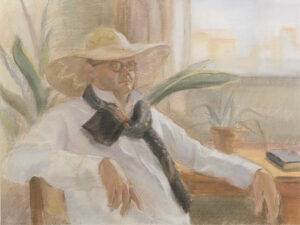
The Poet (1978), one of Tsao’s favorite pastels.
“One thing I know about myself,” she says in her studio as dusk approaches, “is that I need to be in an intimate environment, because my work is so nuanced, even sensual. I cannot be in the outdoors with an easel and having people pass by making comments on the work or trying to engage me in chatter.” While she has been invited to set up her easel at many artist residences, she declines, knowing that she would not be able to create. “I need to be in a very familiar place to be inspired,” she emphasizes. “My subject matter is the light. Yes, the light.” And the light she knows best is that which enters her home, one of a series of contiguous small brick houses that dates from the early 20th century, each with a deeply recessed brick porch and double-hung windows that face a quiet Brooklyn street.
Although Tsao is wedded to where she lives, she has lived and traveled all over the world. She describes her writer/teacher husband as having been a “Sagittarian, which means that he really loved to move around.” She and he lived for a spell in Jeddah, Arabia, where he was teaching—and where she produced many works. They spent much time in various European locales—the big and predictable Western European capitals as well as smaller cities in France and Spain and Greece.” “Early on, my husband let me know that the way to travel is to stay longer in one place. That is what we did, sometimes staying on for several weeks or months.”
For the full story click on the link below for your Digital subscription:

Subscribe to Art & Antiques for your Digital or Print copy